Is Lactated Ringer’s Better Than Normal Saline For Routine Use?

L McIntyre et al. NEJM 2025; 393: 660-670. A Crossover Trial of Hospital-Wide Lactated Ringer’s Solution versus Normal Saline

Background: “A single-center, multiple-crossover trial involving noncritically ill patients in the emergency department found that balanced crystalloid fluids were associated with a lower incidence of major adverse kidney events at 30 days than normal saline. A systematic review of 13 randomized, controlled trials comparing balanced crystalloids with normal saline in a total of 35,884 critically ill participants showed no significant difference in mortality (17.4% with balanced crystalloids and 18.2% with saline; relative risk, 0.96; 95% confidence interval [CI], 0.91 to 1.01) or in the incidence of the use of renal replacement therapy (5.6% and 6.0%, respectively; relative risk, 0.95; 95% CI, 0.81 to 1.11) in trials with a low risk of bias.4 However, the investigators in that analysis and those in another patient-level meta-analysis involving a Bayesian approach concluded that there is a high probability that balanced crystalloids are associated with lower in-hospital mortality and a lower incidence of the use of renal replacement therapy than normal saline.5

Methods of th “FLUID” trial: 3 hospitals used lactated ringer’s (LR) and 4 hospitals used normal saline throughout hospital setting for 12 weeks. Then after a 1-2 week washout period, the hospitals switched to the other fluid for 12 weeks.

Key finding:
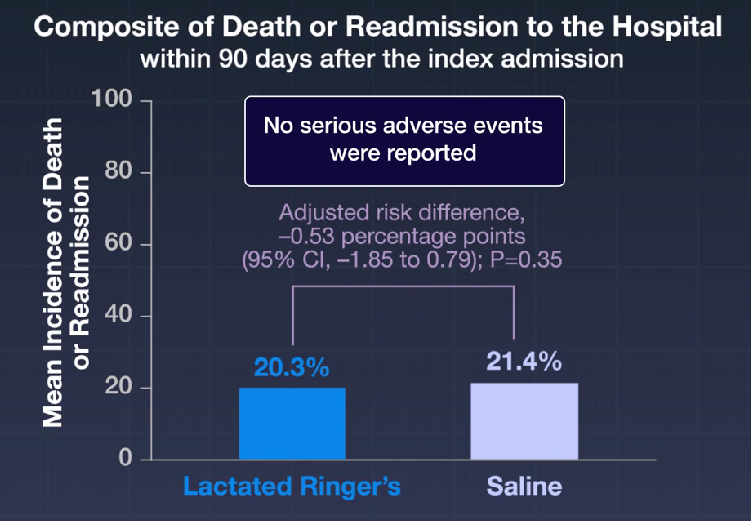
Discussion: “A limitation of this trial was the inability to recruit the total of 16 hospitals as originally planned owing to the Covid-19 pandemic. Hence, the trial had less power to detect differences that were small — but important to patients — at the level of the hospital or health care system…Our findings align with those of recent meta-analyses of randomized, controlled trials that suggest a small but clinically relevant reduction in mortality with balanced crystalloids as compared with normal saline.”

My take: This study did not show a significant difference in death or readmission at 90 days. Yet, lactated ringer’s is probably just a bit better fluid for most adult patients. In the pediatric population, more studies are needed.

Related blog posts:


Disclaimer
: This blog, gutsandgrowth, assumes no responsibility for any use or operation of any method, product, instruction, concept or idea contained in the material herein or for any injury or damage to persons or property (whether products liability, negligence or otherwise) resulting from such use or operation. These blog posts are for educational purposes only. Specific dosing of medications (along with potential adverse effects) should be confirmed by prescribing physician.  Because of rapid advances in the medical sciences, the gutsandgrowth blog cautions that independent verification should be made of diagnosis and drug dosages. The reader is solely responsible for the conduct of any suggested test or procedure.  This content is not a substitute for medical advice, diagnosis or treatment provided by a qualified healthcare provider. Always seek the advice of your physician or other qualified health provider with any questions you may have regarding a condition


Magnesium: The “Poorly Understood” Electrolyte

RM Touyz et al. NEJM 2024; 390: 1998-2009. Magnesium Disorders

Magnesium “is present in all cells in all organisms from plants to higher mammals and is indispensable for health and life because it is an essential cofactor for ATP, the cellular source of energy…All ATPase reactions require Mg2+–ATP, including those involved in RNA and DNA functions…Magnesium is involved in the control of neuromuscular function, regulation of cardiac rhythm.”

Key points:

  • “Hypomagnesemia is present in 3 to 10% of the general population, but its prevalence is increased among persons with type 2 diabetes and hospitalized patients.”
  • “Hypomagnesemia is usually associated with other electrolyte derangements, including hypocalcemia, hypokalemia, and metabolic alkalosis, and refractory hypokalemia” (& refractory hypocalcemia) is often responsive to treatment only after the magnesium concentration has been normalized.
  • “Patients with hypomagnesemia often present with nonspecific symptoms, such as lethargy, muscle cramps, or muscle weakness, and thus the diagnosis of magnesium deficiency may be overlooked.”
  • “Many drug classes, such as antibiotics, diuretics, biologic agents, immunosuppressants (including tacrolimus and rapamycin), proton-pump inhibitors, and chemotherapies, cause renal magnesium loss and hypomagnesemia.”
  • “Long-term use of PPIs causes magnesium deficiency in approximately 20% of patients receiving them, and these effects are dose-dependent.  PPIs reduce intestinal magnesium uptake.”
  • “Dietary sources rich in magnesium include cereals, beans, nuts, and green vegetables (magnesium is the central core of chlorophyll). Of the total dietary magnesium consumed, 30 to 40% is absorbed in the intestine.”
  • “Magnesium is a key component of bone — 60% of the total magnesium in the body is stored in this compartment.” Adequate magnesium intake can reduce fractures and osteopenia.
  • The intestines-bone-kidney axis regulate magnesium. “Hypomagnesemia may result from inadequate dietary intake, increased gastrointestinal loss, reduced renal reabsorption, or redistribution of magnesium from the extracellular to the intracellular space.” Rarely, hypomagnesemia is related to genetic causes.
  • Magnesium replacement is the basis for managing hypomagnesemia. “The most effectively absorbed forms are organic salts (magnesium citrate, aspartate, glycinate, gluconate, and lactate) rather than inorganic salts (magnesium chloride, carbonate, and oxide). However, a common side effect of oral magnesium supplementation is diarrhea, which poses a challenge for oral replacement.”
  • Intravenous magnesium (magnesium sulfate) is given for more severe deficiency and often therapeutically for torsades de pointes, acute asthma exacerbations, and preeclampsia or eclampsia.

This article is geared to adult medicine. Children less frequently have hypomagnesemia which is likely related to less frequent comorbidities.

My take: In pediatric patients taking PPIs as long-term therapy, checking magnesium levels is important particularly if there are multiple medications which could affect levels and if there are other comorbidities (e.g. renal disease).

Related study: A Stanford, R Rahhal. Gastro Open J. 2015; 1(4): 107-110. doi: 10.17140/GOJ-1-118 Effect of Chronic Proton Pump Inhibitor Use on Serum Magnesium Levels in Pediatric Patients

Key findings: This small retrospective pediatric study included 31 patients with a mean age of 7.8 years with 74 serum Mg levels. Only 2 patients, of adult age, had Mg levels below the normal reference limit of 1.6 mg/dL

Switzer Falls Trail (near Los Angeles)

Related blog posts:

Choosing the Right IV Fluids

As noted in previous posts, I tend to favor isotonic IV fluids due to risk of hyponatremia with hypotonic fluids. A new study (below) indicates that some isotonic fluids are associated with an increased risk of electrolyte disturbances. Thanks to Ben Gold for this reference.

In this unblinded, randomized clinical trial with 614 children, participants were randomized to receive commercially available plasmalike isotonic fluid therapy (140 mmol/L of sodium and 5 mmol/L potassium in 5% dextrose) or moderately hypotonic fluid therapy (80 mmol/L sodium and 20 mmol/L potassium in 5% dextrose).

Key findings:

  • Clinically significant electrolyte disorder was more common in children receiving plasmalike isotonic fluid therapy:
    • Hypokalemia developed in 57 patients (19%) and hypernatremia developed in 4 patients (1.3%) receiving isotonic fluids; in total, this group had 61 of 308 patients [20%]) with electrolyte disturbance, compared with 9 of 306 patients [2.9%] of those receiving hypotonic fluid therapy (P < .001)
    • “Severe” hypokalemia (<3.0 mmol/L) was significantly more common in patients receiving isotonic fluid therapy 8 of 308 patients (2.6%) compared with 1 of 306 patients ( 0.3%) patients receiving hypotonic fluid therapy

My take: In the U.S., this suggests that fluids like lactated ringer’s which also has a low amount of potassium should not be routinely used. When choosing an isotonic fluid in children, D5 Normal Saline (0.9%) with added potassium may be more suitable..

Related blog posts:

Disclaimer: This blog, gutsandgrowth, assumes no responsibility for any use or operation of any method, product, instruction, concept or idea contained in the material herein or for any injury or damage to persons or property (whether products liability, negligence or otherwise) resulting from such use or operation. These blog posts are for educational purposes only. Specific dosing of medications (along with potential adverse effects) should be confirmed by prescribing physician.  Because of rapid advances in the medical sciences, the gutsandgrowth blog cautions that independent verification should be made of diagnosis and drug dosages. The reader is solely responsible for the conduct of any suggested test or procedure.  This content is not a substitute for medical advice, diagnosis or treatment provided by a qualified healthcare provider. Always seek the advice of your physician or other qualified health provider with any questions you may have regarding a condition

What’s critical to you

Over the past ten years, there has been increasing scrutiny with regard to iatrogenic hyponatremia.  Specifically, one of the concerns has been that the administration of hypotonic fluids will result in hyponatremia and potential complications.

In our hospital system, several years ago the hospital administration circulated a list of the new critical laboratory values that would be used to notify physicians of severe derangements.  The goal of selecting a critical value is to improve the outcome of patients by allowing a more rapid and direct communication of an abnormality.  At the same time, it takes time to contact physicians and most physicians do not want to be called too often.

I carefully reviewed the critical values list and was very concerned that the value to call for hyponatremia was <120.  When I protested, I was informed that in fact the sodium critical value had not been changed and had been in place “without a problem” for more than ten years.  In addition, the critical value cutoff at several other children’s hospitals was similar (range was between 120-130).

Despite these reassurances, I remained concerned that this was not the right policy, particularly as alterations in sodium are frequently due to physician error and need to be addressed promptly.  This led to a number of discussions with the laboratory and ultimately to a retrospective review (Guarner, J; Hochman, J; Kurbatova, E; Mullins, R.  Study of outcomes associated with hyponatremia and hypernatremia in children.
Pediatric and developmental pathology 2011;14(2):117-23.)  During a six month period, 53,099 sodium tests were reviewed with 166 having sodium values of 124 or less.  Some of the important findings include the following:

  • Mortality was 42% in patients with sodium values <120mmol/L
  • Treatment was instituted more rapidly when physicians were notified
  • Half of the patients with hyponatremia were receiving hypotonic fluids.

At this time, our critical value for sodium has changed so that physicians are now notified if sodium is less than 125.  Do you know your institution’s critical value?  Are your patients receiving hypotonic fluids?  Something to think about.

Another article in Pediatrics adds more insight into the prevention of hyponatremia (Pediatrics 2011; 128: 980 -983).  Moritz and Ayus reiterate their arguments from 2003 that hypotonic fluids should not be used routinely in children due to the risk of hyponatremia and associated complications.  They cite 20 studies completed over the last seven years which indicate that isotonic fluids are safe and prevent hyponatremia.  “There can no longer be any justification for the routine administration of hypotonic fluids in hospitalized children….On the basis of today’s standards, hypotonic fluids would not receive FDA approval for routine use.”  The main concern about hyponatremia is hyponatremic encephalopathy –this remains a common medical emergency (Pediatrics 2008; 121 (6): www.pediatrics.org/cgi/contnet/full/121/e1577).  Early in the hospital course and in the immediate postoperative period are timeframes that have been noted to have increased incidence of hyponatremia.  However, hyponatremia (<135) is common at all times and affects ~25% of hospitalized patients (Arch Dis Child 2008; 93: 285-287).  So, with your next admission, think about lactated ringer’s or normal saline instead of half-normal.

Additional References:

  • -Pediatrics 2011; 128: 857.
  • -J Peds 2008; 153: 444-447 (letters and references on this topic).
  • -Am J Clin Pathol 2007; 127: 56-59.  Critical Na values.
  • -J Pediatr 2008; 152: 33 & 4.  Frequent p-op hyponatremia.
  • -NEJM 2008; 359: 1018.  Hyponatremia associated with poor prognosis in patients awaitng OLT.
  • -Hepatology 2006; 44: 1535.  Hyponatremia (Na <130) associated with increased mortality & ascites reaccumulation.
  • -J Pediatr 2004; 145: 584. Recs 20-80ml/kg of isotonic fluid to correct hypovolemia prior to typical maintenance fluids (to avoid hyponatremia due to hypovolemia).  Says that isotonic fluids for maintenance may be problematic if cardiopulmonary or renal dz.
  • -Pediatrics 2004; 113; 1395.  Advocates use of isotonic saline (0.9%).  States that hypotonic fluids lead to hyponatremia in many cases b/c of excessive ADH in many patients.
  • -NEJM 2005; 352: 1550 & 1613. Hyponatremia related to Boston Marathon & London Marathon