The AAP and more than 40 other medical, health and patient advocacy groups also issued a joint statement condemning the change and called on the CDC to “return to its long history of promoting evidence-based information.”
Potential links between vaccines and autism have been studied for decades. More than 40 high-quality studies in seven countries involving over 5.6 million people have found no connection.
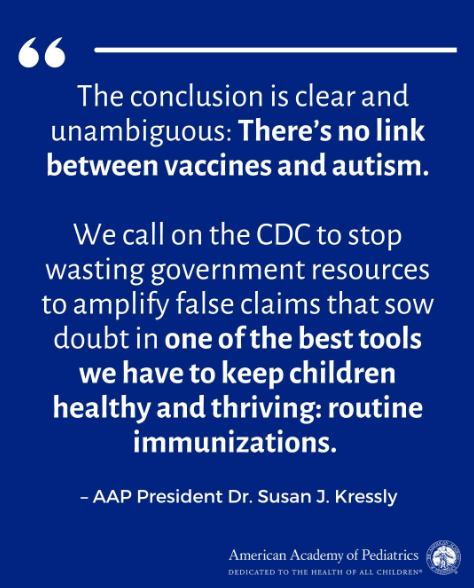
“The conclusion is clear and unambiguous: There’s no link between vaccines and autism,” Dr. Kressly said. “Anyone repeating this harmful myth is misinformed or intentionally trying to mislead parents.”
Scientists believe there is no single root cause of autism. Interactions between genetic changes and environmental influences likely play a role, according to an AAP Fact Checked article. Improved awareness and screening and updated diagnostic criteria have contributed to increases in autism prevalence.
“At this point, it’s not about doing more studies. It’s about being willing to accept what the existing studies clearly show,” said Alison Singer, M.B.A., co-founder and president of the Autism Science Foundation.
She said spending more money on settled science takes funding away from research on genetics and services for autistic people. False claims further stigmatize autistic people and their families…
Sean T. O’Leary, M.D., M.P.H., FAAP, chair of the AAP Committee on Infectious Diseases, called the latest move to put misinformation on the trusted CDC website “madness” and “a tragic moment for this country” and said he does not blame the career CDC scientists.
“For many decades, we (could) rely on CDC to provide the American public with the best available science,” Dr. O’Leary said. “Now our government is using it as an apparatus to spread falsehoods and lies.”
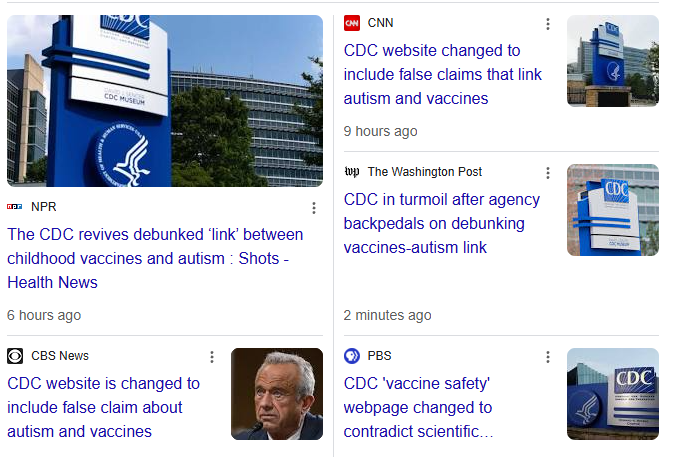
Here is a screenshot on media coverage of this story:
Methods: In this single-center, observational study, the authors deployed an anonymized survey of outcomes that was completed by 107 parents of children with BA who were younger than age 12 years. A detailed assessment of general neurodevelopment (Mullens Scale of Early Learning and Vineland Adaptive Behavior Scale) was carried out in 50 infants younger than 5 years old, and emerging autistic traits (Autism Diagnostic Observation Schedule) were assessed in those eligible. There were 93 matched controls.
Key findings:
Neurodevelopmental concerns were raised by 37% of parents
47% of children required support from at least 1 service (such as speech and language therapy physiotherapy, play therapy, or seen a clinical psychologist), and a further 42% (n = 45) had used more than 1 service. The most accessed service was speech and language therapy (20%, n = 10)
A clinical or research diagnosis of autism was made in 30% of 35 children >2 years old
Early surgical intervention and faster clearance of jaundice after surgery was associated with better general neurodevelopmental outcomes (F = 2.428, P = .042) but not with the presence of emerging autistic traits
My take: High levels of neurodevelopmental difficulties occur in children with BA.
I am not an expert on autism. However, I am concerned about the administration’s recent recommendations regarding acetaminophen and autism. Even scientists who have suggested a possible link have NOT recommended stopping the use of acetaminophen during pregnancy.
It is well-recognized that autism is related to multiple factors, both genetic and potential environmental factors. The use of acetaminophen, even if linked to autism, could represent an epiphenomenon in which a primary disorder (like a fever or infection) is responsible for subsequent neurodevelopmental problems rather than the medicine itself. While there has been growing concern about the increasing frequency of autism, much of this relates to changes in the definition of autism over various periods.
I recommend the following recent sources of information on this topic:
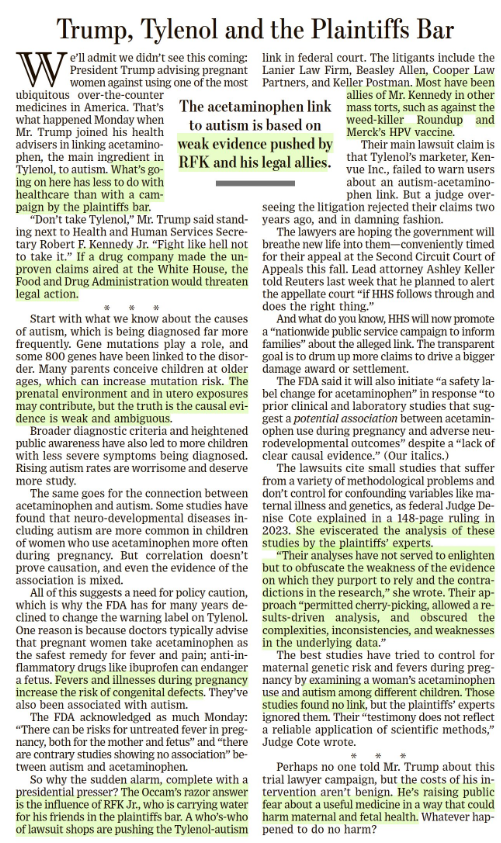
Editorial Board Wall Street Journal, 9/23/25: Trump, Tylenol and the Plaintiffs Bar “The acetaminophen link to autism is based on weak evidence pushed by RFK Jr. and his legal allies.”
“Today’s announcement by HHS is not backed by the full body of scientific evidence and dangerously simplifies the many and complex causes of neurologic challenges in children. It is highly unsettling that our federal health agencies are willing to make an announcement that will affect the health and well-being of millions of people without the backing of reliable data.
“In more than two decades of research on the use of acetaminophen in pregnancy, not a single reputable study has successfully concluded that the use of acetaminophen in any trimester of pregnancy causes neurodevelopmental disorders in children. In fact, the two highest-quality studies on this subject—one of which was published in JAMA last year—found no significant associations between use of acetaminophen during pregnancy and children’s risk of autism, ADHD, or intellectual disability.
“Acetaminophen is one of the few options available to pregnant patients to treat pain and fever, which can be harmful to pregnant people when left untreated. Maternal fever, headaches as an early sign of preeclampsia, and pain are all managed with the therapeutic use of acetaminophen, making acetaminophen essential to the people who need it. The conditions people use acetaminophen to treat during pregnancy are far more dangerous than any theoretical risks and can create severe morbidity and mortality for the pregnant person and the fetus.”
From KFF News:
In August, Bauer and her colleagues published an analysis of 46 previous studies on Tylenol, autism, and attention-deficit/hyperactivity disorder. Many found no link between the drug and the conditions, while some suggested Tylenol might occasionally exacerbate other potential causes of autism, such as genetics.
Bauer, an epidemiologist at the University of Massachusetts-Lowell, and her team called for more judicious use of the drug until the science is settled.
Autism experts at the Centers for Disease Control and Prevention were neither consulted for the White House’s long-awaited autism announcement nor asked to review a draft of the findings and recommendations…
If prenatal Tylenol has any association, which it may not, it would help account for only a fraction of cases, she said. Further, research has not deeply examined Tylenol risks in young children, and manyrigorous studies refute a link between vaccines and autism.
Bauer worries such statements will cut both ways: People may put themselves at risk to avoid vaccines and Tylenol, the only safe painkiller for use during pregnancy. And she frets that scientists might outright reject her team’s measured concerns about Tylenol in a backlash against misleading remarks from Trump and other members of his “Make America Healthy Again” movement….
Helen Tager-Flusberg, director of the Center for Autism Research Excellence at Boston University, called Trump’s comments dangerous. Fevers can harm the mother and the developing fetus, she said, adding that fevers are more strongly associated with autism than Tylenol…
Several medical and scientificassociations have called for Kennedy’s removal or resignation. Many scientists are skeptical of what he says because much of it has been misleading or wrong. For example, he’s said HIV isn’t the only cause of AIDS (it is), that antidepressant drugs cause mass shootings (they don’t), that older adults don’t have severe autism (some do), that the measles vaccine causes brain swelling (it doesn’t), that covid vaccines were the deadliest vaccines ever made (they aren’t), that vaccines aren’t safety-tested (they are), and that vaccines contribute to autism (they don’t).
From the Wall Street Journal:
Washington Post Editorial:
From TIME article: “Despite what we are now hearing from the most powerful health offices in the nation, the science on acetaminophen and autism remains unsettled. What is not unsettled is the damage done when politics masquerades as medicine. Every false certainty erodes the trust that holds the fragile bridge between patients and their doctors. Break that trust, and no study, no drug, no vaccine will be enough to save lives when the next real crisis comes. When politicians play doctor, it’s families who will pay the price.”
My take: Thinking about the damage from this press conference, I was reminded of a scene from the movie “Doubt.” In the movie Doubt, Father Flynn (played by Philip Seymour Hoffman) tells a parable about an old priest instructing a woman who has been gossiping to take a pillow, cut it open on her roof, and then return to gather up all the feathers. When she tells him it can’t be done because “the wind took them all over,” the priest responds: “And that… is gossip!”
The spreading of damaging rumors and lies, which is being done by leaders of this country, is impossible to contain or undo once released, and its impact is far-reaching and destructive.
“A team of researchers found evidence of shady organizations churning out fake or low-quality studies on an industrial scale. And their output is rising fast, threatening the integrity of many fields…“If these trends are not stopped, science is going to be destroyed,” said Luís A. Nunes Amaral, a data scientist at Northwestern University and an author of the study”
““Science relies on trusting what others did, so you do not have to repeat everything,” Dr. Amaral said….By the 2010s, journal editors and watchdog organizations were warning that this trust was under threat. They flagged a growing number of papers with fabricated data and doctored images. In the years that followed, the factors driving this increase grew more intense.”
“As more graduate students were trained in labs, the competition for a limited number of research jobs sharpened. High-profile papers became essential for success, not just for landing a job, but also for getting promotions and grants. Academic publishers have responded to the demand by opening thousands of new scientific journals every year…”
“Organizations known as paper mills are now turning scientific fraud into a lucrative business. Scientists eager to pad out their resumes can pay hundreds to thousands of dollars to be named as an author of a paper that they had nothing to do with…paper mills often use artificial intelligence to alter the text they lift from other papers…”
“The papers that Dr. Amaral and his colleagues could study came to light only because of the work of independent sleuths. To estimate how many paper mill papers have yet to be exposed, Dr. Amaral’s team created a statistical model that accurately predicted the rate at which suspicious papers surfaced. They estimate that the number of paper mill products may be 100 times greater than the ones they have identified…”
“In their new study, they calculated that the number of suspicious new papers appearing each year was doubling every 1.5 years. That’s far faster than the increase of scientific papers overall, which is doubling every 15 years.”
““We need to stop making it profitable to game the system.”
My take: This problem has preceded the widespread use of AI, although Al makes it harder to detect. Unfortunately, fake scientific reporting appears to be worsening.
Related article: Jessica Steier NY Times 8/19/25: The Playbook Used to ‘Prove’ Vaccines Cause Autism This article details very specifically how David Geier (now appointed by RFK Jr to evaluate vaccines and autism) and his father have produced multiple flawed studies regarding vaccine safety. This commentary takes a particularly deep dive into one of his articles on the preservative thimerosol. She shows that the authors likely used p-hacking to identify “atypical autism” since there was not a significant association with autism, compared different time cohorts (the control group was from a period with different diagnostic criteria/lower rates of autism), did not include confounders, and supported their arguments with “personal citing.”
Some excerpts:
There have been some 70 studies since Mr. Wakefield’s looking for any link between vaccines and autism. Of these, 26 have linked vaccines to autism in some way, and 43 found no connection between vaccines and autism.
A whopping two-thirds of studies that claimed to have found a link were written by David and Mark Geier. These studies have been heavily criticized for using deceptive research techniques and flawed data.
Among the eight other studies that found a link, four were retracted for data manipulation, flawed methods or undisclosed conflicts of interest. Most of the authors have been involved in anti-vaccination campaigns and have had other papers retracted.
One such study that Mr. Kennedy referred to in his Senate confirmation hearing was published in a WordPress blog disguised as a journal and was funded by an anti-vaccine organization, among other problems.
Fortunately, independent scientists have conducted more than 40 high-quality studies since 1998 involving over 5.6 million people across seven countries. All found no connection between vaccines and autism. These studies were rigorously designed, were reviewed by independent peers and do not contain telltale signs of data manipulation, as the Geier studies do.
The Consortium for Children’s Environmental Health. NEJM 2025; 392: 299-305. Manufactured Chemicals and Children’s Health — The Need for New Law
This review article explains the worsening toll that chemicals in our environment are exacting on the health of children.
Here are some of the key excerpts:
“An estimated 350,000 manufactured chemicals, chemical mixtures, and plastics are currently listed in global inventories.3 Most are produced from fossil fuels — gas, oil, and coal. Production has expanded 50-fold since 1950, is currently increasing by about 3% per year, and is projected to triple by 2050.4 Environmental pollution5,6 and human exposure7 are widespread.”
In the past half-century, “the incidence of childhood cancers has increased by 35%.10 Male reproductive birth defects have doubled in frequency.11 Neurodevelopmental disorders now affect 1 in 6 children, and autism spectrum disorder is diagnosed in 1 in 36.12 Pediatric asthma has tripled in prevalence.13 Pediatric obesity has nearly quadrupled in prevalence and has driven a sharp increase in type 2 diabetes among children and adolescents.14 In adults, by contrast, illness, disability, and death due to cardiovascular disease, stroke, and many cancers have decreased.15,16“
“Research in environmental pediatrics has flourished over the past 25 years. Two key catalysts of this growth were the 1993 publication of the National Research Council report, Pesticides in the Diets of Infants and Children21 which elucidated the biologic bases of children’s heightened susceptibility to toxic chemicals, and the passage in 1996 of the Food Quality Protection Act (FQPA), the U.S. law on pesticides. The FQPA made protecting children’s environmental health a national priority and required generation of data on chemical hazards to children, stimulating substantial expansion of federally funded research in environmental pediatrics…Prenatal exposures are particularly hazardous…diseases associated with early-life exposures can manifest any time during the life span.23“
“Prospective, birth-cohort epidemiologic studies that measure chemical exposures in pregnant persons and fetuses and follow children longitudinally over many years are particularly powerful platforms for discovering associations between synthetic chemicals and disease because they link exposures to outcomes in individual children and eliminate recall bias.”
“Widespread childhood exposure to a toxic chemical can damage the health, economic viability, and security of an entire society. For example, each year from the 1950s through the 1970s, about 100,000 tons of tetraethyl lead were added to gasoline in the United States to enhance automotive performance, causing massive environmental lead contamination and extensive human exposure… The average IQ among U.S. children was reduced by an estimated 2 to 5 points,32 the number of children with an IQ above 130 decreased by more than 50%, and the number with an IQ below 70 (the criterion used in the International Classification of Diseases to define intellectual disability) increased by more than 50%…reducing toxic chemical exposures can produce major economic benefits…because each additional IQ point is associated with an increase of 1.8 to 2.4% in lifelong earning potential.
“Chemicals should no longer be presumed harmless until proven otherwise…National chemical policies should take into consideration findings from animal and mechanistic toxicology studies, which are highly predictive of human health risks, including risks to children.49“
My take: Pollution from chemicals and plastics is worsening and resulting in worsening health/intellectual outcomes for children. I doubt any legislation will be forthcoming to improve the situation. It is unfortunate that protecting profits is prioritized over protecting our health.
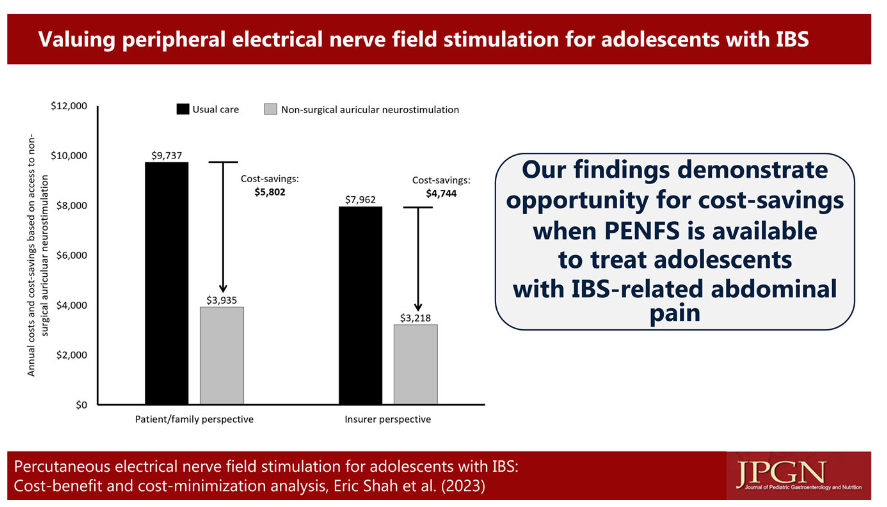
E Shah et al. JPGN 2024; 78: 608–613. Percutaneous electrical nerve field stimulation for adolescents with irritable bowel syndrome: Cost‐benefit and cost‐minimization analysis
Background: “Despite its favorable efficacy and safety profile, access to PENFS and other modalities in IBS can be limited by insurance coverage.”
Methods: The authors performed an economic analysis to estimate cost‐savings for patients’ families and healthcare insurance, and health outcomes, based on abdominal pain improvement with percutaneous electrical nerve field stimulation (PENFS) with IB‐Stim® (Neuraxis). The authors created a a Markov model.
Key findings:
PENFS was associated with 18 added healthy days over 1 year of follow‐up, increased annual parental wages of $5,802 due to fewer missed work days to care for the child, and $4744 in cost‐savings to insurance
Important Limitation: The economic benefits that derive from the clinical improvements used in this analysis are based on a small prospective cohort study of 20 patients with up to 1 year of follow‐up
My take: It appears that auricular stimulation should be positioned earlier in treatment algorithms for adolescents with IBS based on safety, and efficacy, especially if cost is not prohibitive.
This retrospective study compared the findings of children with probable autism (ASD) to age- and gender-matched controls with developmental delay (DD) or with typical development (TD), (n= 526 ASD, 526 DD, 1052 TD). Key findings:
Children with ASD had higher rates of abnormal esophageal histology (ASD 38.4%; DD 33.4%; TD 30.4%, P = .008)
Stomach findings did not differ significantly among the groups: histologic inflammation was identified in ASD 13.3%, DD 18.5%, and TD 22.4% (P=.10).
In the duodenum, histologic abnormalities were observed with lower frequency in ASD (ASD 17.0%; DD 20.1%; TD 24.2%, P = .005).
The authors emphasize the importance of the esophageal findings (increased rates of esophagitis). However, there are some important caveats that are not discussed in the paper:
At baseline (prior to study), it was known that the ASD and DD groups had higher rates of eosinophilic esophagitis: ASD 9.1%, DD 9.5%, and TD 7.4% (Table 1). In addition, both of these groups had higher rates of gastroesophageal reflux at baseline: ASD 7.6%, DD 8.0%, and TD 6.5%. This selection bias is likely to negate much of the esophageal differences observed in their study. Also, the ASD group had much higher numbers receiving H2 blockers at time of procedure: ASD 11.4%, DD 10.3%, and TD 6.4%.
In addition, the TD group had a much higher rate of abdominal pain as the indication for endoscopy (TD 26.6%, ASD 17.5%, and DD 20.2%). It is well-recognized that isolated abdominal pain has a low yield on endoscopy.
The authors do not discuss the elephant in the room. What is the significance of microscopic esophagitis (or microscopic gastritis or microscopic duodenitis)? Previous authors have noted that “15% of healthy individuals may have microscopic esophagitis” (Gastroenterology 2018 (volume 154; pages 263-451 -see page 291). When we were looking at the variation of diagnostic yield for endoscopy, we decided to focus on colonoscopy because of the high rates of microscopic inflammation in the upper GI tract (related blog post: Our Study: Provider Level Variability in Colonoscopy Yield)
My take: In their discussion, the authors state that this study represents “significant progress in the understanding of gastrointestinal pathophysiology in children with ASD…suggest a unique fingerprint of findings in children with ASD.” In my view, the authors showed similar yield of EGD histologic abnormalities in all three groups and these microscopic findings are of uncertain significance.
Dr. Burrell noted that concerns for EoE are increased in those who have more uniform problems with increased textures (rather than selectivity) and in those with more severe feeding disordersSometimes Caregivers will contribute to nutritional disorders by placing on diets like a gluten-free, casein-free diet
Disclaimer: This blog, gutsandgrowth, assumes no responsibility for any use or operation of any method, product, instruction, concept or idea contained in the material herein or for any injury or damage to persons or property (whether products liability, negligence or otherwise) resulting from such use or operation. These blog posts are for educational purposes only. Specific dosing of medications (along with potential adverse effects) should be confirmed by prescribing physician. Because of rapid advances in the medical sciences, the gutsandgrowth blog cautions that independent verification should be made of diagnosis and drug dosages. The reader is solely responsible for the conduct of any suggested test or procedure. This content is not a substitute for medical advice, diagnosis or treatment provided by a qualified healthcare provider. Always seek the advice of your physician or other qualified health provider with any questions you may have regarding a condition.
In this retrospective study with 56 patients with autism spectrum disorder (ASD) and 123 controls underwent colonic manometry (CM). Key findings:
The rate of abnormal CM findings between ASD and matched controls (24% vs 20%, P = 0.78) did not differ significantly
The authors noted that higher rates of abnormal CM with duration of constipation and with soiling in children with ASD. However, “even in the minority of cases with abnormal colonic motility, chronic stool retention due to functional constipation over time likely caused impaired motility in the majority of these cases. In 6 of the 8 ASD cases with abnormal CM finding, impaired motility was isolated to the distal colon while normal motility occurred in the proximal colon.”
My take: In this highly-selected group of patients with ASD from specialized motility centers, only 2 had abnormal colonic motility affecting the entire colon. Overall, patients with ASD did NOT have higher rates of abnormal CM studies. Hence, for most children with ASD, CM has little value.
A recent pilot (38 children) study (WG Sharp et al. J Pediatr 2019; 211: 185-92) examined the effectiveness of a less intensive feeding program to help children with autism and food selectivity.
Background: Many children with autism are extremely picky eaters.
They may limit their diet to a ‘beige diet’ consisting of foods like chicken nuggets and fries.
They may insist on only pureed textures
They may demand only specific foods and limit to specific brands
To normalize these diets, typically intensive structured feeding programs are needed. However, these types of programs are costly, and not available in all communities. Parental training though the MEAL (Managing Eating Aversions and Limited variety) Plan was studied by the authors. This program consisted of 10 core and 3 booster sessions.
Key finding:
At week 16, positive response rates on the Clinical Global Impression Improvement scale was 47.4%for the MEAL plan compared to 5.3% in a control parent education plan.
My take: This pilot study shows that less intensive programs may be helpful in children with autism and feeding problems. However, even with this more limited MEAL plan, a multidisciplinary team with a dietitian plan for each child along with behavior management strategies was needed.









 gutsandgrowth