Consensus Recommendations on Functional Bloating and Distention

C Melchior et al. United European Gastroenterology Journal, 2025; 00:1–39. Open Access! European Consensus on Functional Bloating and Abdominal Distension—An ESNM/UEG Recommendations for Clinical Management

A total of 21 experts (authors of article), recommended by ESNM, The European Association for Gastroenterology, Endoscopy and Nutrition (EAGEN) and The European Society for Primary Care Gastroenterology (ESPCG), from different countries agreed to participate as the International Working Group for the European Consensus on Bloating to vote on the Delphi statements.

This article regarding bloating/distension in adults is summarized in two tables. Table 1 has 75 statements. Table 2 is a summary –here are many of its recommendations:

Patients with functional bloating and abdominal distention should receive a lactose‐limiting diet trial based on their self‐reported symptoms or the presence of intolerance during a breath test after ingestion of a defined lactose load

  • A low FODMAP diet is effective in reducing functional bloating and abdominal distention
  • Rifaximin may be useful for the treatment of functional bloating and abdominal distention with efficacy
  • Among antispasmodic agents, pinaverium and otilonium bromide have been shown to be the most effective drugs for the treatment of functional bloating and abdominal distension
  • Lubiprostone, plecanatide and linaclotide are effective in improving constipation associated with functional bloating and abdominal distension
  • Linaclotide is the most effective secretagogue for functional bloating, although limited data is available for lubiprostone and plecanatide as well
  • Selective serotonin reuptake inhibitors (SSRI’s) are effective in reducing symptoms of functional bloating
  • Tricyclic antidepressants (TCA) such as amitriptyline are effective in reducing symptoms of functional bloating
  • In patients with discrete episodes of visible abdominal distension, biofeedback‐guided techniques to re‐educate abdominothoracic muscular activity are safe and effective for correction of abdominal distention and are associated with improvement in the subjective sensation of abdominal bloating
  • “Hypnotherapy improves symptoms of bloating in patients with IBS. However, its effect on functional bloating and abdominal distension was not explored and cannot be recommended”
  • Figure 1 provides an algorithm. For workup, it suggests checking the following in all patients: TSH, HgbA1c, CBC, CRP, TTG IgA, IgA, Glucose
  • In those with alarm features (eg. anemia, wt loss, suspicion of organic disease), more extensive evaluation is recommended

My take: One of my colleagues would often say that if there are a lot of treatments for a disease it usually indicates that none of them are very good.

Related blog posts:

Bouquet of Flowers, Claude Monet

Disclaimer: This blog, gutsandgrowth, assumes no responsibility for any use or operation of any method, product, instruction, concept or idea contained in the material herein or for any injury or damage to persons or property (whether products liability, negligence or otherwise) resulting from such use or operation. These blog posts are for educational purposes only. Specific dosing of medications (along with potential adverse effects) should be confirmed by prescribing physician.  Because of rapid advances in the medical sciences, the gutsandgrowth blog cautions that independent verification should be made of diagnosis and drug dosages. The reader is solely responsible for the conduct of any suggested test or procedure.  This content is not a substitute for medical advice, diagnosis or treatment provided by a qualified healthcare provider. Always seek the advice of your physician or other qualified health provider with any questions you may have regarding a condition.
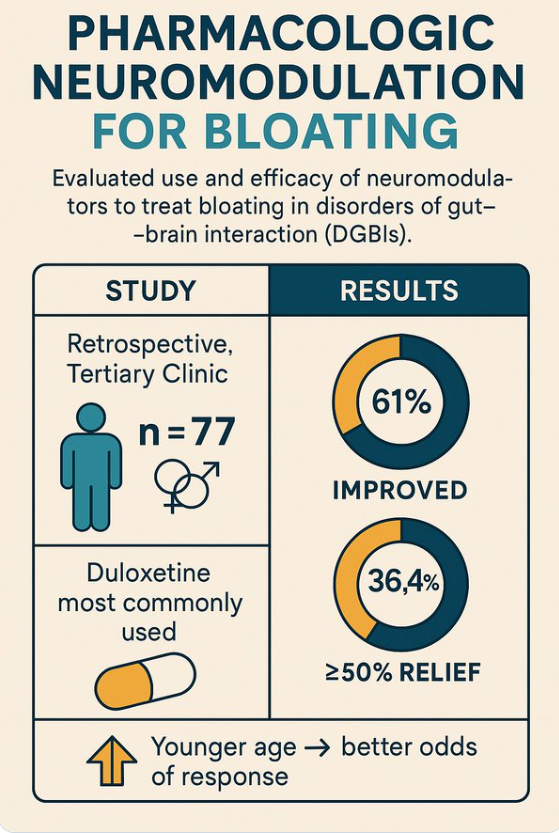
Pharmacologic Neuromodulation for Bloating Symptoms

Briefy noted: EN Madva et al. Scand J Gastroenterol 2025 Aug 8:1-5. doi: 10.1080/00365521.2025.2544306. Online ahead of print. Pharmacologic neuromodulation for bloating.

This was a small retrospective study of consecutively referred patients with a DGBI (N = 77; ages 18-74, 87% female) to a tertiary neurogastroenterology clinic who were prescribed a neuromodulator for a primary complaint of bloating in 2016-2022.  Duloxetine was the most commonly prescribed neuromodulator (n = 52, 67.5%).

My take: This study shows that neuromodulators are likely beneficial for bloating symptoms. Dr. Garza () previously noted that in patients with bloating “the typical increase in excess gas during bloating symptoms is only 22 mL.” Thus, “A lot of bloating symptoms are due to increased sensitivity and ‘weird gas handling.’ The latter could include compression of diaphragm rather than elevation.”

Related blog posts:

Disclaimer: This blog, gutsandgrowth, assumes no responsibility for any use or operation of any method, product, instruction, concept or idea contained in the material herein or for any injury or damage to persons or property (whether products liability, negligence or otherwise) resulting from such use or operation. These blog posts are for educational purposes only. Specific dosing of medications (along with potential adverse effects) should be confirmed by prescribing physician.  Because of rapid advances in the medical sciences, the gutsandgrowth blog cautions that independent verification should be made of diagnosis and drug dosages. The reader is solely responsible for the conduct of any suggested test or procedure.  This content is not a substitute for medical advice, diagnosis or treatment provided by a qualified healthcare provider. Always seek the advice of your physician or other qualified health provider with any questions you may have regarding a condition.

Expert Advice on Bloating, Belching and Distention

B Moshiree, D Drossman, A Shaukat. Gastroenterol 2023; 165: 791-800. Open Access! AGA Clinical Practice Update on Evaluation and Management of Belching, Abdominal Bloating, and Distention: Expert Review

Best Practice Advice:

  • #2: Treatment options for supragastric belching may include brain–gut behavioral therapies, either separately or in combination, such as cognitive behavioral therapy, diaphragmatic breathing, speech therapy, and central neuromodulators.
  • #6: Abdominal imaging and upper endoscopy should be ordered in patients with alarm features, recent worsening symptoms, or an abnormal physical examination only.
  • #7: Gastric emptying studies should not be ordered routinely for bloating and distention, but may be considered if nausea and vomiting are present. Whole gut motility and radiopaque transit studies should not be ordered unless other additional and treatment-refractory lower gastrointestinal symptoms exist to warrant testing for neuromyopathic disorders.
  • #10: Probiotics should not be used to treat abdominal bloating and distention.
  • #11: Central neuromodulators (eg, antidepressants) are used to treat bloating and abdominal distention by reducing visceral hypersensitivity, raising sensation threshold, and improving psychological comorbidities.
Gastric belching: tracing showing instead a distal to proximal increase in impedance with air clearing from the esophagus. Arrows indicate direction of air flow and high-resolution manometric view of gastric belching is shown with direction of air flow from stomach to upper esophagus seen (orange arrow)

Several points from review:

  • Belching can be from the esophagus or from the stomach.
  • Supragastric belching involves air clearing from the esophagus not from stomach and is frequently associated with anxiety.
  • Gastric belching is frequently associated with reflux and occurs after spontaneous transient relaxation of the lower esophageal sphincter.
  • Bloating is a subjective sensation of fullness, tightness or trapped gas. Food intolerances, bacterial overgrowth, and celiac disease need to be considered. If constipation is present, this should be treated.

My take: This is a good review with plenty of practical suggestions for management.

Related blog posts:

Disclaimer: This blog, gutsandgrowth, assumes no responsibility for any use or operation of any method, product, instruction, concept or idea contained in the material herein or for any injury or damage to persons or property (whether products liability, negligence or otherwise) resulting from such use or operation. These blog posts are for educational purposes only. Specific dosing of medications (along with potential adverse effects) should be confirmed by prescribing physician.  Because of rapid advances in the medical sciences, the gutsandgrowth blog cautions that independent verification should be made of diagnosis and drug dosages. The reader is solely responsible for the conduct of any suggested test or procedure.  This content is not a substitute for medical advice, diagnosis or treatment provided by a qualified healthcare provider. Always seek the advice of your physician or other qualified health provider with any questions you may have regarding a condition.

Expert Advice on Bloating

A recent article (AK Kamboj, AS Oxentenko. Clin Gastroenterol Hepatol 2018; 16; 1030-33) provides some useful guidance on bloating.

They describe bloating as an acronym:

  • Bowel disturbance (constipation, SIBO, celiac, IBD)
  • Liquid (ascites)
  • Obstruction
  • Adiposity
  • Thoracic (overexpansion, diaphragm contraction)
  • Increased sensitivity (functional bloating, IBS, dyspepsia)
  • Neuromuscular (gastroparesis, impaired accommodation, medications)
  • Gas (aerophagia, dietary sources, post-Nissen)

The diagnostic approach they recommend:

  • If bloating with diarrhea, evaluate diet, SIBO, celiac, IBD, IBS-D, and medications
  • If bloating with constipation, evaluate for constipation, pelvic floor dysfunction, IBS-C, and medications
  • If bloating and suspected mechanical disturbance, evaluate for gastric outlet obstruction/small bowel obstruction
  • If bloating without bowel disturbance, consider aerophagia, gastroparesis, and functional dyspepsia

Treatment:

  • Treat any underlying disorder
  • For mild symptoms, reassurance may be sufficient
  • Dietary modifications to avoid food triggers & reduce fermentable food products
  • Treating constipation when present
  • A large number of other treatments can be considered as well including antispasmotics, agents to help with visceral hyperalgesia, cognitive behavioral therapy

My take: I like BLOATING acronym, though the 5 Fs I learned a long time ago is a little easier for me to remember — which include flatus (gas), feces (constipation), fluid, fat, and fetus/masses. Flatus can be caused by swallowing air (aerophagia), malabsorption (celiac, lactose intolerance, parasites), muscular discoordination (abdominal phrenic dyssynergia), and motility problems.”

Related blog posts:

Sunshine Meadows, Banff National Park

Understanding Functional Abdominal Distention

A recent study (Barba E, et al. Gastroenterol 2015; 148: 732-9) provides insight into why some patients develop functional abdominal distention.

In this prospective study of 45 patients (42 women), the researchers performed numerous tests to determine the reasons for abdominal distention.  Most patients had CT scan (n=39), and electromyography (EMG) of the abominothoracic wall (n=32) both at baseline and during distention. In addition, 15 patients underwent EMG-guided biofeedback.

Findings:

  • Abdominal distention was associated with diaphragm contraction (~19% increase from baseline) and intercostal contraction (~14% increase from baseline).
  • There was an increase in thoracic antero-posterior diameter compared with basal values with increase in anterior abdominal wall protrusion.
  • Biofeedback treatment was effective in reversing these changes.  This indicates that the distention is under voluntary control.

The authors use the term for the changes that cause the abdominal distention as “abdominal accommodation.”  They note that “in healthy subjects, an increase in intra-abdominal contents induces relaxation and ascent of the diaphragm, which permits cephalic expansion of the abdominal cavity with minor protrusion of the anterior wall.” In this study, the distention was determined in real-life settings to be due to “a paradoxical contraction of the diaphragm, that pushed abdominal contents downward, and relaxation of the anterior abdominal wall.”

Bottomline: These experiments provide a ‘proof-of-concept’ regarding the mechanisms of abdominal distention, though these experiments are not practical for most patients with these symptoms.

Related blog posts:

Abdominal distention – a medical mystery?

A recent ‘think like a doctor’ case in the NY Times involved a patient sent to a pediatric gastroenterologist for abdominal distention.  It’s worth a read (thanks to Ben Enav for sharing this reference).

http://well.blogs.nytimes.com/2013/09/05/think-like-a-doctor-the-gymnasts-big-belly/

With regard to bloating and distention, the ‘smartphrase’ that I use to discuss this issue with parents is based on the “5 Fs” that I learned during fellowship.  I decided to modify the phrase a little bit based on the above case:

” I reviewed the issue of bloating/distention with family. Typically, distention or bloating can be caused by “5 Fs” which include flatus (gas), feces (constipation), fluid, fat, and fetus/masses. Flatus can be caused by swallowing air (aerophagia), malabsorption (celiac, lactose intolerance, parasites), muscular discoordination (abdominal phrenic dyssynergia), and motility problems.”

Are there other etiologies that you discuss with your patients?

Does buspirone help functional dyspepsia?

A recent randomized, double-blind, placebo-controlled crossover functional dyspepsia (FD) trial showed that 4 weeks of treatment with buspirone (10 mg TID) improved overall symptom severity, including early satiety and bloating (Clin Gastroenterol Hepatol 2012; 10: 1239-45).

This study enrolled 17 patients (13 women) with a mean age of 38.5 years.  There were two 2-week treatment periods and a 2-week washout in between.  Patients filled out a dyspepsia symptom score before treatment and at the conclusion.  In addition, patients underwent gastric emptying by using breath tests and barostat measurement.

Overall symptom score was improved with buspirone compared to placebo: 7.5 ± 1.3 vs. 11.5 ± 1.2.  Symptoms of postprandial fullness, early satiety, and abdominal bloating all improved significantly.

Buspirone treatment increased gastric accommodation compared with placebo: 229 ± 28 vs. 141 ± 32 mL respectively.  Overall, gastric emptying was not affected by buspirone treatment; however, delayed emptying of liquids was evident (half-life = 64 vs. 119 minutes respectively).

The effect of buspirone on FD appears to be primarily related to improvement in gastric accommodation.  Impaired accommodation has been identified in about 40% of FD patients.  Buspirone which is a 5-HT1A receptor agonist acts on cholinergic nerve endings and leads to relaxation of the proximal stomach.

Buspirone also is used for the treatment of anxiety.  In the present study, baseline anxiety scores were not correlated to symptom improvement but these scores were not followed at the end of treatment.

In this small study, buspirone was well tolerated and had similar adverse events as placebo.  In previous studies, it has been associated with light-headedness, dizziness, and nausea.

Given the small scale of the study, it would be premature to consider buspirone a proven treatment for FD; however, this study provides the framework for larger studies to determine more conclusively the role of buspirone for FD.

Related blog entries: