The Best Way to Judge Pediatric Poo

J Orozco et al. Am J Gastroenterol 2025; 120: 1381-1387. Comparison of the Bristol Stool Scale and Modified Version for Children: Use by Providers vs Children

Thanks to Ben Gold for this reference.

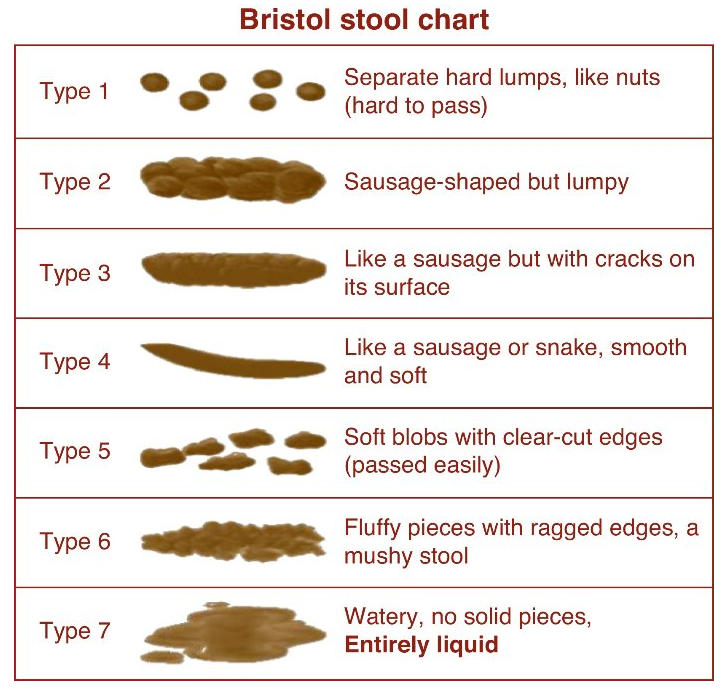
Background: The modified Bristol Stool Form Scale for Children (mBSFS-C) removes #3 and #5 from the Bristol Stool Form Scale (BSFS), leaving only one normal image and shortening the options from seven to five.

Methods: Pediatric gastroenterology providers  (21 faculty, 11 fellows, 3 nurse practitioners)  and 200 children/families rated the same 35 stool photographs, reflecting diverse stool forms, using both scales. The order of photograph presentation and scale use were randomized.
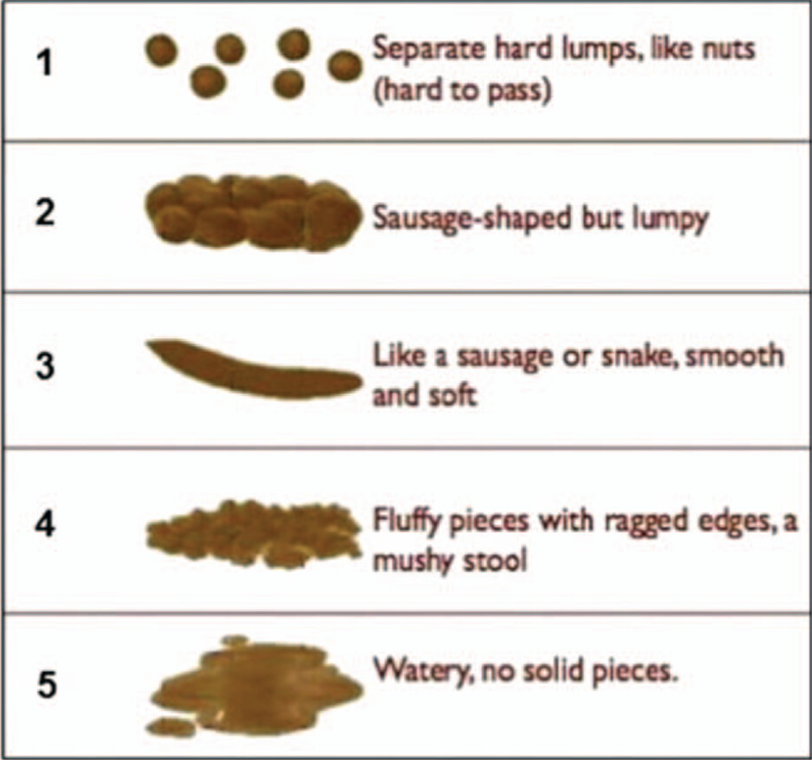
Modified Bristol Stool Scale
Bristol Stool Chart

Key findings:

  •  Of 1,225 provider ratings using the mBSFS-C, 90.0% agreed with the provider’s modal ratings vs 77.8% using the BSFS.
  • Of 7,000 child ratings using the mBSFS-C, 84.6% agreed with the children’s modal ratings vs 71.8% using the BSFS.
  • Using providers’ modal ratings as the reference, all mBSFS-C photograph modal ratings matched between children and providers (35/35 photographs) whereas only 86% (30/35 photographs) matched with the BSFS.

Discussion:

  • “Unique and new in this study is the direct head-to-head comparison of the 2 scales (BSFS, mBSFS-C) when used by pediatric gastroenterology providers and children. Both the BSFS and mBSFS-C demonstrated excellent reliability…modal rating agreement was significantly poorer for the BSFS than for the mBSFS-C.”
  • “Almost 20% of the time expert raters using the BSFS (vs. 8% with the mBSFS-C) deemed a stool to be a different clinical delineation than that selected by the majority of their peers.”

Related editorial: Peter Lu, The American Journal of Gastroenterology 120(6):p 1267, June 2025. Is It Time to Scale Down the Bristol?

My take: The modified BSFS is easier and better. This study indicates it should be widely used for children but probably for adults too. As Dr. Lu’s editorial notes, “aren’t adults just big children?”

Related blog posts:

Does It Matter How Hard Your Poop Is?

A recent study (MH Vriesman et al. J Pediatr 2017; 190: 69-73) with 1835 children examined the issue of stool consistency, comparing the Bristol Stool Scale (BSS) and the Questionnaire on Pediatric Gastrontestinal Symptoms-Rome III (QPGS-RIII). Most of the patients in this study were older children, with 803 (43.7%) age 8-12 years and 1032 (56.3%) ≥13 years.

Key findings:

  • Surprisingly (to me) there only slight agreement between BSS and QPGS-RIII for assessing stool consistency (κ = .046; P=.022).
  • With the BSS, hard stools (types 1 & 2) were reported more frequently than QPGS-RIII: 18.0% vs. 7.1%.
  • Both scales reported similar levels of functional constipation, 9.3% for BSS and 8.6% for QPGS-RIII. The presence of hard stools or painful defecation is only 1 of 6 Rome criteria for the diagnosis of functional constipation.

These results indicate significant variability in how often pediatric patients considered their stools hard based on the instrument (BSS vs QPGS-RIII).  The reason why there is fairly close agreement on functional constipation is due to the fact that Rome III criteria combine the presence of hard stools and painful defecation into a single criteria and the fact that there are multiple criteria needed.  “Not all children with hard stools have painful defecation and vice versa, with only 21% of children with painful defecation reporting hard stools.”

My take: This study suggests that painful defecation is more important to ascertain than if the stools are hard. In addition, this may explain why softening the stools as a stand alone strategy is not effective in many children.

Related study: S Muddasani et al. J Pediatr 2017; 190: 74-8.  This retrospective study showed that pelvic floor physical therapy was effective in the majority of children (n=64,mean age 8.7 yrs) with fecal incontinence due to pelvic floor dyssynergia. It is notable that there were only two physical therapists involved; thus, in order to replicate these results, one would need quite capable PTs.

Related blog posts:

IBD Incidence Increasing: 30 Years of Data from Manitoba

A recent study (JPGN 2014; 59: 763-66) shows a steady trend of increased incidence of IBD in Manitoba. This figure is available online:


Increasing IBD Incidence in Children

Increasing IBD Incidence in Children from JPGNonline

Abstract:

Objectives: The aim of this study was to describe the incidence and prevalence of inflammatory bowel disease (IBD) in children <17 years of age in 30 years from 1978 to 2007.

Methods: From January 1, 1978, to December 31, 2007, the sex- and age-adjusted annual incidence and prevalence of pediatric IBD per 100,000 population were calculated based on the pediatric IBD database of the only pediatric tertiary center in the province. The annual health statistics records for the Province of Manitoba were used to calculate population estimates for the participants. To ensure validity of data, the University of Manitoba IBD Epidemiology Database was analyzed for patients <17 years of age from 1989 to 2000.

Results: The sex- and age-adjusted incidence of pediatric Crohn disease has increased from 1.2/100,000 in 1978 to 4.68/100,000 in 2007 (P < 0.001). For ulcerative colitis, the incidence has increased from 0.47/100,000 in 1978 to 1.64/100,000 in 2007 (P < 0.001). During the same time period, the prevalence of Crohn disease has increased from 3.1 to 18.9/100,000 (P < 0.001) and from 0.7 to 12.7/100,000 for ulcerative colitis (P < 0.001). During the last 5 years of the study the average annual incidence of IBD in urban patients was 8.69/100,000 as compared with 4.75/100,000 for rural patients (P < 0.001).

Conclusions: The incidence and prevalence of pediatric IBD are increasing. The majority of patients were residents of urban Manitoba, confirming the important role of environmental factors in the etiopathogenesis of IBD.

Unrelated: As a bonus for those who made it to the bottom of this post : there’s a new Bristol Stool App for iPhones.  Here’s the link: http://www.bristol-stool-scale.com (from John Pohl’s twitter feed)