Sugary Diet and Colonic Adenomas

H-K Joh et al. Gastroenterol 2021; 161: 128-142. Full text: Simple Sugar and Sugar-Sweetened Beverage Intake During Adolescence and Risk of Colorectal Cancer Precursors

Methods: We prospectively investigated the association of adolescent simple sugar (fructose, glucose, added sugar, total sugar) and sugar-sweetened beverage (SSB) intake with CRC precursor risk in 33,106 participants of the Nurses’ Health Study II who provided adolescent dietary information in 1998 and subsequently underwent lower gastrointestinal endoscopy between 1999 and 2015.

Key Findings:

  • High sugar and SSB intake during adolescence was positively associated with risk of adenoma, but not serrated lesions.
  • Per each increment of 5% of calories from total fructose intake, multivariable ORs were 1.17 (95% CI, 1.05–1.31) for total and 1.30 (95% CI, 1.06–1.60) for high-risk adenoma

Full text (editorial, pg 27): JK Lee et al: Sugary Truth of Early-Onset Colorectal Neoplasia—Not So Sweet After All

Key points:

  • “In the United States, SSB [sugar-sweetened beverage] consumption has increased by nearly 5-fold over time, from 10.8 gallons per person in 1950 to 49.3 gallons per person in 2000.8 In adolescents, SSB consumption has more than doubled since the 1960s and comprises the largest source of simple sugar and calories in their diets”
  • “Recent studies, including several from the Nurses’ Health Study, have identified lifestyle factors from early adulthood, including Western diet,13,14 alcohol,15 tobacco,16 sedentary television viewing,11 diabetes,17 and obesity12 as risk factors for early-onset CRC or adenoma. Other studies report no association between sugar, fruit juice, and SSB consumption during adulthood and risk of CRC in older adults”

My take (borrowed from editorial): “Increasing fructose and SSB consumption, particularly among adolescents and young adults, is troublesome because substantial evidence links consumption to various health outcomes, including obesity, type 2 diabetes, cardiovascular disease, some cancers, all-cause mortality, and now early-onset high-risk adenoma…. clinicians should continue to support public health policies discouraging or reducing consumption of simple sugars and SSBs in adolescents, for whom exposure might have lifelong consequences.”

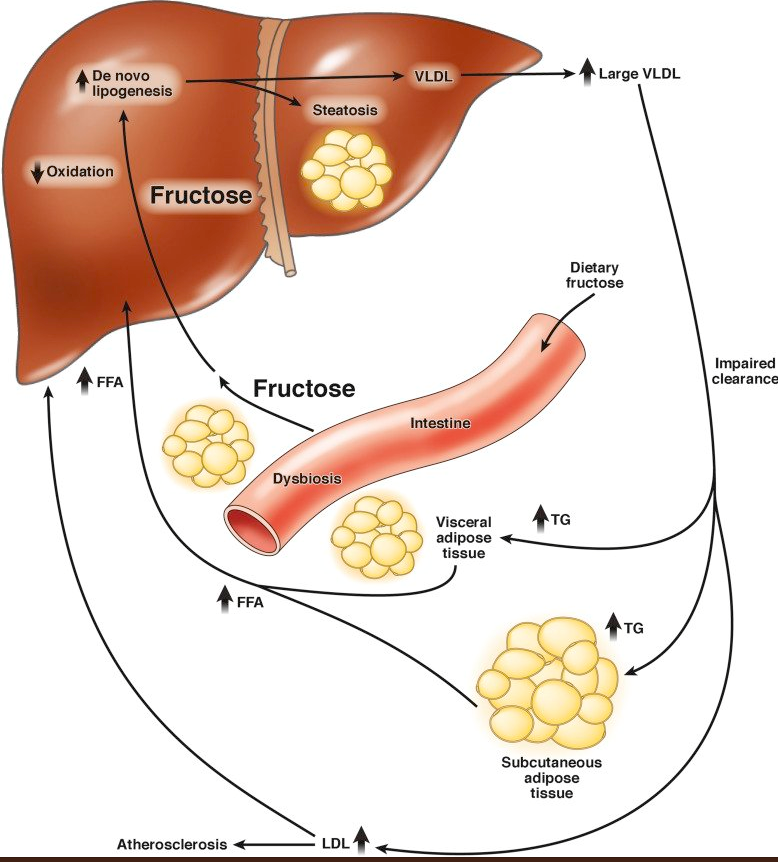
Fructose Restriction Improved Fatty Liver Disease in Children

A recent study (J-M Schwarz et al. Gastroenterol 2017; 153: 743-52, editorial MB Vos, IR Goran Gastroenterol 2017; 153: 642-5 ) showed that restriction of fructose quickly improved fatty liver disease.

Several points from the editorial:

  • “The metabolic driver of buildup of fat storage in the liver is de novo lipogenesis (DNL) and fructose is a major substrate of DNL”
  • “In the healthy state, DNL is not expected to be a major contributor to lipid accumulation in the liver….[but] in a fatty liver, it has been estimated that 26% of the fat originates from DNL.”
  • Fructose is “limited in a natural diet…However, it is added to many processed foods and drinks in the form of cane sugar..and other types of sugars, going by ≥57 different names.”
  • Fructose is “commonly used in animal models to induce hepatic steatosis.”

The study is summarized in a recent AGA Journals Blog: Can Restricting Fructose Intake Reduce Fatty Liver Disease in Children?

An excerpt:

Jean-Marc Schwarz et al performed a clinical trial to investigate the effects of reducing fructose intake for 9 days in obese Latino and African American children with habitual high sugar consumption (fructose intake >50 g/day). They measured the effects of isocaloric fructose restriction on de novo lipogenesis, liver fat, visceral fat, subcutaneous fat, and insulin kinetics.

In their study, 41 children, 9−18 years old, had all meals provided for 9 days. The meals had the same energy and macronutrient composition as their standard diet, but with starch substituted for sugar, yielding a final fructose content of 4% of total kilocalories. The authors measured metabolic factors before and after fructose restriction. They measured liver fat, visceral fat, and subcutaneous fat by magnetic resonance spectroscopy and imaging.

Schwarz et al found that on day 10 of the diet, liver fat decreased from a median 7.2% at baseline to 3.8%, and visceral fat decreased from 123 cm3  at baseline to 110 cm3. Liver fat decreased in all but 1 of the 38 participants for whom paired data were available…

De novo lipogenesis decreased significantly after 9 days of fructose restriction; the de novo lipogenesis area under the curve value on day 10 decreased from 68% at baseline to 26% after the diet, in childen with low or high baseline levels of liver fat.

Insulin secretion during fasting and in response to an oral glucose tolerance test decreased significantly in children with low and high baseline levels of liver fat…

In an editorial that accompanies the article, Miriam B. Vos and Michael I. Goran say that it will be important to determine whether the effects of fructose reduction are sustained past 9 days…Vos and Goran state that it is important for physicians, nutritionists, schools, and parents to find ways to reduce fructose in the diets of children and patients with NAFLD.

Related posts: