Opioid Epidemic Affecting HCV Infection in Adolescents (as well as adults)

SA Barritt et al. J Pediatr 2018; 192: 159-64. Increasing Prevalence of Hepatitis C among Hospitalized Children Is Associated with an Increase in Substance Abuse

Background:  “After a sustained decline in new HCV cases, in recent years there has been a significant increase in HCV incidence in adults in many areas, primarily associated with the use and abuse of intravenous heroin and prescription opioids.” This study examines this trend in adolescents.

From abstract:

Study design

We examined hospitalizations in children using the Kids’ Inpatient Database, a part of the Healthcare Cost and Utilization Project. We identified cases using the International Classification of Diseases, 9th edition, codes for HCV infection during 2006, 2009, and 2012. Nonparametric tests for trend were used to calculate trend statistics.

Results

From 2006 to 2012 nationally, the number of hospitalizations of children with HCV increased 37% (2.69 to 3.69 per 10 000 admissions; P < .001). The mean age of children hospitalized was 17.6 years (95% CI, 17.4-17.8). HCV cases among those 19-20 years of age represented 68% of the total HCV diagnoses, with a 54% increase over the years sampled (P < .001 for trend). The burden of HCV in children was highest in whites, those in the lowest income quartile, and in the Northeast and Southern regions of the US (all P < .0001). The prevalence of substance use among children with HCV increased from 25% in 2006 to 41% in 2012 (P < .001).

Conclusion

The increases of HCV in hospitalized children are largely in teenagers, highly associated with substance abuse, and concentrated in Northeast and Southern states. These results strongly suggest that public health efforts to prevent and treat HCV will also need to include adolescents.

My take: Despite the availability of highly effective therapy for hepatitis C, the opioid epidemic undermines any prospect for eliminating hepatitis C infections.

Related blog posts:
Deadly Market Forces in Narcotics

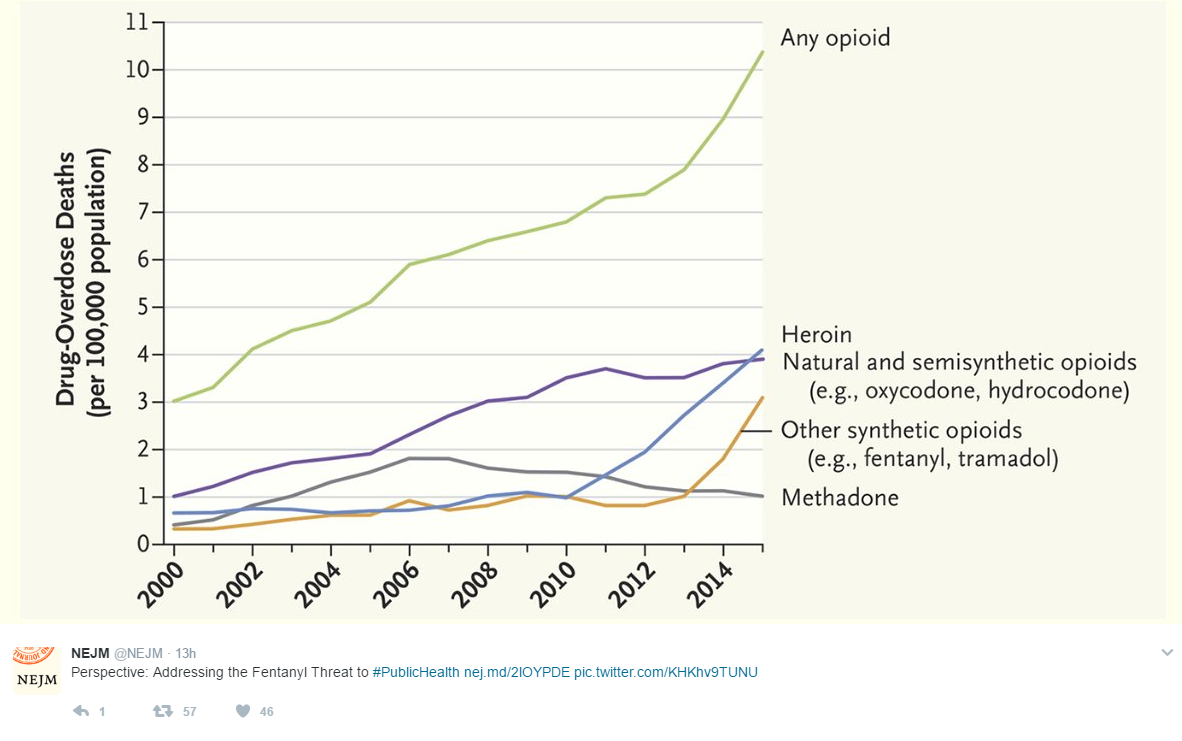
Lately, I’ve been shocked and dismayed by the frequent headlines about the number of overdoses and deaths due to narcotics throughout our country.  A timely article (RG Frank, HA Pollack. NEJM 2017; 376: 605-7) addresses one aspect of this threat to public health that I was not aware of previously.

  • Fentanyl, which is a powerful synthetic opioid, is much cheaper to produce than heroin.  In addition, fentanyl can result in death much more quickly as well.
  • Presumably due to its lower cost, suppliers ‘cut’ heroin with the drug.  As a consequence, fentanyl is increasingly responsible for opioid deaths. The authors estimate that from 2012 to 2014, the number of deaths due to fentanyl doubled to 5544 and that “41% of the roughly 7100 heroin-related deaths during this period involved fentanyl.”
  • Fentanyl has been found in multiple counterfeit illicit drugs.  For example, in a recent analysis from Canada, “89% of seized counterfeit OxyContin tablets” had fentanyl present.
  • Naloxone can reverse fentanyl overdoses but needs to be given more quickly and sometimes multiple doses are needed.

My take: The presence of fentanyl in illicit drugs means that even experimenting once could be fatal.

screenshot-135

Related blog posts:


Trends in Non-medical Opiod Use and Heroin Addiction

Almost all physicians use opiods in their practice and need to keep up with the challenges of pain management and addiction.  An update on the problem of non-medical opiod use and heroin addiction from NEJM:

Full article link: Relationship between Nonmedical Prescription-Opiod Use and Heroin Use

An excerpt:

The transition from nonmedical use of prescription opioids to heroin use appears to be part of the progression of addiction in a subgroup of nonmedical users of prescription opioids, primarily among persons with frequent nonmedical use and those with prescription opioid abuse or dependence. Although some authors suggest that there is an association between policy-driven reductions in the availability of prescription opioids and increases in the rates of heroin use,16,18 the timing of these shifts, many of which began before policies were robustly implemented, makes a causal link unlikely…

In the majority of studies, the increase in the rates of heroin use preceded changes in prescription-opioid policies, and there is no consistent evidence of an association between the implementation of policies related to prescription opioids and increases in the rates of heroin use or deaths, although the data are relatively sparse. Alternatively, heroin market forces, including increased accessibility, reduced price, and high purity of heroin appear to be major drivers of the recent increases in rates of heroin use…

Fundamentally, prescription opioids and heroin are each elements of a larger epidemic of opioid-related disorders and death. Viewing them from a unified perspective is essential to improving public health. The perniciousness of this epidemic requires a multipronged interventional approach that engages all sectors of society.

Related blog posts:


Screen Shot 2016-01-14 at 8.01.08 PM