
8/21/23 Gastroenterology & Endoscopy News, Open Access! Gut Transit Time Varies by Country
The “Blue Poop Challenge,” (joinzoe.com/bluepoop), a citizen scientist project involving 21,541 volunteers in 17 countries on five continents, is evaluating whole gut transit time (WGTT). “Findings were based on self-reported WGTT after volunteers consumed blue muffins (84.5 g per muffin x 2, each containing 0.75 g of blue food coloring paste). WGTT was defined as the time elapsing between muffin ingestion and first appearance of blue color in the stool…”
“The mean WGTT was 23.9 hours (range, 16.2- 32.0 hours), with country-specific differences, said Dr. Bulsiewicz, reporting the findings at Digestive Disease Week 2023 (abstract Su1612)“…
“Fast and slow WGTTs were significantly associated with less healthful diet quality compared with normal WGTT (P<0.001). ‘Lower intakes of plant-based foods were associated with abnormal transit times, which is consistent with the known effect of dietary fiber,‘”‘”
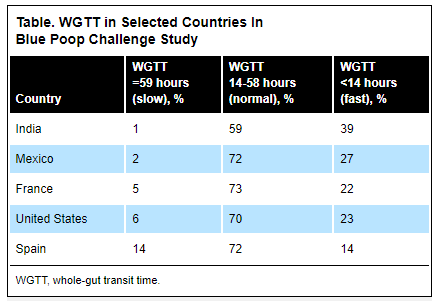
My take: Food-based transit studies are a lot easier to perform than Sitz marker studies. And, of course, who would not want to know if their transit time is faster than their friends?
Related blog posts:

 gutsandgrowth