
IBD Updates: Newer biologics for post-op Crohn’s, Vedolizumab-exposed newborns, and Anti-TNF injections for Orofacial Granulomatosis

FH Mourad et al. Inflammatory Bowel Diseases, Volume 30, Issue 3, March 2024, Pages 459–469. Open Access! Are the New Biologics Effective in the Management of Postoperative Crohn’s Disease?

In this  a systematic review, the authors identified 32 relevant studies. The literature review revealed some encouraging, although conflicting, results on the role of the newer biologic agents, ustekinumab and vedolizumab, in the prevention and treatment of postoperative Crohn’s disease. My take: More high-quality studies are needed to determine the effectiveness of these newer biologics at preventing recurrence disease activity after resection.

This is their recommended management algorithm:
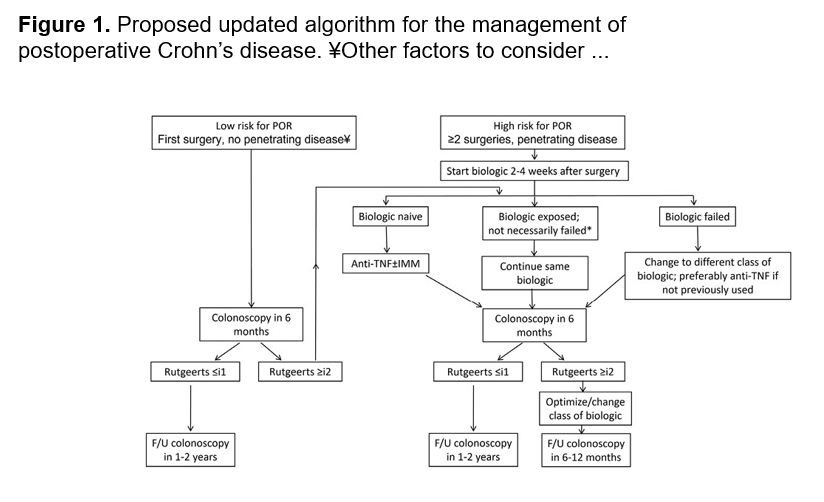
 ¥Other factors to consider are duration of Crohn’s disease,
age of patient at diagnosis, and length of stricture.

—————————————

JH Gorodensky et al. Inflammatory Bowel Diseases, Volume 30, Issue 3, March 2024, Pages 496–498. Serious Infections in Offspring Exposed in Utero to Vedolizumab

Background/Methods:  “Offspring exposed to vedolizumab in utero are born with lower blood drug (relative to maternal drug levels) compared with offspring exposed to TNFi or ustekinumab.4,5 In addition, offspring exposed to vedolizumab are known to clear the drug quickly after birth.6” In this IBM MarketScan database cohort of 8507 offspring to women with IBD, 43 offspring were exposed to vedolizumab. Key findings:

Key finding: The cumulative incidence of serious infection at 1 year was 2.3% in the vedolizumab group. This was lower than in those who had no drug exposure (3.0%) and similar to the rate in the TNFi (2.9%), traditional immunosuppressants (2.5%), and groups. Discussion: “This aligns with data from the PIANO study,5 a French retrospective cohort study,8 and the pan-European CONCEIVE study9

My take: This article title is textbook clickbait. A more accurate title would be “Lack of Serious Infections in Offspring Exposed in Utero to Vedolizumab”

——————————————

J Lee et al. Inflammatory Bowel Diseases, Volume 30, Issue 3, March 2024, Pages 499–500. Intralesional Injections of a TNF-α Inhibitor to Treat Orofacial Granulomatosis

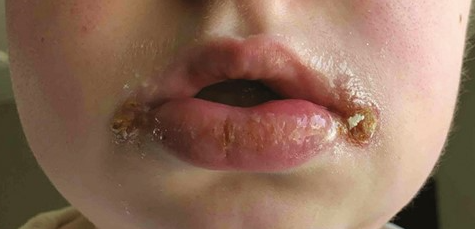
This case report demonstrated successful injection of orofacial granulomatosis in a 24 yo with moderate-to-severe CD of the small and large intestines who presented with facial edema, painful lip sores with crusting, and tongue fissures. After numerous other failed treatments (topical steroids, adalimumab, hydroxychloroquine, prednisone, and methotrexate), the patient who had a mild treatment response to certolizumab had three injections split between thigh and lower lip (intralesional). After improvement, the patient continued to maintain response with injections into the thigh.

My take: This is an interesting case report; however, this is not an established therapy for orofacial granulomatosis.

Vitamin K Shots Protect Newborns from Severe Bleeding: AAP Policy Statement

HealthyChildren.org: Why Your Newborn Needs a Vitamin K Shot

AAP Policy Statement (I Hand et al. Pediatrics (2022) 149 (3): e2021056036) Open Access: Vitamin K and the Newborn Infant

This policy is welcome as there has been an increase in parents refusing vitamin K administration and a resultant increase in the number of cases of late-onset VKDB (vitamin K deficiency bleeding); some of these cases result in devastating outcomes.

Summary and Recommendations

VKDB remains a significant concern in newborn and young infants. Parenteral vitamin K has been shown to be the most effective way to prevent VKDB of the newborn and young infant, and the AAP recommends the following:

  1. Vitamin K should be administered to all newborn infants weighing >1500 g as a single, intramuscular dose of 1 mg within 6 hours of birth.
  2. Preterm infants weighing ≤1500 g should receive a vitamin K dose of 0.3 mg/kg to 0.5 mg/kg as a single, intramuscular dose. A single intravenous dose of vitamin K for preterm infants is not recommended for prophylaxis.
  3. Pediatricians and other health care providers must be aware of the benefits of vitamin K administration as well as the risks of refusal and convey this information to the infant’s caregivers.
  4. VKDB should be considered when evaluating bleeding in the first 6 months of life, even in infants who received prophylaxis, and especially in exclusively breastfed infants.

Related blog posts: 

Vedolizumab Exposure in Newborns

M Juulsgard et al. AP&T 2021: https://doi.org/10.1111/apt.16593. Vedolizumab clearance in neonates, susceptibility to infections and developmental milestones: a prospective multicentre population-based cohort study

Key findings:

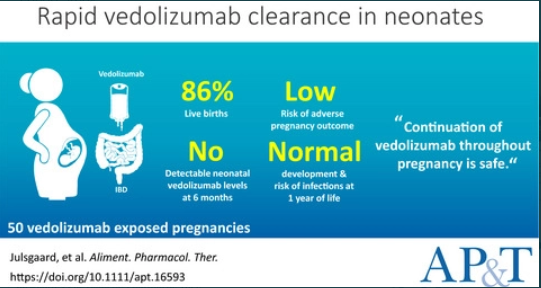
  • In 50 vedolizumab-exposed pregnancies, we observed 43 (86%) live births, seven (14%) miscarriages, no congenital malformations and low risk of adverse pregnancy outcomes
  • The mean time to vedolizumab clearance in infants was 3.8 months (95% CI, 3.1-4.4)
  • No infant had detectable levels of vedolizumab at 6 months of age
  • Developmental milestones at 12 months were normal or above average
  • Neither vedolizumab exposure in the third trimester (RR 0.54, 95% CI, 0.28-1.03) nor combination therapy with thiopurines (RR 1.29, 95% CI, 0.60-2.77) seemed to increase the risk of infections in the offspring

My take: Given the good safety profile of vedolizumab, this small study provides additional reassurance regarding use of vedolizumab during pregnancy.

Related blog posts:

Disclaimer: This blog, gutsandgrowth, assumes no responsibility for any use or operation of any method, product, instruction, concept or idea contained in the material herein or for any injury or damage to persons or property (whether products liability, negligence or otherwise) resulting from such use or operation. These blog posts are for educational purposes only. Specific dosing of medications (along with potential adverse effects) should be confirmed by prescribing physician.  Because of rapid advances in the medical sciences, the gutsandgrowth blog cautions that independent verification should be made of diagnosis and drug dosages. The reader is solely responsible for the conduct of any suggested test or procedure.  This content is not a substitute for medical advice, diagnosis or treatment provided by a qualified healthcare provider. Always seek the advice of your physician or other qualified health provider with any questions you may have regarding a condition.