Environmental Toxins/Forever Chemicals and Steatotic Liver Disease

AK Jain et al. JPGN 2024; 79:943–953. Open access: Environmental toxicants modulate disease severity in pediatric metabolic dysfunction-associated steatohepatitis

This study correlated environmental toxins and steatotic liver disease. Four hundred and thirty-five children distributed across MASH (n = 293) and MASLD (n = 142), with 304 (69.9%) males. Toxins analyzed: PFAS chemicals included perfluorohexane-1-sulphonic acid (PFHXS), perfluorononanoic acid, perfluorooctanoic acid, and perfluorooctanesulfonic acid and PBDE included 2,2′,4,4′-tetrabromodiphenyl ether (BDE47), 2,2′,4,4′,5-pentabromodiphenyl ether (BDE99), and 2,2′,4,4′,6-pentabromodiphenyl ether (BDE100).

Key findings:

  • There was an inverse association between PFAS/PBDE mixture and MASH versus MASLD, lobular inflammation (p = 0.026), NAS (p = 0.009, FDR p = 0.04), and log-transformed ALT (p = 0.005, FDR p = 0.025) driven by perfluorohexane sulfonate (PFHXS). 
  • PFASs were detected in 290 (67%) samples, showing the pervasive nature of this chemical exposure in children

My take: Not surprisingly, our environmental exposures influence the severity of steatotic liver disease. There is widespread exposure to pollutants and the full toll on our health is not clear.

Related blog posts:

What We Don’t Know About Toxic Exposures is a Lot and Dangerous

TJ Woodruff. NEJM 2024; 390: 922-933. Health Effects of Fossil Fuel–Derived Endocrine Disruptors

Initially, I was tempted to title this post ‘Burying the Evidence and the Bodies from Pollution.’ That sounded too alarmist, though. That said, this review article asserts that “chemical pollution is estimated to be responsible for at least 1.8 million deaths each year…This number is probably an underestimate, since less than 5% of approximately 350,000 chemicals registered for use globally have been adequately studied.1”  (90% of pollution-related deaths occurring in low- and middle-income countries).

In addition, “polluting industries [are] “weaponizing” scientific uncertainty to foster distrust in scientific findings and lobbying for weaker regulations.71 For example, previously secret industry documents show that the industries knew about the health harms of PFAS decades before the scientific and public health community did.72” The science behind pollution is hampered by the inability (unethical) to conduct randomized trials of pollution exposure.

This article focuses on Endocrine Disruptors Chemicals (EDCs).

Health Effects of Fossil Fuel–Derived Endocrine Disruptors

  • Fossil fuels contribute to chemical pollution through production of petrochemicals, many of which interfere with hormonal function (endocrine-disrupting chemicals [EDCs]). Examples include perfluoroalkyl and polyfluoroalkyl substances in food packaging and fabrics and phthalates in plastics and consumer products.
  • Petrochemical production is increasing, and people are exposed through contaminated air, water, food, and manufactured products (e.g., plastics, pesticides, building materials, and cosmetics).
  • EDCs can increase several health risks, including cancer, neurodevelopmental harm, and infertility.
  • Risks are higher with exposures during fetal and child development and with exposure to multiple EDCs and occur at low exposure levels. Exposures are higher in communities of color and low-income communities and contribute to health inequities.
  • Clinicians can provide advice to patients toward reducing some exposures, but policy change is needed to establish legal requirements for comprehensive safety testing and to reduce health threats from petrochemicals. Clinicians are important advocates for these changes.

Figure 2 reviews the potential individual modifiers to the effects of pollution as well as the increased adverse health effects.

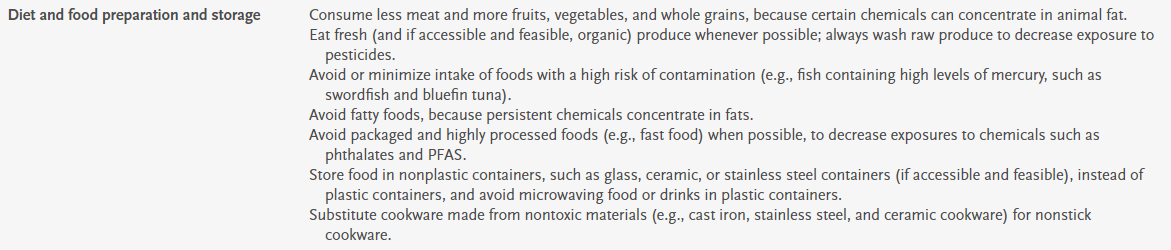
Table 2 provides recommendations for reducing exposures including diet/food preparation, cleaning/use of cleaning products, minimizing occupational exposures, and advocacy.

My take: There are limited steps that individuals can take to reduce their exposures. In order to make our environment safer, this requires policy changes. Most individuals do not even know if they are being exposed to dangerous pollutants and would have limited ability to move away from unsafe areas.

Related blog posts:

Prenatal Liver Pollutants: Perfluoroalkyl Substances

It is very difficult to try to understand potential toxic substances in our environments. Some of the reasons for this are that there are always numerous simultaneous exposures and harm from substances can accrue over long periods. Once a substance is identified, it can take a long time to develop convincing evidence and even longer time frames to try to enact policy changes.

Despite these challenges, fortunately researchers continue to try to tease out these dangerous agents. A recent study (N Stratakis et al. Hepatology 2020; 72: 1758-1770. Free Full text: Prenatal Exposure to Perfluoroalkyl Substances Associated With Increased Susceptibility to Liver Injury in Children)

Background/Methods: Per- and polyfluoroalkyl substances (PFAS) are widespread and persistent pollutants that have been shown to have hepatotoxic effects in animal models. However, human evidence is scarce. PFAS chemicals have a myriad industrial/household applications which include nonstick cookware and products that confer resistance to stains. According to the editorial (MC Cave, pg 1518-21), some refer to PFAS as “forever chemicals” due to their decades-long half-lives.

The study authors used data from 1105 mothers and their children (median age 8.2 years) from the European Human Early-Life Exposome cohort. Key findings:

  • High prenatal exposure to PFAS resulted in children who were at higher risk of liver injury (odds ratio, 1.56; 95% confidence interval, 1.21–1.92)
  • PFAS exposure is associated with alterations in key amino acids and lipid pathways characterizing liver injury risk.

Related blog posts: