The Alarming Impact of Microplastics on Human Health

Yesterday’s post described the problems than pollution and chemicals are associated with in children.

Today’s post reviews data that microplastics accumulate in the brain and are associated with dementia in adults. A thorough review of this topic from Eric Topol 2/3/25: The Microplastic Concerns Elevate—To the Brain

Some excerpts:

Background: Last March a landmark prospective study of microplastics found nearly 60% of patients undergoing an artery operation (carotid endarterectomy) 58% had microplastics and nanoplastics (MNPs) in their plaque. Their presence was linked to a subsequent 4.5 -fold increase of the composite of all-cause mortality, heart attack and stroke…A multi-center study from China showed microplastics were present in the semen and urine of all 113 men assessed and were associated with reduced sperm count and semen quality The CDC data indicate they are likely present in the bodies of all Americans. As you know by now, MNPs are pervasive in our air and water, there’s currently an annual output of 400 million tons of plastics, and the burden of MNPs is expected to double by 2040 if nothing is done to change course.

The main sources of MNPs

The New Study

As reported in today’s Nature Medicine, Alexander Nihart and colleagues assessed concentrations of MNPs in the brain, liver and kidney…To emphasize, the MNP concentration in the brain was 7-30 times greater than the concentration in the liver or kidneys...the increased concentration of MNPs was considerably greater in the people with dementia. Even at the most recent, higher MNP concentration, the brains without dementia averaged ~5,000 μg g−1 whereas the brains from individuals with dementia has MNP concentrations that were 2 to 10-times higher…

Another study published on 22 January in Science Advances demonstrates, in the mouse model, that MNPs in the bloodstream cross the blood-brain-barrier, activate the immune system (schematic below) and result in stagnation of blood flow, culminating in blood clots, also resulting in neurological abnormalities…

Some practical tips were, however, provided: “Reducing exposure to microplastics is feasible, by avoiding food and drinks packaged in plastics, using less synthetic fabric and cleaning up household dust. Heating plastic containers leaches lots of microplastics, so avoiding microwaved ready-meals and plastic kettles should help too.”

The essential point of this post is that the striking brain accumulation of MNPs is paralleled by the overwhelming accumulation of evidence for their toxicity to human health. 

Related blog posts:

Environmental Impact of Endoscopy

M Desai et al. Gastroenterol 2024; 166: 496-502. The Environmental Impact of Gastrointestinal Procedures: A Prospective Study of Waste Generation, Energy Consumption, and Auditing in an Endoscopy Unit

This study prospectively collected data on total waste generation, energy consumption, and the role of intraprocedural inventory audit of a single tertiary care academic endoscopy unit over a 2-month period (May–June 2022, 450 procedures).

Key findings:

  • The total waste generated during the study period was 1398.6 kg (61.6% directly going to landfill, 33.3% biohazard waste, and 5.1% sharps), averaging 3.03 kg/procedure.
  • The average waste directly going to landfill was 219 kg per 100 procedures. The estimated total annual waste generation approximated the size of 2 football fields (1-foot-high layered waste). 
  • Endoscope reprocessing generated 194 gallons of liquid waste per day, averaging 13.85 gallons per procedure.
  • Thus, every 100 GI endoscopy procedures (esophagogastroduodenoscopy/colonoscopy) was associated with 303 kg of solid waste and 1385 gallons of liquid waste generation 
  • 20% of total waste consisted of potentially recyclable items (8.6 kg/d) that could be avoided by appropriate waste segregation of these items.

My take: The huge amount of trash (solid and liquid) generated by endoscopy is difficult to fathom. It is incumbent for gastroenterologists to consider this hidden extra cost. Recycling could help in a modest way. Trying to limit low-value procedures is another step. Long-term alternative diagnostic procedures will need to be developed/utilized which reduce the environmental impact.

Atlanta Botanical Gardens

What We Don’t Know About Toxic Exposures is a Lot and Dangerous

TJ Woodruff. NEJM 2024; 390: 922-933. Health Effects of Fossil Fuel–Derived Endocrine Disruptors

Initially, I was tempted to title this post ‘Burying the Evidence and the Bodies from Pollution.’ That sounded too alarmist, though. That said, this review article asserts that “chemical pollution is estimated to be responsible for at least 1.8 million deaths each year…This number is probably an underestimate, since less than 5% of approximately 350,000 chemicals registered for use globally have been adequately studied.1”  (90% of pollution-related deaths occurring in low- and middle-income countries).

In addition, “polluting industries [are] “weaponizing” scientific uncertainty to foster distrust in scientific findings and lobbying for weaker regulations.71 For example, previously secret industry documents show that the industries knew about the health harms of PFAS decades before the scientific and public health community did.72” The science behind pollution is hampered by the inability (unethical) to conduct randomized trials of pollution exposure.

This article focuses on Endocrine Disruptors Chemicals (EDCs).

Health Effects of Fossil Fuel–Derived Endocrine Disruptors

  • Fossil fuels contribute to chemical pollution through production of petrochemicals, many of which interfere with hormonal function (endocrine-disrupting chemicals [EDCs]). Examples include perfluoroalkyl and polyfluoroalkyl substances in food packaging and fabrics and phthalates in plastics and consumer products.
  • Petrochemical production is increasing, and people are exposed through contaminated air, water, food, and manufactured products (e.g., plastics, pesticides, building materials, and cosmetics).
  • EDCs can increase several health risks, including cancer, neurodevelopmental harm, and infertility.
  • Risks are higher with exposures during fetal and child development and with exposure to multiple EDCs and occur at low exposure levels. Exposures are higher in communities of color and low-income communities and contribute to health inequities.
  • Clinicians can provide advice to patients toward reducing some exposures, but policy change is needed to establish legal requirements for comprehensive safety testing and to reduce health threats from petrochemicals. Clinicians are important advocates for these changes.

Figure 2 reviews the potential individual modifiers to the effects of pollution as well as the increased adverse health effects.

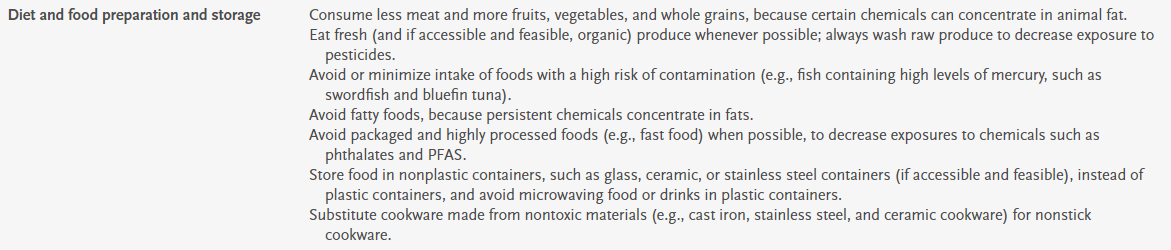
Table 2 provides recommendations for reducing exposures including diet/food preparation, cleaning/use of cleaning products, minimizing occupational exposures, and advocacy.

My take: There are limited steps that individuals can take to reduce their exposures. In order to make our environment safer, this requires policy changes. Most individuals do not even know if they are being exposed to dangerous pollutants and would have limited ability to move away from unsafe areas.

Related blog posts: