
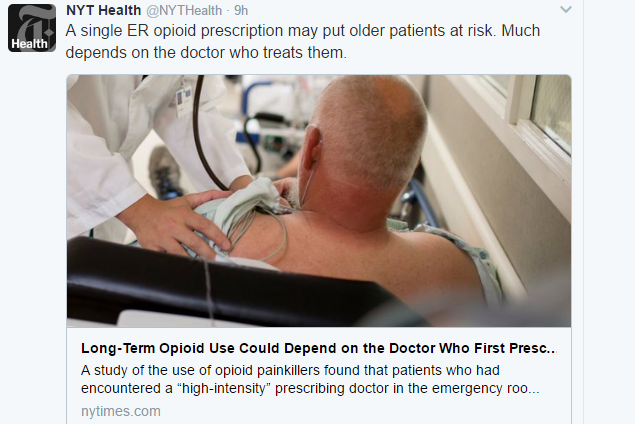
In a recent article (NEJM 2017; 376: 663-73), ML Barnett show that opioid-prescribing patterns of emergency physicians may increase the risk of long-term use. By focusing on variation of prescribing practices among physicians at the same hospitals and with a sample size of ~380,000 patients, the authors provide convincing data that starting opioids even for an intended brief period can have lasting consequences. This study focused on medicare beneficiaries (average age ~68 yrs) who received narcotics from either higher-frequency or lower-frequency physician prescribers.
In their discussion, the authors state “if our results represent a causal relationship, for every 49 patients prescribed a new opioid in the emergency department who might not otherwise use opioids, 1 will become a long-term user.”
My take: Starting a narcotic may be the first step in a long treacherous road.
Related blog posts:
- Trends in Non-medical opioid Use and Heroin Addiction
- CDC Guideline for Prescribing Opioids for Chronic Pain
- Deadly consequences of pain management | gutsandgrowth
- Increased Narcotic Usage in Pediatric Patients with IBD …
- Epidemic of Prescription Drug Overdoses | gutsandgrowth
- Increased Narcotic Usage in Pediatric Patients with IBD
 gutsandgrowth
Pingback: Opioid Use and Liver Transplantation Outcomes | gutsandgrowth
Pingback: Likelihood of Opioid Dependency If Opioid Given During an IBD Flare | gutsandgrowth