
R Marfella et al. NEJM 2024; 390: 900-910. Microplastics and Nanoplastics in Atheromas and Cardiovascular Events
The authors conducted a prospective, multicenter, observational study involving patients who were undergoing carotid endarterectomy for asymptomatic carotid artery disease with 257 patients who completed a mean follow-up of 34 months.
Key findings:
- Polyethylene was detected in carotid artery plaque of 150 patients (58.4%), with a mean level of 21.7±24.5 μg per milligram of plaque; 31 patients (12.1%) also had measurable amounts of polyvinyl chloride, with a mean level of 5.2±2.4 μg per milligram of plaque.
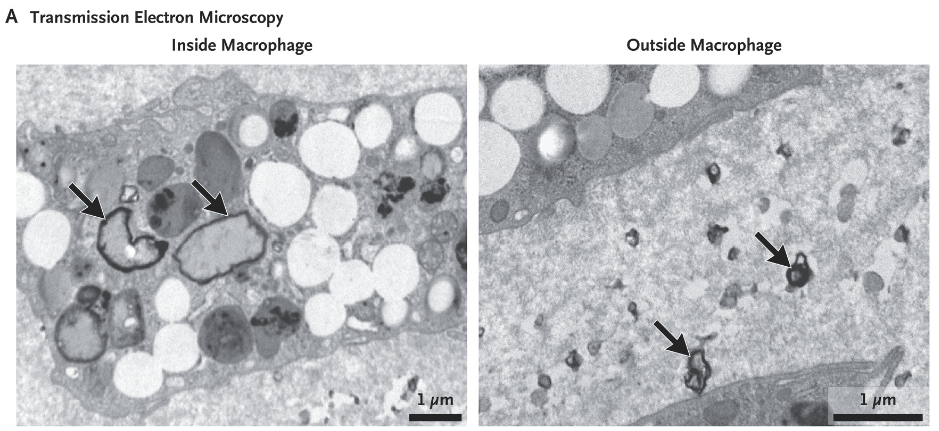
- Electron microscopy revealed visible, jagged-edged foreign particles among plaque macrophages and scattered in the external debris.
- There was a 4.5 -fold increase of the composite of all-cause mortality, heart attack and stroke in patients in whom microplastics and nanoplastics (MNPs) were detected within the atheroma than in those in whom these substances were not detected (hazard ratio, 4.53)
Discussion notes that “according to a World Health Organization statement, MNPs larger than 150 μm or 10 μm in diameter, respectively, are not absorbed into blood and do not penetrate blood vessels.25 Our findings suggest that nanoplastics, rather than microplastics, might accumulate in sites of atherosclerosis…Given the wide distribution and availability of MNPs, the attribution of all potential sources in humans is nearly impossible.”
“It is important to note that our results do not prove causality. The association between the presence of MNPs within plaque and the incidence of a composite of cardiovascular disease or death outcomes may also entail the risk from exposure to other residual, unmeasured confounding variables.”

The associated editorial (PJ Landrigan. NEJM 2024; 390: 948-950) provides some additional context and notes the need for wide-scale transition form fossil carbon.
Key points:
- “Plastics have enabled extraordinary advances in virtually every area of medicine and have made our lives immeasurably more convenient. Multiple lines of evidence now indicate, however, that plastics are neither as safe nor as inexpensive as they seem. The benefits of plastics come at great and increasingly visible costs to human health and the environment.”
- “Plastics comprise a polymer matrix plus thousands of chemical additives that impart such properties as color, stability, flexibility, flame resistance, and water repellency. Many additives are toxic; these include carcinogens, neurotoxicants, and endocrine disruptors such as bisphenols and perfluorinated and polyfluorinated substances that can disrupt lipid metabolism and increase the risk of diabetes, cardiovascular disease, and stroke.2“
- “Worldwide, the annual output … to approximately 400 million tons today.3 This output is projected to double by 2040 and triple by 2060…Disposable, single-use items account for about 40% of current production and contribute disproportionately to the accumulation of plastic waste.”
- ” Data from the National Biomonitoring Surveys of the Centers for Disease Control and Prevention (https://www.cdc.gov/biomonitoring/index.html. opens in new tab) suggest that plastic additive chemicals are present in the bodies of nearly all Americans. The Minderoo Monaco Commission has concluded that plastics endanger human health at every stage of the plastic life cycle.1“
My take: This study provides further evidence that plastics, while incredibly important and convenient, take a huge toll on the environment and are increasingly recognized as having harmful effects on the the human body. In the same issue, is a review article “Health Effects of Fossil Fuel-Derived Endocrine Disrupters.” However, trying to reduce our dependence on plastics is not going to be easy.

Related blog posts:
 gutsandgrowth