
- GWK Wong. NEJM 2024; 390: 946-948 (commentary).
- RA Wood, et al. NEJM 2024; 390: 889-899.Omalizumab for the Treatment of Multiple Food Allergies
The Omalizumab as Monotherapy and as Adjunct Therapy to Multi-Allergen Oral Immunotherapy in Food Allergic Participants (OUtMATCH) trial was designed as a multistage clinical trial to evaluate the safety and efficacy of omalizumab in persons with multiple food allergies. This publication received a lot publicity in multiple media outlets (one example below) and has been labelled a “landmark” study. For a more sober assessment of this study, I recommend reviewing the commentary by Dr. Gary Wong.
Background: “Food allergy is common, affecting up to 8% of children and 10% of adults in the United States.1,2“
The key findings from the study:
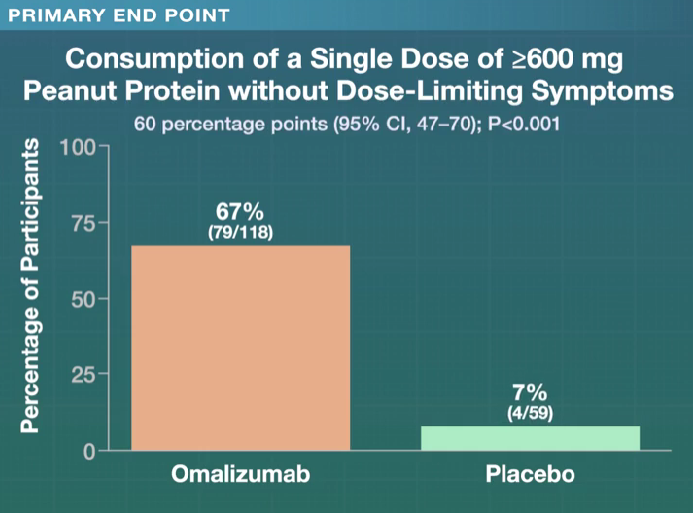
In this double-blind, randomized, placebo-controlled study in patients with at least three food allergies (all with peanut), the authors found that omalizumab, a monoclonal anti-IgE antibody injected every 2-4 weeks for 16-20 weeks (then a 24-week open-label extension) had the following results:
- A total of 79 of the 118 children/adolescent participants (67%) receiving omalizumab met the primary end-point criteria (tolerating a single dose of at least 600 mg of peanut protein, a peanut is ~250 mg), as compared with 4 of the 59 participants (7%) receiving placebo (P<0.001).
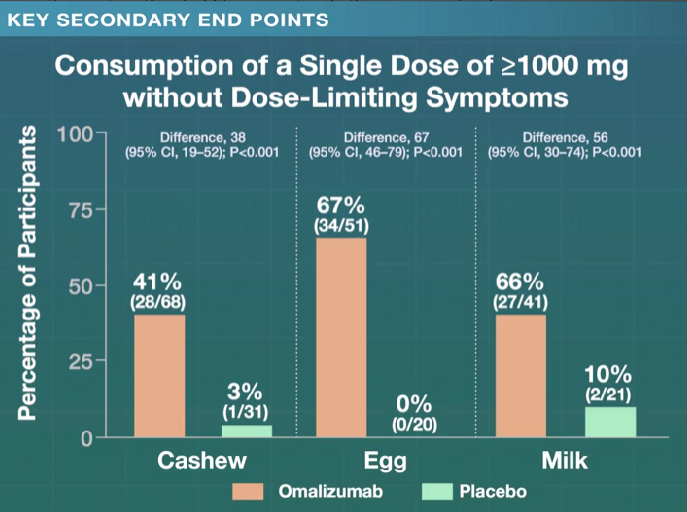
- Results for the key secondary end points were consistent with those of the primary end point (cashew, 41% vs. 3%; milk, 66% vs. 10%; egg, 67% vs. 0%; P<0.001 for all comparisons).
The editorial points out the following:
- “The concept of using anti-IgE antibody to protect patients with severe food allergy is not new. A randomized trial published in the Journal 20 years ago showed that the use of a humanized IgG1 monoclonal antibody, TNX-901, could significantly increase the threshold of reaction in patients with peanut allergy.5“
- “21% of the participants had a decreased reaction threshold at the end of the extension period.” (?Will this ‘safety net’ continue to work in the long run)
- “With regard to quality-of-life assessments, no changes from baseline were seen in either caregiver or participant scores at the end of the first stage of the trial.”
- “In clinical trials assessing new therapies for food allergy, investigators have primarily selected reaction thresholds as the primary outcome. In real life, people want treatments that will decrease the risk of accidental allergic reactions, lift the burden on their daily lives, simplify their dietary restrictions, and improve their quality of life.”
- “Persons who opt to receive omalizumab must be informed that the possible protection will most likely disappear after omalizumab treatment is stopped.”
- “Data regarding the possible benefits of omalizumab with respect to important patient-centered outcomes and quality of life are needed before we can make recommendations for patients in clinical practice.”
NBC News 2/25/24: Newly approved drug protects against multiple food allergies, giving an ‘extra layer of comfort’ Earlier this month, the Food and Drug Administration expanded the approval for Xolair for certain kids and adults with food allergies, based on the results of the clinical trial…In the U.S., Xolair is made by drugmakers Genentech and Novartis. A spokesperson for Genentech said the estimated monthly list price for the drug is around $2,900 for children and $5,000 for adults
My take: This is a very expensive therapy that is likely to help only if maintained indefinitely. Whether it provides a durable benefit or truly improves clinical outcomes has not been established. I anticipate early adoption mainly in patients with severe allergies, especially in those with documented severe reactions.
Related blog posts:
- “Separating Fact from Fiction in the Diagnosis and Management of Food Allergy” In this post summarizing a review article, the authors note “The risk of fatal anaphylaxis is about 1 in 10 million (about equivalent to being struck by lightning)..and fatality on first ingestion of an allergen in infancy has never been described”
- Current Approach for FPIES
- The Peanut Story -Skin Patch Chapter
- New Strategy to Overcome Severe Reactions to Peanuts
- “The Truth About Allergies and Food Sensitivity Tests”
- Poorly-Conceived Allergy Testing Can Lead to Unnecessary Diet Restrictions and Complications
 gutsandgrowth