
Home | About Jay Hochman -Pediatric Gastroenterology Blog | Archives
February 15, 2017 7:04 am
Recently I gave a lecture on parenteral nutrition associated liver disease (PNALD), though the term intestinal failure associated liver disease (IFALD) is probably more popular at this time. The day afterwards, I read an important study (L Beauport et al. J Pediatr 2017; 181: 29-36) reiterating one of the concerns in the lecture.
This study showed that higher lipid intake in a cohort of neonates born at <30 weeks during the first 2 weeks after birth was associated with a lower incidence of brain lesions and dysmaturation when examined by MRI at term equivalent age (TEA).
Details: This prospective cohort study examined energy/lipid intake in the first 2 weeks of life. Eligible patients were neonates ≤30 weeks. Group 1 with 27 patients had birth weight median of 900 gm compared with Group 2 with 15 patients had median weight of 844 gm. During the first year of the study, participants received a soybean emulsion whereas in the last year of the study, the neonates received a mixture of soybean and olive oil (Clinoleic).
Key finding: After adjusting for clinical risk scores and sepsis, the authors found that the higher energy/lipid intakes resulted in improved brain MRIs in group 1. A “10 Kcal/kg/day increase in energy of 0.7 g/kg/day increase in lipids intake would reduce the risk of having more severely abnormal MRI at TEA by >60%.”
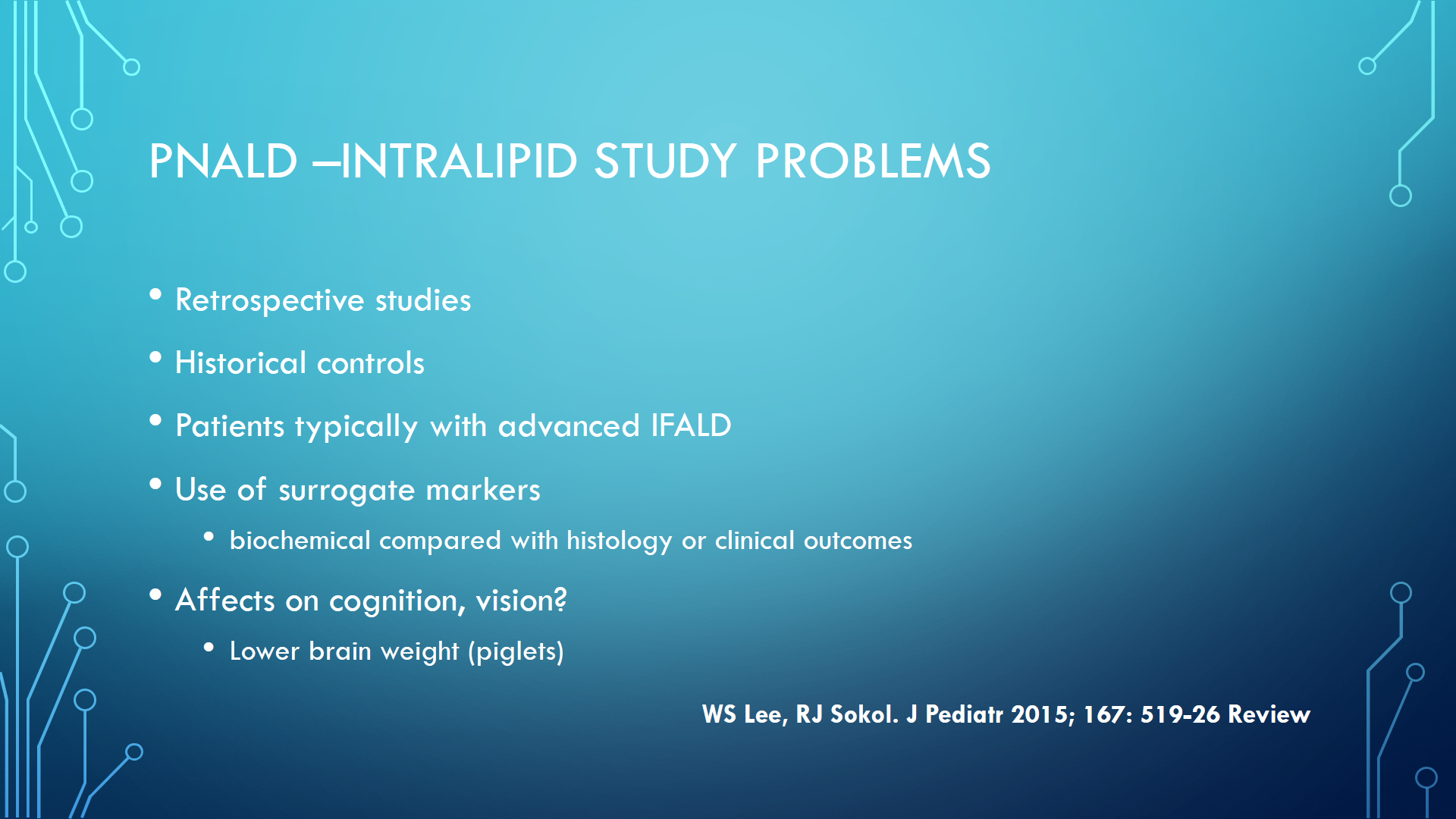
Here are some slides from my talk relevant to this topic and to parenteral nutrition associated liver disease (PNALD):
Posted by gutsandgrowth
Categories: Nutrition
Tags: cholestasis, PNALD, SMOFlipid
Mobile Site | Full Site
Get a free blog at WordPress.com Theme: WordPress Mobile Edition by Alex King.
Hi,
Thanks for the information.
Can you kindly share the slides? Do you have any on TPN in developing country setting?
We will certainly acknowledge you in the presentations.
Kind regards,
Ahmed, Kenya
>
By ahmed laving on February 15, 2017 at 10:22 am
Many of the slides will be posted over next several days. Hard to transfer entire group of slides due to large size (memory)
By gutsandgrowth on February 15, 2017 at 1:48 pm
[…] My take: This study does not provide any information regarding neurotoxicity. It shows that potentially toxic levels of Bf & FFAu can occur in infants born <28 weeks who receive 2 g/k/day or more of intralipid. While this is a concern, we also know that poor growth is associated with worsened neurocognitive outcomes (Nutrition Week: Downside of Lipid Reduction) […]
By Lipid Emulsions and Unbound Bilirubin in Preterm Infants | gutsandgrowth on June 3, 2017 at 9:01 am
[…] Downside of Lipid Reduction (Nutrition Week Day 1) This study showed that higher lipid intake in a cohort of neonates born at <30 weeks during the first 2 weeks after birth was associated with a lower incidence of brain lesions and dysmaturation when examined by MRI at term equivalent age (TEA). […]
By SMOF Neurodevelopmental Data Looks Good –In Five Years We’ll Know More | gutsandgrowth on August 9, 2019 at 7:03 am
[…] Downside on Lipid Reduction […]
By Liver Shorts -June 2020 | gutsandgrowth on June 30, 2020 at 7:01 am
[…] Downside of Lipid Reduction (Nutrition Week Day 1) This study showed that higher lipid intake in a cohort of neonates born at <30 weeks during the first 2 weeks after birth was associated with a lower incidence of brain lesions and dysmaturation when examined by MRI at term equivalent age (TEA). […]
By Building a Bigger (Better?) Brain in Premature Infants | gutsandgrowth on August 23, 2020 at 9:01 am