
A recent review (EB Tapper, AS-F Lok. NEJM 2017; 377: 756-68) provides a good review of liver biopsy and liver imaging. My take of this review is that it highlights the emergence of noninvasive tools (imaging & fibrosis markers) which may supplant liver biopsy. This article does not delve into how more widespread genetic testing may obviate a liver biopsy in many cases as well. The article notes that about 8% of persons in the U.S. have elevated liver enzymes.
Liver biopsy:
- “A typical liver biopsy samples one fifty-thousandth of the liver.”
- Limitations of liver biopsy: sampling error is common, biopsy interpretation is subjective, and biopsies can cause complications. Pain is noted in 30-50% of patients, serious bleeding in 0.6%, injury to other organs (0.08%), and in rare cases, death (up to 0.1%).
- Cost: “the average direct cost of a percutaneous liver biopsy is $1448 (in 2016 U.S. dollars).” Transjugular biopsies are much more expensive. In addition, there are unmeasured indirect costs, due to missing work.
Some prior blogs on liver biopsy
- Briefly noted: Outpatient liver biopsy in children
- Liver biopsy -risks and benefits
- Liver biopsy risk in children | gutsandgrowth
Blood tests:
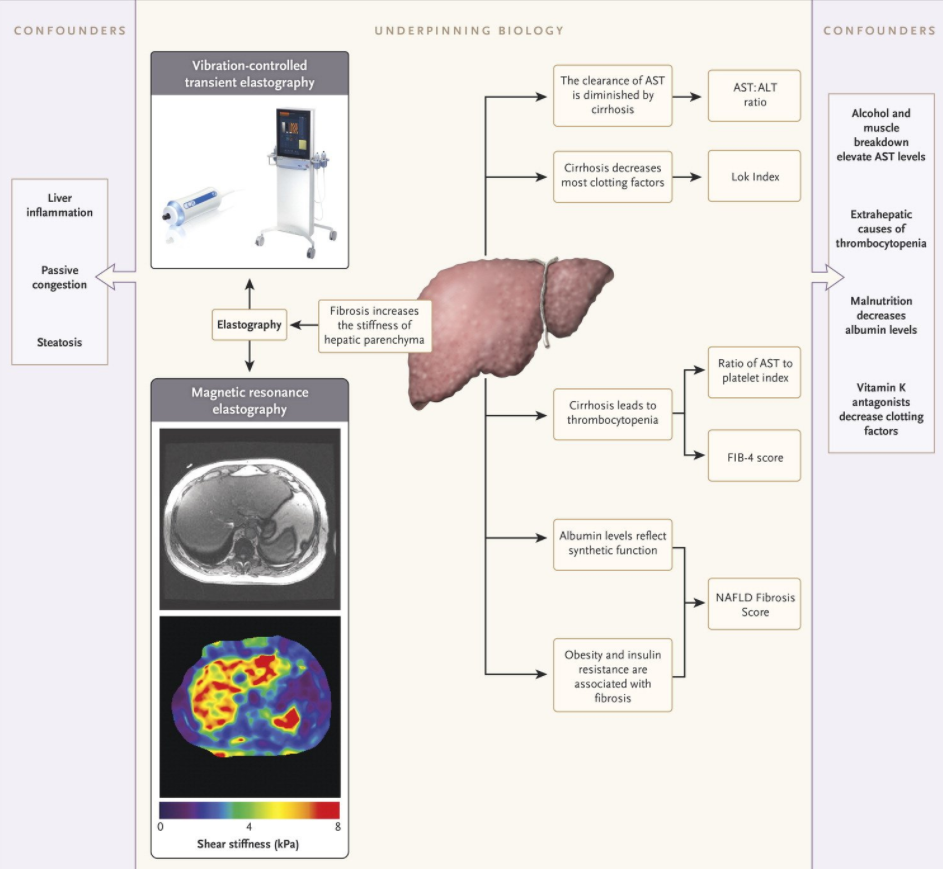
- The article details the formulas for biomarker measurements that predict the risk of fibrosis, inlcuding FIB-4, Lok Index, and NAFLD Fibrosis Score.
- In most liver diseases, aspartate aminotransferase levels “exceed alanine aminotransferase levels when cirrhosis develops.”
- Thrombocytopenia “is the earliest indicator of cirrhosis among routine blood tests…[due to] diminished liver function (throbopoietin underproduction) and portal hypertension (splenic sequestration).”
- Proprietary algorithms to assess fibrosis have variable sensitivity, specificity –include FibroTest (aka FibroSure [LabCorp]), FibroMeter, HepaScore (Quest), FIBROSpect, and the Enhanced Liver Fibrosis Score.
Imaging:
- Elastography with vibration-controlled transient elastography (VCTE) OR magnetic resonance elastography
- “Elastography offers excellent negative likelihood ratios for advanced fibrosis but much poorer positive likelihood ratios.”
- Patients with severe obesity are less likely to obtain adequate study with VCTE and could need magnetic resonance elastography to assess fibrosis.
My take: Noninvasive tests have already sharply reduced the need for liver biopsy.
Related posts:
- Defining the role for elastography
- Magnetic Resonance Elastography for Hepatic Fibrosis Assessment | gutsandgrowth
- Pediatric NAFLD Guidelines 2017 | gutsandgrowth
- Ultrasound Unreliable to Exclude Fatty Liver | gutsandgrowth
- Coming soon –Fibroscan? | gutsandgrowth
 gutsandgrowth