
M Agrawal et al. Gastroenterol 2023; 165: 976-985. Open Access! Early Ileocecal Resection for Crohn’s Disease Is Associated With Improved Long-term Outcomes Compared With Anti-Tumor Necrosis Factor Therapy: A Population-Based Cohort Study
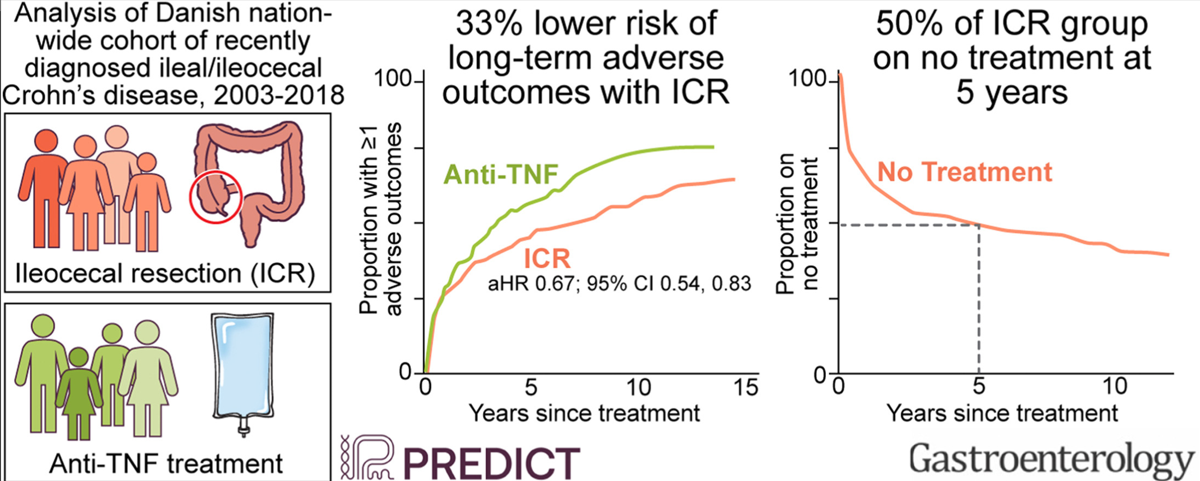
In this study from Denmark (2003-2018) using the Danish National Patient and Prescription Registries, the role of early ileocecal resection (CR), n=581, was compared with anti-TNF treatment, n=698. The primary outcome was a composite of ≥1 of the following: CD-related hospitalization, systemic corticosteroid exposure, CD-related surgery, and perianal CD. Only 178 patients (13.9%) were less than 17 years old. ICR cohort had surgery within 5 months of diagnosis in 85%, and in all within 1 yr of diagnosis. Key findings:
- The risk of the composite outcome was 33% lower with ICR compared with anti-TNF (adjusted hazard ratio, 0.67; 95% confidence interval, 0.54–0.83). ICR was associated with reduced risk of systemic corticosteroid exposure and CD-related surgery, but not other secondary outcomes
- Of individuals who underwent ICR, the Kaplan-Meier estimate of the proportion who postoperatively initiated IMM, initiated anti-TNF treatment, underwent another intestinal resection, or were on no treatment at 5 years of postoperative follow-up was 46.3%, 16.8%, 1.8% and 49.7%,
- Of those who were initiated on infliximab as primary therapy, the Kaplan-Meier estimate of the proportion who underwent ICR, switched to a different biologic agent, or continued infliximab at 5 years of follow-up was 17.7%, 40.8%, and 47.3%
The authors note that their cohort had infrequent complicated disease: “Before ICR, 21% were diagnosed with a stricture, ileus, internal fistula, or abscess, indicative of complicated CD and representative of the real world. In contrast, only 1.7% in the anti-TNF group had complicated CD.”
My take: This study suggests that ICR may be a reasonable option in many cases of Crohn’s disease at an earlier stage rather than reserved for only those with refractory disease and complications. However, in pediatric patients, I would be more reluctant to start with a surgical approach given even longer time frame in which further surgery could be needed.
Related blog posts:
 gutsandgrowth