
The pioneers of endoscopy are discussed in the following article:
AR Schulman, JD Howell. Clin Gastroenterol Hepatol 2024; 22: 684-688.Open Access! From Hirschowitz to 2023: Modern Endoscopy and Beyond
A few excerpts:
- “In 1868, the German physician Adolph Kussmaul looked inside the stomach of a human being. He chose to peruse the stomach of a professional sword-swallower, someone who was able to tolerate, although probably not to enjoy, a straight, 47-cm long metal tube with a diameter of 13 mm.1 This marked the beginning of the first era of endoscopy, the era of rigid endoscopy…encountered 2 fundamental problems. One, although a metal tube is straight, the gastrointestinal tract is not. And, two, the inside of the human body is dark.”
- “Rudolf Schindler, working in Munich, realized that the rigid gastroscope “never could be routinely used.”2 In 1932 he designed a semiflexible endoscope, an invention that marked the beginning of the second era of endoscopy…[after surviving Dachau concentration camp], he settled at the University of Chicago.3“
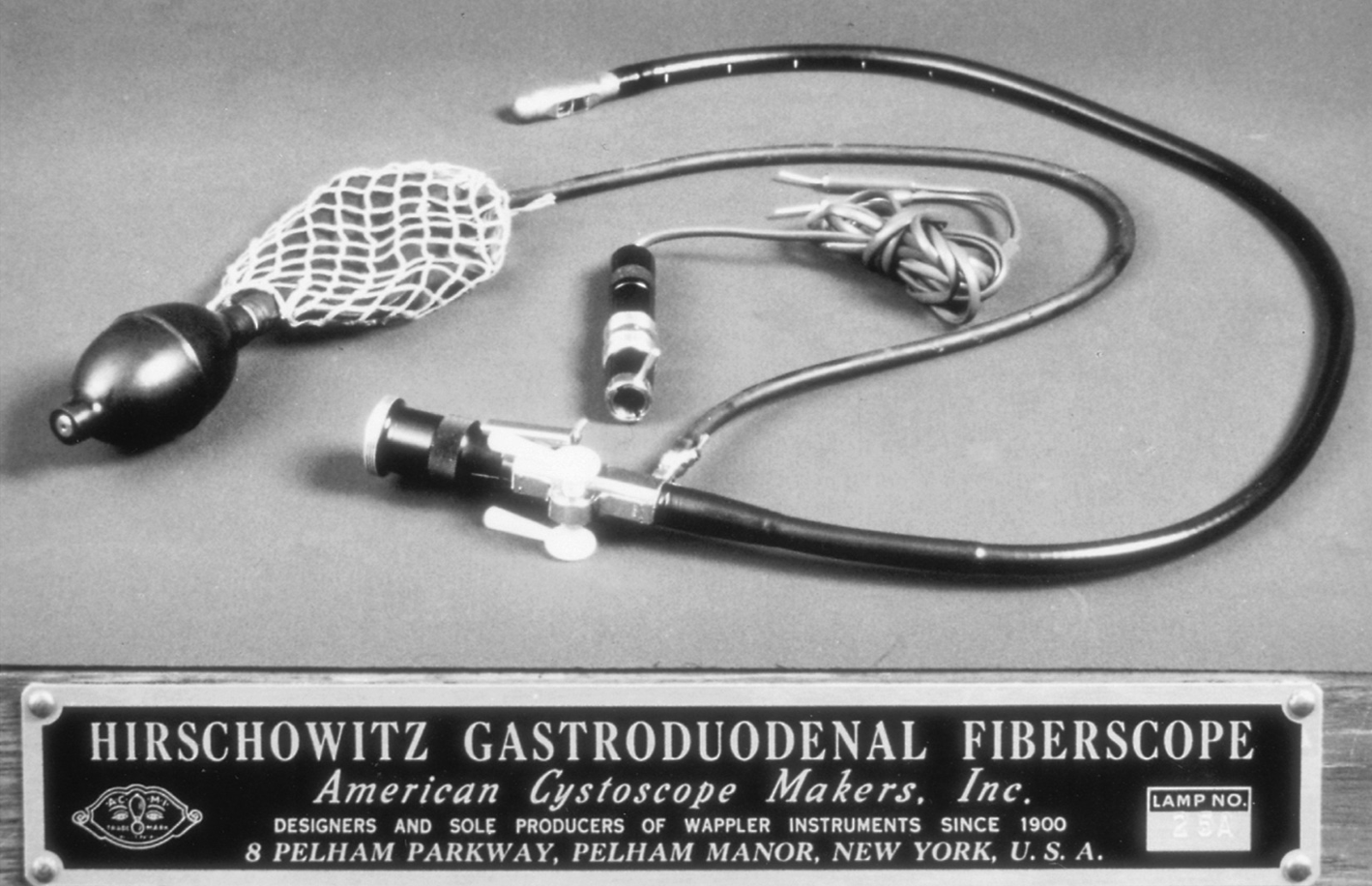
- “In 1954, [Basil] Hirschowitz learned that it might be possible to create a device that could transmit optical images along a flexible axis. Working with 2 colleagues from the University of Michigan Physics Department, which was located not far from the Medical School, he created a prototype device for looking into the stomach.”
Related blog posts:
- 538: Gut Science Week describes Alexis St Martin (in 1822) who had a persistent gastrocutaneous fistula which enabled his doctor William Beaumont to do more than 200 experiments over 8 years on digestion.
- NASPGHAN22: History of Pediatric GI & Selected Slides from the William F Balistreri Lecture (Part 1)
- NASPGHAN22: History of Pediatric GI & Selected Slides from the William F Balistreri Lecture (Part 2)
- NASPGHAN22: History of Pediatric GI & Selected Slides from the William F Balistreri Lecture (Part 3)
 gutsandgrowth