
A-K Wiklund, et al. Gastroenterol 2024; 167: 485-492. Risk of Esophageal Adenocarcinoma After Helicobacter pylori Eradication Treatment in a Population-Based Multinational Cohort Study
Background: Helicobacter pylori infection is associated with a decreased risk of esophageal adenocarcinoma, and the decreasing prevalence of such infection might contribute to the increasing incidence of this tumor. For this reason, the authors examined the hypothesis that eradication treatment of H pylori increases the risk of esophageal adenocarcinoma.
Methods: Using national registries with Nordic population adults (≥18 years, n=661,987) receiving H pylori eradication treatment from 1995–2018, the authors evaluated 5,495,552 person-years after eradication treatment.
Key findings:
- The standardized incidence ratios (SIR) did not increase over time after eradication treatment, but rather decreased and was 0.73 at 11–24 years after treatment
- The overall SIR of esophageal squamous cell carcinoma, calculated for comparison, showed no association (SIR = 0.99)
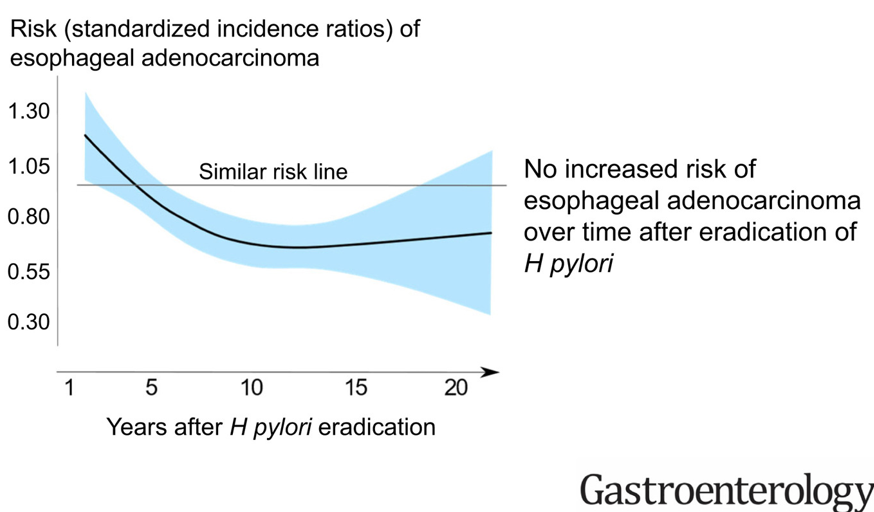
My take: Eradication of H pylori lowers the risk of gastric cancer. This study shows that treatment does NOT result in an unintended consequence of increasing esophageal cancer.
Related blog posts:
- Synergistic Dangers: Helicobacter Pylori and Cancer Genes
- Treating Helicobacter Pylori Lowers The Risk of Gastric Cancer
- Long Term Benefits of Helicobacter Eradication in U.S.
- Does Antireflux Surgery Prevent Esophageal Cancer in Patient’s with Barrett’s Esophagus? No
- Does Nonerosive Reflux Increase the Risk of Esophageal Cancer?
 gutsandgrowth