
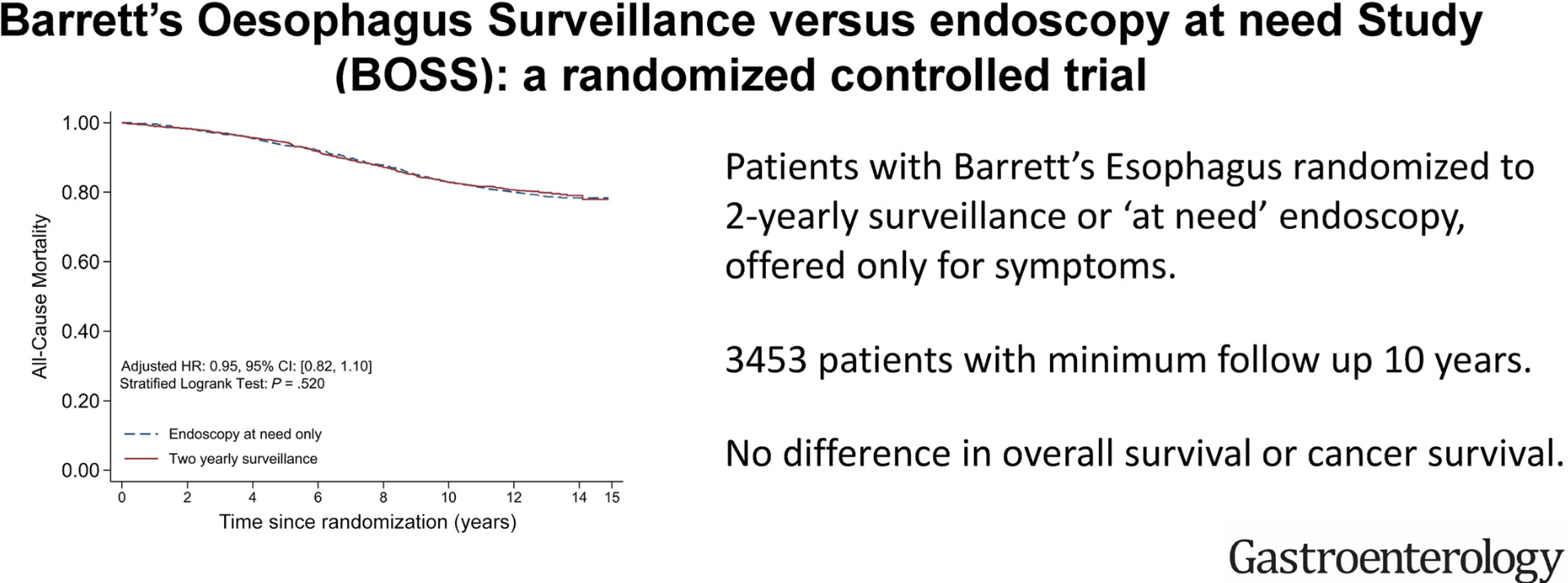
- O Old et al. Gastroenterol 2025; 169: 1233-1243. Open Access! Barrett’s Oesophagus Surveillance Versus Endoscopy at Need Study (BOSS): A Randomized Controlled Trial
- M Deidda, O Old et al. Gastroenterol 2025; 169: 1244-1252. Open Access! Cost- effectiveness of Regular Surveillance Versus Endoscopy at Need for Patients With Barrett’s Esophagus: Economic Evaluation Alongside the Barrett’s Oesophagus Surveillance Study (BOSS) Randomized Controlled Trial
Key finding: Compared with at need endoscopy, 2-yearly surveillance costs $115,563/QALY
gained.
Related editorial: SN Van Munster et al. Gastroenterol; 2025: 169: 1116 – 1118. Open Access! Endoscopic Surveillance for Nondysplastic Barrett’s Esophagus: Are We Violating “Primum Non Nocere”?
“Although guidelines have historically endorsed surveillance, this endorsement has rested on observational studies vulnerable to bias and confounding. The first RCT now available provides no evidence that routine surveillance improves survival or decreases cancer burden. These findings align with an expanding body of prospective cohort evidence suggesting that the annual progression rate from NDBE to EAC [Non-Dysplastic Barrett’s Esophagus to Esophageal Adenocarcinoma] is substantially lower than historically believed—approximately 0.3%–0.5% per year,8–10,13,14 as opposed to the 2.0%–4.0% per year estimated in the early 1990s.15–17“
The authors note that recent Dutch guidelines have been revised: “Routine surveillance is no longer recommended for low-risk Barrett’s patients—defined as those with segments with a maximal extent (Prague M) of <5 cm and no prior dysplasia.”
My take: While Barrett’s esophagus is a rare issue for pediatric gastroenterologists, it is worth noting that these recent studies cast doubt on the benefit of routine surveillance endoscopy in patients with nondysplastic Barrett’s esophagus.
Related blog posts:
- Does Antireflux Surgery Prevent Esophageal Cancer in Patient’s with Barrett’s Esophagus? No
- Esophageal Atresia and Barrett’s Esophagus
- Barrett’s Esophagus -New Review
- What GI Doctors Should Know About Anti-Reflux Surgery
Disclaimer: This blog, gutsandgrowth, assumes no responsibility for any use or operation of any method, product, instruction, concept or idea contained in the material herein or for any injury or damage to persons or property (whether products liability, negligence or otherwise) resulting from such use or operation. These blog posts are for educational purposes only. Specific dosing of medications (along with potential adverse effects) should be confirmed by prescribing physician. Because of rapid advances in the medical sciences, the gutsandgrowth blog cautions that independent verification should be made of diagnosis and drug dosages. The reader is solely responsible for the conduct of any suggested test or procedure. This content is not a substitute for medical advice, diagnosis or treatment provided by a qualified healthcare provider. Always seek the advice of your physician or other qualified health provider with any questions you may have regarding a condition.
 gutsandgrowth