
INNOCENT Study: Psychological Impact for Gastroenterologist Associated with Procedural Complications

Holzwanger, Erik A. et al. Gastroenterology 2025. Psychosocial Impact of Endoscopic Procedural Complications on Gastroenterologists: The Second Victims

Background: “Serious adverse events (SAEs) are unavoidable occurrences for those performing complex endoscopic interventions. These affect not only the patient (the first victim), but also possibly the proceduralist (the second victim). Second victim syndrome (SVS) was first described by Dr. Wu detailing the negative psychological effects of adverse patient events on physicians (Ref: Wu AW. Medical error: the second victim. BMJ. 2000;320(7237):726-727).”

Methods: Survey responses form “X” platform (n=195) were collected in 2023. Only
responses from advanced endoscopists (defined as those who perform either endoscopic
ultrasound or endoscopic retrograde cholangiopancreatography annually) and advanced
endoscopy fellows were included.

Key findings:

  • Higher procedural volume (>1000/year) was associated with feelings of greater emotional preparedness for SAEs
  • Speaking with colleagues (53%), exercise (33%), discussions at conferences (17%) and meditation (8%) were rated as used and very or extremely helpful
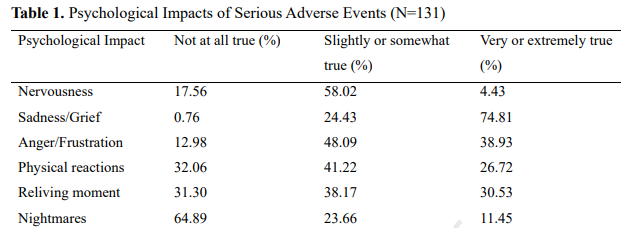
Discussion Points: “Peer support programs have proven to be well received and highly utilized. Additionally, surgeons criticize the often-punitive handling of SAEs, and note that the tone and culture in the review process following an SAE dictates reduction or exacerbation of SVS.”

My take: When I have had a complication in a patient, speaking with colleagues has provided a lot of support. One book I have recommended to others is the following: Complications: A Surgeon’s Notes on an Imperfect Science by Atul Gawande.

Related article (2022): “We Suffer in Silence” The Challenge of Surgeons as Second Victims

Related blog posts:

Something Bad is Going to Happen

A recent commentary (Sonnenberg A, Clin Gastroenterol Hepatol 2015; 13: 820-23) discusses the statistical inevitability of adverse events.  As such, despite our efforts to provide the best care, we should consider how we look at bad outcomes. This article highlights a few common issues in adult gastroenterology, failing to identify colorectal cancer and adverse events at the time of endoscopy.  Using statistical models, the author notes that avoiding all adverse events is nearly impossible.

The broader points for pediatric gastroenterologists/all physicians:

  • Using simple statistics, “adverse events can be expected to occur with a high probability.  Their occurrence is a function of the number of patient encounters and the probability of making mistakes.”
  • “It is a statistical misconception to believe that their rare occurrence would make it possible for an individual gastroenterologist to dodge the bullet.”
  • “It is another statistical misconception to assume that by exerting extreme caution a gastroenterologist also could avert adverse events. The only means to truly reduce adverse events is to avoid patient encounters.”
  • “The physician rarely is given credit for innumerous other patient encounters with good outcomes.  The bad outcome is considered potentially reflective of professional failure or flawed performance. The process ultimately is geared toward showing avoidable mistakes and assigning guilt.  The occurrence of an error, even at its lowest rate, generally is not accepted as a viable reason, although under different circumstances the same reviewers would be willing to accept the less-than-perfect sensitivity or specificity of all diagnostic tests.”
  • “We have to …free ourselves from the illusion that perfection will become achievable through limitless quality assurance.”
  • “Highlighting the statistical nature of adverse events is not meant to belittle the need for continued efforts at improving patient safety and increasing the quality of health care delivery…In a ‘just culture’ of safety and accountability, the occurrence of any error would become an opportunity for learning and improvement rather than retribution or punishment.”

As a personal aside, I took some solace in reading this article and previously in reading the book “Complications: A Surgeon’s Notes on an Imperfect Science” (Complications | Atul Gawande). I clearly remember a few terrible situations that from time to time still fill me with sadness and regret.  I feel better knowing that the mistakes that I have made were not due to a lack of effort or due to a lack of caring.

Take-home message: If you practice medicine, something bad is going to happen. Can we forgive ourselves if our judgement contributed to an adverse event?

Zoo Atlanta

Zoo Atlanta