More Than 100 Leading Scientists: “Stop Bashing GMO Foods”

“Scientific and regulatory agencies around the world have repeatedly and consistently found crops and foods improved through biotechnology to be as safe as, if not safer than those derived from any other method of production,” the group of laureates wrote. “There has never been a single confirmed case of a negative health outcome for humans or animals from their consumption. Their environmental impacts have been shown repeatedly to be less damaging to the environment, and a boon to global biodiversity.”

Here’s the link: NY Times Stop Bashing GMO Foods

Related posts:

Sullivan's Island, SC

Sullivan’s Island, SC

Expert Review: GMOs are safe

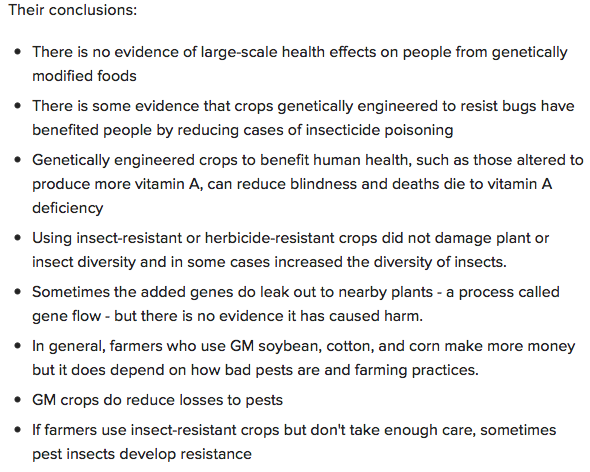
Here’s a link to NBC report on National Academies of Science review of Genetically Modified & Genetically Engineered crops: Genetically Modified Crops Are Safe

Here’s an excerpt:

Screen Shot 2016-05-18 at 9.39.35 PM

Here’s a website with full report and data:

National Academies of Science Genetically Engineered Crop Website

Related blog post: War on Science and Genetically-Modified Food | gutsandgrowth

Report also covered by USATODAY:

Screen Shot 2016-05-18 at 9.44.10 PM

Why GMO labels are a bad idea

I was pleased to see the March 11 USAToday editorial: Our view: GMO Labels Feed Unwarranted Fears

Excerpt:

“Mandatory labeling …on balance it’s a bad idea. A key reason is that it validates the notion that genetically modified organisms (GMOs) are dangerous, which is simply not true.  Using science to make crops more resistance to drought or insects builds on the ancient practice of selectively breeding plants…Doing this in a lab at the genetic level makes it faster, more precise, and more effective.  But…harder for nonscientists to grasp…the European Union found that GMOs ‘are not per se more risky than…conventional plant breeding.’…75% to 80% of foods contain them.”

“The risk from mandatory labeling is the same as any action that ignores science and plays to unfounded fear.”

Related blog posts:

Walnut Street Bridge

Walnut Street Bridge

War on Science and Genetically-Modified Food

In the battlefield of ideas, science is losing badly.  The problem with science is that many concepts are complex and sometimes difficult to communicate.  For anyone interested in the science of food, and not the hysteria, a great lecture on this topic was presented by Ronald Kleinman, MD:  Biotechnology, Nutrition, and Agriculture: A Perspective and Implications for Child Health

Group Shot

Stanley Cohen, Jeff Lewis, Evelyn Johnson (Georgia AAP President), Ronald Kleinman, and Jay Hochman at the Georgia AAP Nutrition Symposium.

I had the opportunity to participate and moderate a nutrition symposium at the Georgia American Academy of Pediatrics (AAP) pediatric meeting. This symposium was sponsored by Nutrition4Kids and funded by an educational grant from Nutricia.  The first lecture was given by Dr. Kleinman. He is Chief of the Department of Pediatrics at Massachusetts General Hospital and Physician-in-Chief at MassGeneral Hospital for Children (MGHfC) and Partners Pediatrics.  This was a fabulous talk and will be available at the Nutrition4Kids website.  This blog post is a summary of the talk.  Over the next few days, a couple of these ideas will be discussed further. Key points:

  1. Genetically Modified Foods/Genetically modified organisms (GMO). These foods are safer and better than foods that are not genetically modified.
  2. Roundup is not dangerous for humans.  With biotechnology, we can kill weeds without killing plants. Thus no till farming is needed. Current herbicides are much safer than prior agents. Humans, unlike plants, do not have the enzyme that roundup targets –so it is safe. Roundup is water-soluble; it is not stored in fat. There is a 30 yr hx/o safe use.  There is no data indicating cancer risk in humans or fertility risk. In the past, testing breastmilk for roundup used a flawed methodology. F/u study by McGuire M (sponsored by US govt) showed no roundup in breastmilk.
  3. GMOs are part of a larger “War on Science.” As with vaccinations, there is a great deal of misleading and exaggerated information.
  4. Genetic engineering has not only improved our food supply but has been essential in innovations like vaccines and insulin.
  5. Biotechnology is ubiquitous. It’s not just crops, but cheese, wine, etc. Biotechnology has led 16,000 fewer children dying each day compared to 1990; this is largely due to biotechnology. Improved food security and less malnutrition results in fewer secondary complications (eg pneumonia, diarrhea).
  6. Genetic change in foods is as old as agriculture. Lots of vegetables/crops were not found in nature, including corn and wheat. Cross-breeding allowed development of modern corn and wheat.
  7. Why is it false to talk about genetic modification as a special category? It’s all DNA which is undergoing constant change. Traditional breeding allows selection of random multiple genes and then selecting plant we like. Biotechnology is more precise and safer (eg. only the gene for sweetness for corn is transferred, so can be more safe).
  8. 240 Agencies have confirmed that biotechnology is safe because of the testing that shows these agents are at least as safe as ‘natural’ products. 2500 studies of GMO products from across the globe (not just Monsanto!) have proven the safety of these products.
  9. Most of GMO-farming occurs with small farmers (90% in developing world) who are not rich; these products result in income gains of greater than 30%.
  10. Why is there such widespread adoption of GMO products by farmers? They are better: insect resistance, herbicide resistance, viral resistance, and drought/salt resistance
  11. Other examples of beneficial biotechnology: a) BT Corn — safer, less liver cancer, less birth defects (eg. myelomeningocele) b) Golden Rice –can solve iron & vitamin A deficiency.  Vitamin A deficiency contributes >1 million deaths/yr due to increased susceptibility to infections. Golden Rice in normal quantities provides RDA of Vit A. This is a lot more effective and less expensive than a supplement. These products are not commercially available even though nonprofits willing to give seeds for free –due to hysteria, politics. Greenpeace has actually burned Golden Rice rice fields.
  12. Drought-resistant crops are becoming increasingly important. Meeting global food production will require more ‘crop per drop’ due to increasing population and less lands available for farming. Not just 3rd World –look at California. There are low crop yields in areas without biotech (Subsaharan Africa) and higher mortality.

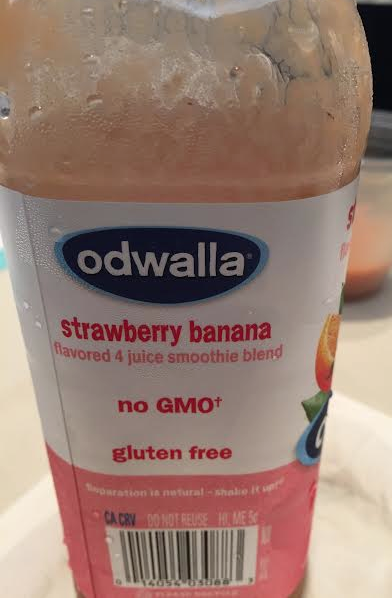
Unfortunately, shortly after hearing this lecture explain in great detail why GMO-containing products should be praised and not shunned, I picked up a drink.  Here’s the label: GMO free drink

Bottomline: The science is sound.  Biotechnology and GMOs/genetically modified foods are making are food better, safer and reducing mortality. If only we could communicate this fact effectively.

Related blog posts:

When “All-Natural” Really Isn’t

A recent tweet from David Kessler provided this link, fooddive.com/news/the-case-, regarding all-natural products and recent spate of lawsuits:

Here’s an excerpt from “The case against ‘all-natural’:

But how “natural” is the “natural” label? It might be a bit more misleading than you think. The U.S. Food and Drug Administration admits it doesn’t even have a hard-and-fast definition on what the term means. The agency also doesn’t object to a product being labeled as such, so long as “the food does not contain added color, artificial flavors, or synthetic substances.”

However, some consumers just aren’t buying that “all-natural” claim, and there have already been many notable court cases to prove it. Here’s a roundup of five recent lawsuits forcing food producers to cough up cash and remove labels after products didn’t live up to their farm-to-store promise.

Five recent lawsuits -highlighted in article

  • Kashi
  • Nature Valley
  • PopChips
  • Naked Juice
  • Tropicana Orange Juice

In a related post, ClarkHoward.com discusses how labels are misleading:

Here’s the link: 5 Label Tricks

“Food labels like “organic,” “free range,” “all natural,” and “multigrain” don’t necessarily mean what you think.”  He provides specific advice to avoid buying a misleading product.