“Rude Surgeons May Have Worse Outcomes”

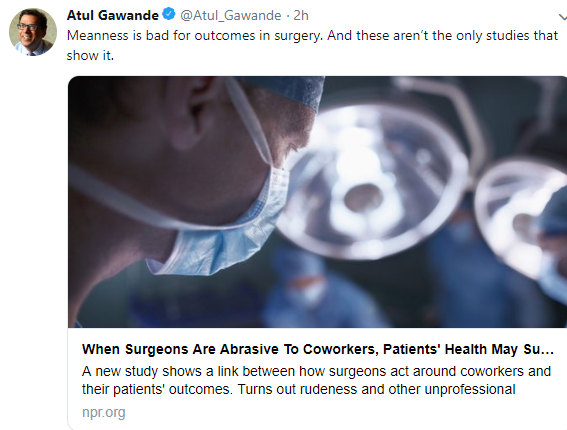
NPR: When Surgeons Are Abrasive To Co-Workers, Patients’ Health May Suffer

An excerpt:
A study published Wednesday in JAMA Surgery challenges these ideas. The study, which looked at interactions between surgeons and their teams, found that patients of surgeons who behaved unprofessionally around their colleagues tended to have more complications after surgery. Surgeons who model unprofessional behavior can undermine the performance of their teams, the authors write, potentially threatening patients’ safety.

For the study, researchers gathered data on nearly 13,700 patients and 202 surgeons from the National Surgical Quality Improvement Program, a system designed to track and improve surgical care…

The researchers found that when surgeons had one or more reports of unprofessional behavior over the previous 36 months, their patients were 12% to 14% more likely to experience complications in a 30-day period following surgery. These complications included infections, pneumonia, stroke and kidney failure.

Full text article: Association of Coworker Reports About Unprofessional Behavior by Surgeons With Surgical Complications in Their Patients WO Cooper et al. JAMA Surg. Published online June 19, 2019. doi:10.1001/jamasurg.2019.1738

My take: It is interesting to speculate about why rude behavior may affect long-term outcomes.  My suspicion would be that team members would be more hesitant to offer advice or to call quickly if concerns arose.  Alternatively, it could be that if someone is not considerate enough to work well with their colleagues/other health professionals that they could be less attentive in their care.

Related blog post: How Rudeness Affects Performance in Medicine (and probably elsewhere)
How Rudeness Affects Performance in Medicine (and probably elsewhere)

From A Riskin et al. Pediatrics Jan 2017 (Thanks to Seth Marcus for pointing out this study), Link: Rudeness and Medical Team Performance

Abstract

OBJECTIVES: Rudeness is routinely experienced by medical teams. We sought to explore the impact of rudeness on medical teams’ performance and test interventions that might mitigate its negative consequences.

METHODS: Thirty-nine NICU teams participated in a training workshop including simulations of acute care of term and preterm newborns. In each workshop, 2 teams were randomly assigned to either an exposure to rudeness (in which the comments of the patient’s mother included rude statements completely unrelated to the teams’ performance) or control (neutral comments) condition, and 2 additional teams were assigned to rudeness with either a preventative (cognitive bias modification [CBM]) or therapeutic (narrative) intervention. Simulation sessions were evaluated by 2 independent judges, blind to team exposure, who used structured questionnaires to assess team performance.

RESULTS: Rudeness had adverse consequences not only on diagnostic and intervention parameters (mean therapeutic score 3.81 ± 0.36 vs 4.31 ± 0.35 in controls, P < .01), but also on team processes (such as information and workload sharing, helping and communication) central to patient care (mean teamwork score 4.04 ± 0.34 vs 4.43 ± 0.37, P < .05). CBM mitigated most of these adverse effects of rudeness, but the postexposure narrative intervention had no significant effect.

CONCLUSIONS: Rudeness has robust, deleterious effects on the performance of medical teams. Moreover, exposure to rudeness debilitated the very collaborative mechanisms recognized as essential for patient care and safety. Interventions focusing on teaching medical professionals to implicitly avoid cognitive distraction such as CBM may offer a means to mitigate the adverse consequences of behaviors that, unfortunately, cannot be prevented.

This same group had a related study in 2015:The Impact of Rudeness on Medical Team Performance: A Randomized Trial

My take:The saying “you catch more flies with honey than you do with vinegar” is probably accurate.

Costa Maya, Mexico

Costa Maya, Mexico