
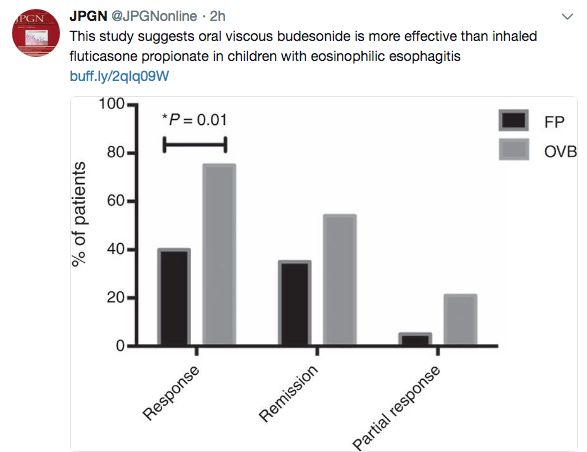
A recent retrospective study (JM Fable et al. JPGN 2018; 66: 26-32) found that patients with eosinophilic esophagitis (EoE) who were treated with oral viscous budesonide (OVB) had more favorable outcomes than those treated with fluticasone propionate (FP). This single center study included 68 pediatric patients (mean age 10.6 years) with 20 receiving FP and 48 OVB.
Dosing in study:
- FP 110 mcg/actuation 2 puffs twice a day if 1-10 years, and 220 mcg/actuation 2 puffs twice a day if >10 years
- OVB: 0.5 mg twice a day if 1-10 years, and 1 mg twice a day if >10 years
- The authors noted that Duocal (which contains cornstarch and coconut oil) was a suitable alternative to Splenda. They note that Neocate Nutra is effective too (limited by cost/coverage) as is pasteurized honey and maple syrup.
Key findings:
- Histologic response (<15 eos/hpf) was noted in 75% (36/48) of OVB group and 40% (8/20) of FP group
- Mean post-treatment peak eos/hpf was 12 ± 16 in OVB group and 20 ± 29 in the FP group (P=0.002)
- Histologic remission (<5 eos/hpf) was noted in 54% OVB group and 35% FP group
- In OVB-treated patients, those without asthma were more likely to achieve a histologic response (P=0.031)
Since this is a retrospective study, there are several potential limitations, including possible selection bias. In addition, higher doses of topical agents have been shown to have higher response rates.
My take: Budesonide is probably better than fluticasone for EoE and its high first-pass metabolism indicates that it is probably safer as well.
Related blog posts:
- A Better Budesonide for Eosinophilic Esophagitis
- A Better Budesonide for Eosinophilic Esophagitis (Part 2) | gutsandgrowth
- Dilatation for Eosinophilic Esophagitis -Pediatric Data | gutsandgrowth
- Adrenal Insufficiency due to Fluticasone in … – gutsandgrowth
- Higher Doses of Topical Steroids for Eosinophilic … – gutsandgrowth
- Do We Still Need PPI-REE? | gutsandgrowth
- Eosinophilic Esophagitis Slide Set | gutsandgrowth
- Eosinophilic Esophagitis Review -NEJM | gutsandgrowth
- How Common is Eosinophilic Esophagitis? | gutsandgrowth
- Nexium versus Fluticasone for EoE | gutsandgrowth
- Predicting Response to Topical Steroids in Eosinophilic Esophagitis …
- Putting in Place a Big Piece of the Eosinophilic Esophagitis Puzzle …
- Sweet Alternative to Splenda for Budesonide | gutsandgrowth
 gutsandgrowth
1. Proper technique with fluticasone inhaler is very important. In light of retrospective study, unlikely that was accounted for.
–side note: Denver Children’s/Glen Furuta, made a really nice video on proper technique (https://youtu.be/0x7IXhgTsb0)
2. Apologies for not reading entire article, but not sure your comment on bio-availability is correct. I’ve seen data on fluticasone being <1% and budesonide being 10-15%.
–Aliment Pharmacol Ther 1998, 12: 591-603
–J Allergy Clin Immunol, 1998, Vol. 101, Number 4, Part 2: S440-S446