
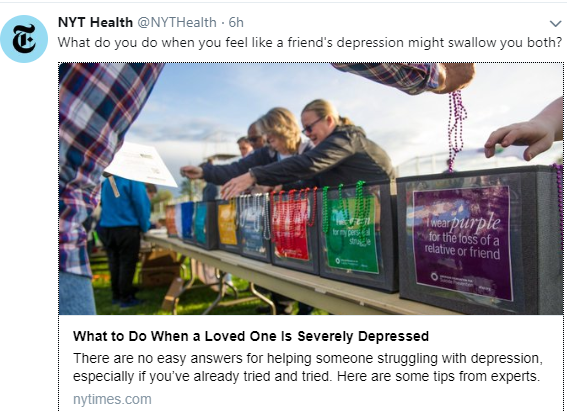
In light of the troubling news of recent suicides, I wanted to reference a recent NY Times article which provides useful guidance on What to Do When a Loved One is Severely Depressed
Here are the key points/excerpts:
- Don’t underestimate the power of showing up
- Don’t try to cheer him up or offer advice
“Your job as a support person is not to cheer people up. It’s to acknowledge that it sucks right now, and their pain exists,” she said…
Instead of upbeat rebuttals about why it’s not so bad, she recommended trying something like, “It sounds like life is really overwhelming for you right now.”
- It’s O.K. to ask if she is having suicidal thoughts
- Take any mention of death seriously
If this person is seeing a psychiatrist or therapist, get him or her on the phone…
If that’s not an option, have the person you’re worried about call a suicide prevention line, such as a 1-800-273-TALK, or take her to the hospital emergency room; say aloud that this is what one does when a loved one’s life is in danger.
- Make getting to that first appointment as easy as possible
You alone cannot fix this problem, no matter how patient and loving you are. A severely depressed friend needs professional assistance from a psychologist, psychiatrist, social worker or another medical professional.
- Take care of yourself and set boundaries
Still, just because someone is depressed is not a reason to let their abusive behavior slide. Set clear boundaries with straightforward language such as, “It sounds like you’re in a lot of pain right now. But you can’t call me names.”..
It’s O.K. not to be available 24-7, but try to be explicit about when you can and cannot help. One way to do this, Ms. Devine advised, is to say: “I know you’ve been really struggling a lot, and I really want to be here for you. There are times that I physically can’t do that.”
- Remember, people do recover from depression
Disclaimer: These blog posts are for educational purposes only. Specific dosing of medications/diets (along with potential adverse effects) should be confirmed by prescribing physician/nutritionist. This content is not a substitute for medical advice, diagnosis or treatment provided by a qualified healthcare provider. Always seek the advice of your physician or other qualified health provider with any questions you may have regarding a condition.
Also, it is worth noting that the suicide rate has been increasing.

 gutsandgrowth
Pingback: Depression Screening for Pediatric Patients with IBD | gutsandgrowth
Pingback: “We Have Ruined Childhood” and Possible Link to Depression, Anxiety and Suicide | gutsandgrowth
Pingback: Integrating Mental Health into Pediatric IBD Care | gutsandgrowth
Pingback: IBD Depression Screening | gutsandgrowth
Pingback: Working Together to Improve Outcomes for Children with Inflammatory Bowel Disease | gutsandgrowth
Pingback: “Implementing psychological therapies for gastrointestinal disorders in pediatrics” | gutsandgrowth
Pingback: Alterations in Microbes and Impaired Psychological Function in Patients with Inflammatory Bowel Disease | gutsandgrowth