
HB Kersten, PS Goday et al. PEDIATRICS Volume 157, Issue 4, April 2026:e2025075764. Open Access! PDF: Clinical Practice Guideline for Diagnosis and Management of Faltering Weight
The AAP in partnership with the North American Society for Pediatric Gastroenterology, Hepatology and Nutrition (NASPGHAN) has published its first clinical practice guideline on diagnosis and management of “faltering weight,” a condition formerly described as “failure to thrive” that affects 5%-10% of young pediatric patients in the primary care setting.
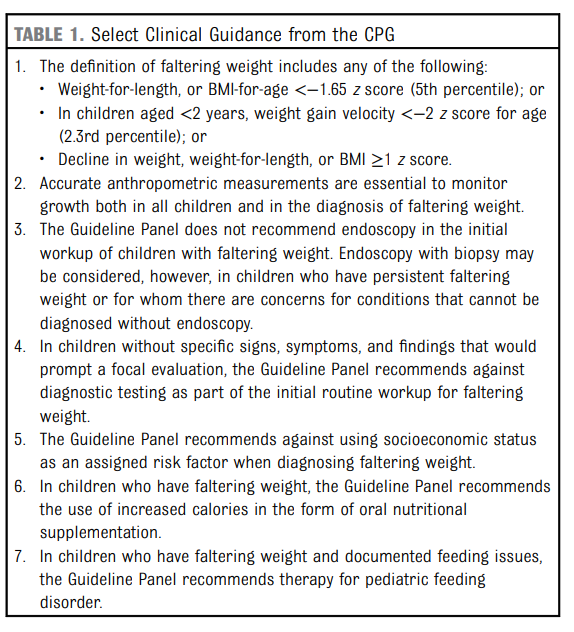
- The clinical practice guideline (CPG) explains that the prior term, failure to thrive (FTT), has never been well-defined. In addition, “the term FTT has also been fraught with controversy that has contributed to the difficulty in determining the criteria used to define it. The word “failure” has led caregivers to feel blamed for their child’s condition. The term has also
been inconsistently applied, which may exacerbate existing health care inequities.” - “When evaluating a child who has been hospitalized for faltering weight, consider the 5 most-common co-occurring conditions…congenital heart disease, gastroesophageal reflux disease (GERD), swallow dysfunction, neurologic disease, genetic abnormalities/congenital syndrome.”
- “When evaluating a child in the outpatient setting for faltering weight, consider the 5 most-common co-occurring conditions….gastrointestinal disease, pulmonary disease, food allergy, genetic abnormalities/congenital syndrome, neurologic disease.”
My take: Overall, this is a useful guideline. A couple comments:
- For several decades I have avoided the term ‘failure to thrive’ (for the reasons given in the CPG) and typically have used terms like poor weight gain or growth failure.
- Most pediatric patients with faltering weight need to ingest more calories and do not need extensive testing. I agree that endoscopy should not be part of the routine workup for faltering weight in the absence of other indications
- “Gastroesophageal reflux disease” is often attributed as a reason for faltering weight as well as choking. However, isolated reflux is unlikely to cause these presentations in the absence of other factors (e.g. pyloric stenosis, malrotation, swallow dysfunction)
Additional Links:
Clinical Practice Guideline
Technical Reports
- “The Benefits and Harms of Endoscopy and Other Diagnostic Tests to Detect Underlying Conditions in Children With Faltering Weight”
- “The Impact of Socioeconomic Status and Different Treatment Modalities on Children With Faltering Weight”
AAP News coverage
- New clinical practice guideline defines ‘faltering weight,’ recommends treatment options
- GRADE framework helps evaluate quality of evidence to develop recommendations
- New faltering weight guidance impacts coding, reporting, documentation
Information for Families from HealthyChildren.org
- Faltering Weight in Children: Parent FAQs, in English and Spanish
- Understanding Growth Charts: A Parent’s Guide to Percentiles & Z-Scores, in English and Spanish
Further reading
- Implementation toolkit: CPG for Diagnosis and Management of Faltering Weight
- News release: AAP Issues Clinical Practice Guideline for Diagnosis and Management of Faltering Weight
Related blog posts:
- Ten-Year Trends in Pediatric Pharmacology for Gastroesophageal Reflux and Pediatric Feeding Disorders
- NEJM: Pharmacologic Treatment of Reflux in Infants?
- Arching in Infants Not Due to Reflux
- How Likely is Reflux in Infants with “Reflux-like” Behaviors?
- Which Symptom is Best for Indicating Reflux in Infants?
- Is Reflux Really a Disease in Premature Infants?
- Incredible Review of GERD, BRUE, Aspiration, and Gastroparesis
- Acid Suppression for Laryngomalacia -Handed This Article to My ENT Colleagues
- How Many Kids with Reflux have Reflux?
- Better to do a coin toss than an ENT exam to determine reflux
- Treating reflux does not help asthma | gutsandgrowth
- No Effect of Proton Pump Inhibitors and Irritability on … – gutsandgrowth
- Gastroesophageal Reflux: I know it when I see it | gutsandgrowth
- 2018 Pediatric Gastroesophageal Reflux Clinical Practice Guidelines
- Blaming Reflux for BRUEs -Not Changing Despite Guideline Recommendations
 gutsandgrowth