
BA Barsky et al. N Engl J Med 2026;395:419-421. Medical Standards by Federal Fiat
An excerpt:
“Historically, the federal–state division of authority over medical practice has been strict. This division is evident in health care financing and medical product regulation, for example. States license physicians and set standards for medical care, often incorporating standards established by the medical profession while allowing broad discretion for physician judgment.1…
The Trump administration has attempted to alter the balance of federal–state authority in the area of gender-affirming care in two important ways. First, in June 2025, the U.S. Department of Justice (DOJ) issued administrative subpoenas to more than 20 health systems and clinics providing gender-affirming care, demanding unusually broad information related to off-label prescribing of puberty blockers and hormones…The DOJ’s subpoenas, however, demanded information at the heart of physician judgment and the patient–doctor relationship, including physicians’ case-specific clinical assessments justifying off-label prescriptions and information that could be used to identify patients, including children, by name…
The second federal disruption came in December 2025, when Secretary of Health and Human Services Robert F. Kennedy, Jr., issued a declaration stating that gender-affirming care for children and adolescents is unsafe and does not meet professionally recognized standards of care…
Much of the authority and discretion now held by medical professionals and the states would move upward to a federal government that would exert expanded control over the health care that patients receive. Such a shift would potentially force all states to accept a single federal standard of care in various areas of medicine while concentrating immense medical power in the hands of political appointees. Federal authority over health care standards is appropriate in some instances. But this authority should be established using a proper legal process — Congress acting within its enumerated constitutional powers, or the executive branch acting under properly delegated authority — not by fiat.”
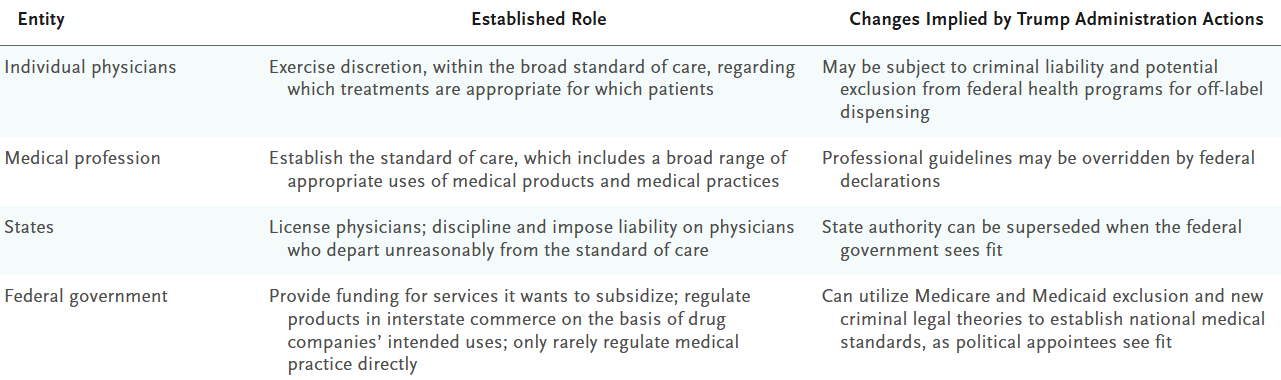
and Changes Implied by Trump Administration Actions.
My take: While this issue primarily affects a narrow area currently, it is not difficult to imagine that other administratioins could similarly impose policies affecting other sensitive decisions like abortion (expanding or limiting options), contraceptive availability, discussions about guns, and viability decisions.

