
KH Denton et al. J Pediatr: Clin Pract 2026;22:200239. Pediatric Water Bead Ingestion: Experience from a Quaternary Care Children’s Hospital and a Proposed Management Algorithm
Methods: This retrospective chart review identified 36 pediatric patients (median age 2 yrs) who presented to a quaternary care children’s emergency department for water bead ingestion from 2015 to 2024.
Key findings:
- The majority (n = 28, 78%) were asymptomatic.
- Only 4 of 52 (8%) imaging studies were abnormal.
- Endoscopy was performed in 6 (17%) patient encounters, none of which
successfully retrieved water beads. - There were no patients with bowel obstructions or complications.
Discussion:
- The results are “similar to a prior case series from 2011 to 2016, which examined 110 patients aged 19 years or younger who had called the Texas Poison Control Center for water bead ingestion. The study found that many were managed at home, without any known complications.”
- “However, there are reports of morbidity and mortality associated with water bead ingestions. A literature review published in 2022 described 43 cases of bowel obstruction
and 2 deaths following the ingestion of water beads.” - “Current NASPGHAN guidelines recommend early endoscopy in cases involving high-risk or potentially obstructive foreign bodies, with emphasis on emergent endoscopy in the case of superabsorbent objects such as water beads…Upon reviewing our data and the current
literature, we propose a new algorithm for managing pediatric patients presenting with water bead ingestion.“

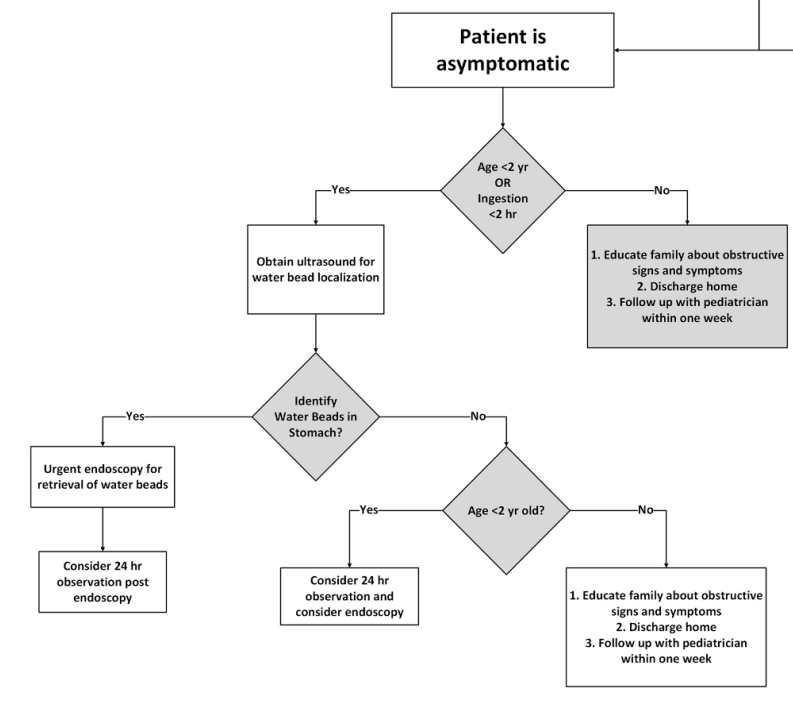
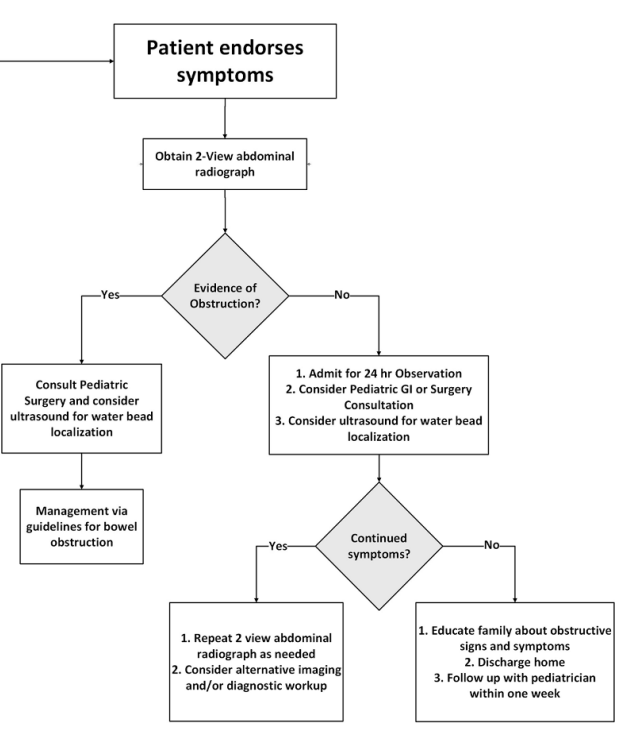
My take: This article offers a practical approach to manage water bead ingestion and includes appropriate caution and caveats.
The recent ESPGHAN 2026 Position Paper (O Ledder et al. J Pediatr Gastroenterol Nutr. 2026;83:539–554) has not incorporated this suggested algorithm and is similar to previous NASPGHAN recommendations. See blog post on 9/28/26: “In cases of witnessed or suspected ingestion of SAP [superabsorbent polymers], emergency endoscopy should be performed to attempt retrieval of the material. If this is unsuccessful, or not completely retrieved, the child should be admitted for close observation with surgical support.”
Related blog posts:
- Water Beads in the News and in JPGN
- Weird Xray and Successful Treatment for Water Bead Ingestion
- Orbeez Ball Obstruction
- Foreign Bodies in Children -Expert Guidance
Disclaimer: This blog, gutsandgrowth, assumes no responsibility for any use or operation of any method, product, instruction, concept or idea contained in the material herein or for any injury or damage to persons or property (whether products liability, negligence or otherwise) resulting from such use or operation. These blog posts are for educational purposes only. Specific dosing of medications (along with potential adverse effects) should be confirmed by prescribing physician. Because of rapid advances in the medical sciences, the gutsandgrowth blog cautions that independent verification should be made of diagnosis and drug dosages. The reader is solely responsible for the conduct of any suggested test or procedure. This content is not a substitute for medical advice, diagnosis or treatment provided by a qualified healthcare provider. Always seek the advice of your physician or other qualified health provider with any questions you may have regarding a condition.

