Operating Room Privacy: What Patients May Record and Hear

J Goldstein, NY Times, 12/1/25: The Transgender Cancer Patient and What She Heard on Tape

This article focuses on the experience of a transgender patient who recorded unfavorable remarks while under anesthesia.

An excerpt:

On the recording, the health care workers express a variety of opinions about transgender identity more generally….And in the middle of the conversation, one person suggests updating Ms. Capasso’s medical file. “Yeah, it needs to say ‘male,’” the person says.Ms. Capasso said it appeared that hospital staff had in fact changed her electronic medical records, all while she was unconscious…

Ms. Capasso insists that she was not trying to catch the medical staff speaking disrespectfully about her. She said she was motivated by curiosity and a desire to know exactly what the surgeons discovered. It may not be such an unusual impulse.

Dr. Alexander Langerman, a surgeon at Vanderbilt University Medical Center, led a medical conference in 2021 on surgical recordings.

There is often “a really strong desire by patients to know what happened to them in the operating room,” Dr. Langerman said. “And, I think, a valid right to know what happened.”

Surgery was once a relatively public event — operating rooms were called “theaters” for a reason. But infection control and malpractice litigation pulled the operating room out of public view.

“Operating rooms and surgery have become one of the most secretive environments in modern society,” said Dr. Teodor Grantcharov, a Stanford University professor who started a company that uses operating room recordings to improve patient safety and hospital efficiency.

My take: While a patient is under anesthesia, it is best to treat them in the same manner as if they were awake.

“The true test of a man’s character is what he does when no one is watching.”

― John Wooden

Sandy Springs, GA

Providing Care and Upholding the Law in an Evolving Immigration Landscape

H Kaplan et al. NEJM 2025; 392: 21: 2084-2086. Health Care in an Evolving Immigration Landscape — Providing Care while Upholding the Law

An excerpt:

In January 2025, the “sensitive locations policy,” which protected health care facilities and other designated areas from immigration enforcement activities, was rescinded. This change does not grant the officials unrestricted access to all areas of health care facilities or to patient information — the Fourth Amendment and the Health Insurance Portability and Accountability Act (HIPAA) Privacy Rule remain in place. Immigration officials may enter public spaces (e.g., lobbies) without consent, but they can access private spaces (e.g., exam rooms) only with a valid warrant or in exigent circumstances, such as threats to public safety…

Under the HIPAA Privacy Rule, health care professionals are not obligated to provide protected health information (PHI) to anyone without a judicial warrant or subpoena. The definition of PHI is expansive and includes a patient’s name, immigration status, and hospital discharge date. Administrative warrants from the Department of Homeland Security (such as Form I-200 or I-205) are not judicial warrants and do not compel health care professionals to disclose PHI. A judicial warrant must be signed by a judge and list a state court or U.S. district court on the document.

If an immigration official presents a judicial warrant or subpoena, health care professionals should verify its validity with their institution’s legal counsel before complying with it. They should escort the official away from private areas and document the official’s name and identification number, the nature of the request, and any actions taken, and obtain a copy of any documentation the official provides. They should not provide immigration officials with information beyond the scope of the warrant. When possible, they should avoid documenting a patient’s immigration status in the medical record, since that information could be used against the patient in legal proceedings….

If an official attempts to gain access to a private area by claiming there are exigent circumstances, legal counsel should be contacted. If an official forcibly enters a private area without legal authorization, staff should avoid physical confrontation, document the incident in detail (including names, badge numbers, and any statements made), and notify institutional leadership, their security team, and legal counsel as soon as possible…

In the past, immigration officials have pressured clinicians to transgress their clinical duties or to conduct evaluations or interventions that are not clinically indicated, such as certifying detainees’ fitness to travel for deportation…Without a court order, clinicians are not obligated to perform interventions that are not clinically indicated.

My take (borrowed in part from authors): “Health care professionals may face legal and ethical challenges as immigration policies evolve. By understanding their own legal rights and those of their patients, they can continue caring for patients while advocating for them and adhering to the law.”

Related blog posts:

Understanding New Risks for Clinicians Under Utah’s Health Law

K Underhill, KM Nelson. NEJM 2025; 392: 523-525. Legal Threats to Clinicians and Patients

An excerpt:

In January 2023, Utah added a section to its Health Care Malpractice Act (see box). The change was part of Senate Bill 16, a larger package of laws targeting gender-affirming care. The new Malpractice Act language specifies that for “hormonal transgender treatment” and surgery on “sex characteristics,” patients treated when they are minors have the option to disaffirm — revoke — their consent before 25 years of age...

Although patients consent at the time of treatment, Utah’s new law enables them to withdraw their informed consent retroactively, even years later, and pursue legal claims based on being treated without consent...

Utah’s new law places a tremendous burden on clinicians

It is unrealistic and unreasonable to expect clinicians to predict which patients may later reverse their consent to treatment. Clinicians who undertake these predictions will make mistakes in both directions — either failing to predict regrets (which are rare2) or, more likely, erroneously denying medically necessary care to minors who would benefit from it

 Allowing minors to recant their consent undermines the efforts that many states have made to strengthen minors’ independent access to care for sexual health, mental health, and substance use. Laws that have a chilling effect on medical services can also interfere with the pipeline of clinicians who have the training and experience to deliver care, reducing access for all patients

Utah’s law is more worrisome, however, as a potential harbinger of things to come…As legislators develop and test state laws interfering with gender-affirming care, the same strategies become available for other politically contested forms of health care.

My take: Allowing individuals to recant consent for treatment years later will undermine access to all types of health care.

Related article: DG Aaron, C Konnoth. NEJM 2025; 392: 526-528. This article explains the flawed “Cass Review” which was a a 388-page report commissioned by England’s National Health Service (NHS) concluded that “there is not a reliable evidence base upon which to make clinical decisions” regarding gender-affirming care (GAC).

Our concern here is that the Review transgresses medical law, policy, and practice, which puts it at odds with all mainstream U.S. expert guidelines. The report deviates from pharmaceutical regulatory standards in the United Kingdom. And if it had been published in the United States, where it has been invoked frequently, it would have violated federal law because the authors failed to adhere to legal requirements protecting the integrity of the scientific process..3 The Review calls for evidentiary standards for GAC that are not applied elsewhere in pediatric medicine.

Grand Palace in Bangkok

Age of Loper Bright –Forget Chevron Doctrine

  • RE Sachs, EC Fuse Brown. NEJM 2024: 391: 777-779. Supreme Power — The Loss of Judicial Deference to Health Agencies
  • YouTube: NEJM Interview Erin Fuse Brown (12 minutes)

Excerpts from this commentary:

  • “On June 28, 2024, the U.S. Supreme Court issued its decision in the companion cases of Loper Bright Enterprises v. Raimondo and Relentless, Inc. v. Department of Commerce, overturning the 40-year-old Chevron doctrine. Under Chevron, courts would defer to reasonable agency interpretations of ambiguous statutes.”
  • Loper Bright will touch every aspect of society, but the potential consequences of putting generalist judges at the center of power are especially troubling for scientific and technical agencies within the Department of Health and Human Services. These implications could include increased litigation and regulatory uncertainty for the health care industry as well as diminished expert authority over the regulation of health care products and services — with heightened risks to patient safety and public health.”
  • For Centers for Medicare and Medicaid Services (CMS): “Well-funded industry actors will now have an incentive to challenge every unfavorable payment rule, hoping to convince a court to adopt their preferred interpretation of a particular statute. The result is likely to be greater uncertainty, more litigation, and generalist judges making consequential and often technical determinations about Medicare payment policies…Well-funded industry actors will now have an incentive to challenge every unfavorable payment rule, hoping to convince a court to adopt their preferred interpretation of a particular statute. The result is likely to be greater uncertainty, more litigation, and generalist judges making consequential and often technical determinations about Medicare payment policies.”
  • For the FDA: “The FDA has had the authority to regulate devices, which are defined by statute to include various types of instruments or other articles, including those that are “intended for use in the diagnosis of disease or other conditions…decision by a court to adopt the industry’s interpretation would hamstring the FDA’s ability to regulate the accuracy of tests that are intended to, for example, detect cancers, enable noninvasive prenatal screening, or identify the presence of a new pandemic pathogen.”
  • “Whereas Chevron favored the government experts charged with administering public programs, Loper Bright favors well-funded industry insiders with the resources to litigate rules that threaten to curb waste, fraud, or abuse. For example, industry-driven litigation has hampered government implementation of the No Surprises Act, which has resulted in far less savings and weaker protections for patients from surprise out-of-network bills than anticipated.”
  • “The net effect of Loper Bright will be to move regulatory policy in an industry-friendly — and in many cases deregulatory — direction, to the detriment of patient welfare, public health, and safety…Disavowing any deference to agency expertise, the Supreme Court has claimed greater authority for generalist judges like themselves to decide whether to allow efforts aimed at “keeping air and water clean, food and drugs safe, and financial markets honest.” In this regard, Loper Bright continues the Court’s assault on administrative authority and scientific expertise.”

My take: By overturning the Chevron doctrine, in the event of legislative ambiguity, technical decisions will be in the hands of judges rather than in those with expertise in the federal agencies. This is going to lead to all sorts of ill-informed policy changes.

Related blog posts:

Isle of Palms, SC

Fewer Malpractice Cases Per National Practioner Data Bank

DM Studdert, MA Hall. NEJM 2022; 387: 1533-1537. Medical Malpractice Law — Doctrine and Dynamic

This article reviews the topic of malpractice and the hurdles for plaintiffs to establish liability. Some of the interesting points:

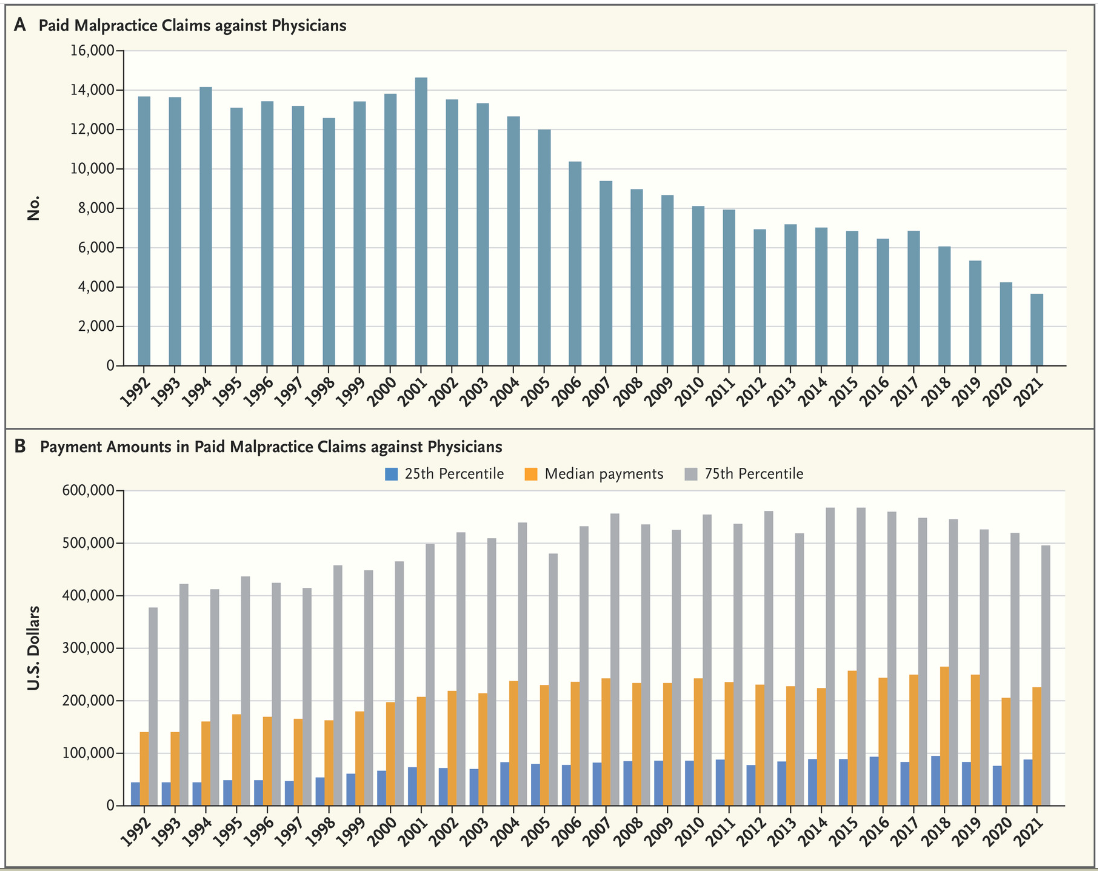
  • “Patients lose about 80% of medical malpractice trials.3 However, fewer than 1 in 20 claims end in courtroom verdicts; about one third are settled out of court with a payment to the patient, and the remainder are dropped or dismissed.3
  • “NPDB data reveal a remarkable phenomenon: the number of paid claims against physicians has decreased by 75% in the past 20 years.” The potential reasons include tort reform, greater openness about medical errors may have reduced patients’ inclination to sue, better medical care (no evidence of this), and incomplete NPDB data. With regard to incomplete data, this can occur with “corporate shielding” in which institutions assume liability and payment responsibility in claims against physicians, thus averting reporting requirements).

In the graph, “payments have been adjusted to 2021 dollars using the consumer price index for all urban consumers (https://data.bls.gov/PDQWeb/cu. opens in new tab).”

Related blog post: “Physician-Patient Relationship is Not Necessary to Sue Docs for Malpractice”

Public Health Laws Weakened After COVID-19

MM Mello, WE Parmet. NEJM 2021; 385: 1153-5. Open Access: Public Health Law after Covid-19 This commentary describes changes in public health law as a result of the COVID-19 pandemic.

Key points:

  • “More than 1000 suits challenged orders shuttering businesses, banning indoor worship services, restricting travel, and mandating mask wearing.”
  • “In 1905 in Jacobson v Massachusetts, the Supreme Court upheld a vaccination mandate…Judicial review, the Court found is limited to …’arbitrary and oppressive in particular cases”
  • “Most courts..have …granted considerable deference to health officials…Courts have been more receptive, however, to challenges relating to religious liberty and the scope of executive authority.”
  • “The court in an unsigned opinion ruled that the CDC had overstepped its authority [with an eviction ban] under the Public Health Service Act (PHSA)…Congress…must pass legislation to impose one or to clarify that the CDC may impose one.”
  • “The decisions with regard to free exercise of religion suggest that health orders will face strict scrutiny if they regulate religious practices more strictly than any secular activity that courts deem similar.”

My take: This article makes clear that “while emergencies can lead to abuses of authority, …in their [Courts] zeal to protect religious liberty and constrain executive action, courts may be leaving officials with fewer tools to fight Covid-19 and the next pandemic.”

Related blog post: Supreme Court Justices “Play a Deadly Game”

Related article from NY Times (10/4/21): The Supreme Court Has Gone Off the Rails by Donald Ayers

Mr. Ayer was a U.S. attorney and principal deputy solicitor general in the Reagan administration and deputy attorney general in the George H.W. Bush administration.

An excerpt:

[The Supreme Court’s] recent history suggests that it lacks a majority of justices with sufficient concern about the basic continuity and integrity of the law or the ability of government to functionit seems ready to cast aside certain constitutional rights, the court today regularly gives sweeping new interpretations to other rights and invokes them to radically narrow certain government powers that were until quite recently uncontroversial, including, for example, powers related to public safety or our democratic process...

Perhaps most unexpected and disturbing were decisions elevating rights of religious assembly over local public-safety rules related to Covid-19 that limited the ability to gather. Yet throughout our history, in matters of public health, the powers of local government have usually been at their apex. That did not matter here — nor did the fact that Chief Justice Roberts was among the dissenters.

Supreme Court Justices “Play a Deadly Game”

A recent commentary (WE Parmet. NEJM 2021; 384: 199-201. Full text: Roman Catholic Diocese of Brooklyn v. Cuomo — The Supreme Court and Pandemic Controls) explains how a recent court decision undermines the future of many public health laws.

Key points:

  • “On November 25, 2020, … the U.S. Supreme Court, by a 5-to-4 vote, undermined states’ ability to control that pandemic.” (Roman Catholic Diocese of Brooklyn v. Cuomo)
  • Initially, most courts rejected challenges to restrictions imposed by governors during the pandemic. “Initially, most courts rejected these claims, citing the Supreme Court’s 1905 decision in Jacobson v. Massachusetts, which upheld a Cambridge, Massachusetts, regulation mandating smallpox vaccination during an outbreak.”
  • After the appointment of Justice Amy Coney Barrett, ” there was now a 5-to-4 majority willing to block limits on religious services.” This was based on the rationale that it is unlawful to “single out houses of worship for especially harsh treatment” and that “even in a pandemic, the Constitution cannot be put away and forgotten.”
  • In dissent, “Justice Stephen Breyer pointed to epidemiologic evidence that in-person worship may pose a greater risk than shopping and other activities that were less stringently regulated to argue that the Court should defer to state officials.”
  • “The Court’s eagerness to intervene even though New York’s orders were no longer in effect and its failure to consider epidemiologic evidence in determining which activities are comparable to worship will serve as a warning” against “state orders that impose tighter measures on worship…[and] suggests that states will not be able to act before super-spreader events occur or as long as other states take a more lax approach.”
  • The author note that “although courts should not abdicate their role during a pandemic, they also should not rush to assume an expertise they lack.”
  • “[The] most important legacy may be the dethroning of Jacobson…[which] has been the key precedent supporting vaccine mandates and other public health laws….With Jacobson apparently sidelined, the future of many public health laws, including and especially vaccine mandates, appears perilous.”

From The Onion:

Also, useful website via NBC: Plan Your Vaccine

Can the FDA prohibit free speech?

Maybe not (NEJM 2013; 368: 103-05).

While the FDA is responsible for overseeing the safety of pharmaceuticals and veracity of marketing, its authority does not extend to the practice of medicine.  This enables the widespread practice of using medications for “off-label” purposes.  Physicians can use approved drugs for nonapproved uses.  FDA regulations have restrained marketing of off-label uses of prescription medications by pharmaceutical representatives.

However, a recent appellate ruling in United States v. Caronia has stated “the government cannot prosecute pharmaceutical manufacturers…for speech promoting the lawful, off-label use of an FDA-approved drug.”  According to this perspective article, the ruling stemmed from the argument that refusing to “allow the free flow of information would result in …limitations, and side effects of the drug.”

At stake is whether the ability of the FDA to combat false or misleading speech.  In addition, limiting the FDA’s authority may lead to fewer studies documenting the effectiveness of medications for various indications.  If the medication is approved for one use and there are no constraints on marketing, there will be little incentive to complete additional studies.

Additonal references:

UNITED STATES V. CARONIA 09-5006-cr Unofficial Oral Argument …

United States vCaronia – Reed Smith