
MS Cattral et al. Gastroenterol 2023; 165: 1315-1317. Open access (PDF)! Anonymous Living Donor Liver Transplantation: The Altruistic Strangers
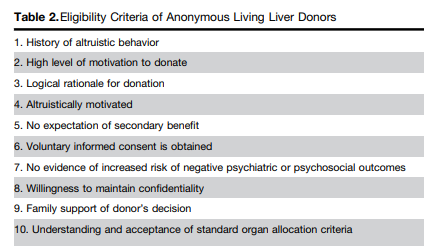
This commentary, from Toronto General Hospital practitioners, discusses the increasing use of anonymous living liver donation (ALLD) in North America and donor altruism which is a term coined and popularized by the French philosopher Auguste Comte in the 1800s. Altruism is the principle and moral practice of concern for the welfare or happiness of others.
Key points:
- Living-donor liver transplantation (LDLT) … in Toronto currently makes up 30% of adult and 80% of pediatric liver transplants.
- Over the past 4 years, ALLD activity has doubled and now accounts for 15% of our yearly LDLT activity (80–85/year). Similar rates of growth in ALLD have occurred in the USA, whereas it remains rare outside of North America
- The Canadian system provides several important advantages for anonymous donors: publicly funded health care that covers the cost of the donor assessment, surgery, and
postoperative care; supportive employers and social programs that minimize financial losses; and a provincially funded program (Prelod) that reimburses incidental costs related to travel, accommodation, and meals up to $6000. - Important steps toward supporting living donation have been taken in the USA, such as the development of the National Living Donor Assistance Center as well as the Patient Protection and Affordable Care Act, which makes it illegal for insurance companies to deny
health coverage to living donors… - Donors in the USA, however, still face significant obstacles to obtaining life insurance, long term care insurance, and disability insurance. Notably, the National Living Donor Protection act, which aims to rectify this problem (https://www.congress.gov/bill/117th-congress/
house-bill/1255/text) has yet to move through Congress despite pressure from the transplant community
My take: It is definitely a good idea to promote living donors by removing insurance obstacles/discrimination
Related blog posts:
 gutsandgrowth