Esophageal and Gastric Outcomes of Bleach Ingestion in Children

P Quitadamo et al. J Pediatr Gastroenterol Nutr. 2025;81:11–17. The effects of liquid bleach ingestion on children’s esophageal and gastric mucosa

Background:  It has been recently reported that household bleach ingestion cause no or low-grade esophagitis in adults.13

Methods: This prospective observational study was carried out between January 2017 and December 2023. One hundred children with a mean age of 58.7 months were included and divide into three groups. Group 1, children who had ingested household chlorine-based bleach; Group 2, children who had ingested household peroxidase-based bleach; Group 3, children who had ingested artisanal or industrial bleaches.

Key findings:

  • Eighty-nine/100 (89%) children had ingested household bleaches (both chlorine- or peroxidase-based) while 11/100 (11%) had ingested homemade or industrial bleaches
  • 73/100 (73%) patients were symptomatic. The most commonly reported symptoms were vomiting and drooling
  • 13/100 (13%) were intentional with self-injurious or suicidal purposes
  • Among the 71 children who performed EGD, no children reported severe esophageal lesions
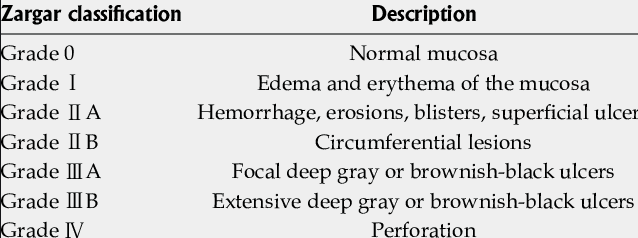
  • Zargar’s score 2a in 2/71 (2.8%). Both patients who reported moderate esophageal mucosal lesions (Zargar’s grade 2a) had ingested a homemade NaOCl-based (sodium hypochlorite) bleach with unknown dilution
  • Gastric injury was reported in 6/71 (8.5%) patients, including hemorrhagic gastritis in one child. Among these children, five had ingested an artisanal or industrial bleach, and two had ingested a peroxidase-based bleach

My take (borrowed from authors): “Endoscopy is generally unnecessary in case of household bleach ingestion …[but] should be performed in children who ingest homemade or industrial bleaches.” Children having ingested commercially available household bleaches did not report significant mucosal lesions. The authors also advocated endoscopy in those with large volume ingestions (>100 mL) if symptomatic.

Related blog posts:

Disclaimer: This blog, gutsandgrowth, assumes no responsibility for any use or operation of any method, product, instruction, concept or idea contained in the material herein or for any injury or damage to persons or property (whether products liability, negligence or otherwise) resulting from such use or operation. These blog posts are for educational purposes only. Specific dosing of medications (along with potential adverse effects) should be confirmed by prescribing physician.  Because of rapid advances in the medical sciences, the gutsandgrowth blog cautions that independent verification should be made of diagnosis and drug dosages. The reader is solely responsible for the conduct of any suggested test or procedure.  This content is not a substitute for medical advice, diagnosis or treatment provided by a qualified healthcare provider. Always seek the advice of your physician or other qualified health provider with any questions you may have regarding a condition
Early Management of Caustic Ingestions in Children

Briefly noted: ES Gordon, E Barfiedl, BD Gold. J Pediatr Gastroenterol Nutr. 2025;1–12. Early management of acute caustic ingestion in pediatrics

Congratulations to my partner Dr. Gold and his coauthors.

Key points:

  • In symptomatic patients, EGD within 24‐hours is most optimal to evaluate the degree of injury and for prognostication
  • Further research is needed on the use of steroids, antibiotics, and acid‐suppression
  • Early placement of NGT under direct visualization during endoscopy may help prevent stricture formation and allow for enteral nutrition in cases of significant injury (Zargar grade 2b and above)

Related blog posts:

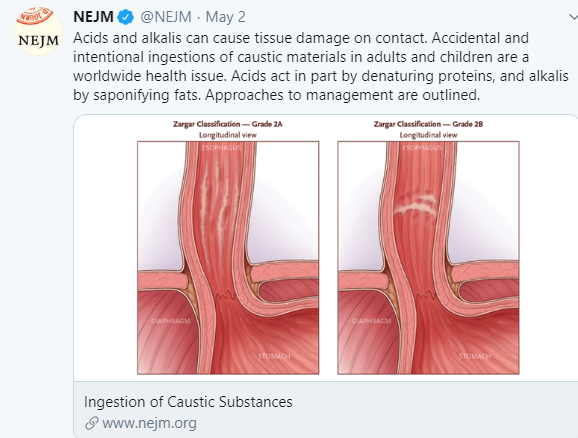
Why Ingestion of Caustic Substances is Not A Good Idea

The week that the U.S. President suggested that using disinfectants to treat the coronavirus could be helpful, there was a spike in calls to poison control centers: Calls to poison control centers spike after Trump disinfectant comments.  In addition, coincidentally, a review article was published: Ingestion of Caustic Substances (RS Hoffman et al. NEJM 2020; 382: 1739-48).

Background:

  • Chevalier Jackson (1865-1958), an otolaryngologist and often called the ‘father of endoscopy,’ advocated for warning labels on bottles that contained caustic agents.
  • U.S. Federal Caustic Poison Act 1927 mandated labeling and U.S. Poison Prevention Packaging Act 1970 mandated child-resistant containers
  • Currently, poison control centers in the U.S. advise storage “up and away” of caustic agents (Great website for families: www.upandaway.org)

Epidemiology:

  • Nearly 1000 children are hospitalized each year with caustic ingestions.
  • In younger children, ingestions typically involve smaller amounts than in adolescents and adults (in which ingestions are usually deliberate attempts at self-harm)

Clinical Outcomes:

  • GI: Caustics (both acid and alkali) may result in esophageal perforations with mediastinitis, as well as bowel perforation and bleeding.  Esophageal strictures can develop weeks to months afterwards
  • ENT: May compromise airway
  • Eye/Skin: Splash may cause eye injuries and skin burns

Approach to Management:

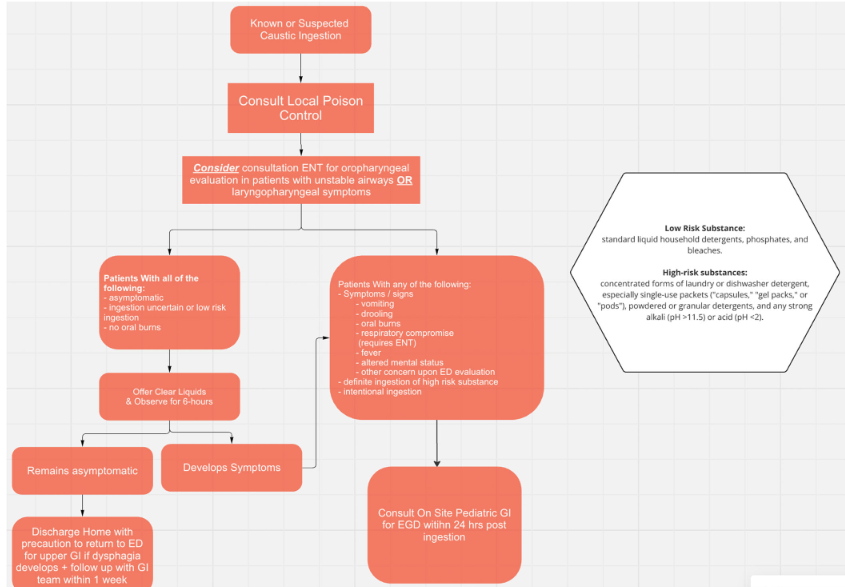
The authors present an algorithm (Figure 1) –Key points:

  • For adults and adolescents, when there are oropharyngeal findings with intentional ingestions, there is a high likelihood of gastroesophageal injury. In younger children, the presence of oropharyngeal findings is much less likely to be associated with gastroesophageal injury due to smaller ingested quantities.
  • The authors advocate a selective approach towards endoscopy in young children.  “For children with only vomiting or drooling and those who refuse to drink, overnight observation is routine, and endoscopy is performed only if symptoms persist and the child remains unable to take oral fluids”  If there is vomiting and drooling or stridor alone, endoscopy is recommended.
  • Endoscopy, when indicated, “should be performed in the first 24 to 48 hours.”  Delayed endoscopy may increase the risk of perforation.
  • Clinical attempts to empty the stomach can potentially increase injury. However, “use of water immediately after ingestion (usually at home) to irrigate adherent materials” may be useful if patient can swallow safely and breathe without difficulty.

Grading Esophageal Injury -Zargar Classification:

For patients too ill to undergo endoscopy, CT is an alternative

Use of Corticosteroids:

This issue is discussed at length.  Though routine use of steroids failed to show benefit in several (underpowered) studies, the authors not that Usta et al (Pediatrics 2014; 133: E1518-24) “randomly assigned children with grade 2B esophageal injuries to 3 days of methylprednisolone ( 1 g per 1.73m2 of BSA per day) or placebo, plus 1 week of ceftriaxone and ranitidine…A significant benefit was reported in the methylprednisolone group.”  Thus, “patients with grade 2B injuries, who have a high risk of progression to stricture and a low risk of perforation, are most likely to benefit from…glucocorticoid therapy.”  The authors state this is in agreement with current guidelines (JPGN 2017; 64: 133-53).

Other Management:

  • Consider placement of nasogastric tube at time of endoscopy
  • Sucralfate has been shown to help with esophageal healing
  • Mitomycin C has been studied and has some data indicating fewer dilatations were needed for caustic-induced strictures.  Long-term risk of malignancy with mitomycin C is uncertain.

My take: Most children with caustic ingestions will not need endoscopy.  Sucralfate is a useful adjunct.  A subset of children may benefit from 3 days of methylprednisolone.

Related blog posts:


Disclaimer: This blog, gutsandgrowth, assumes no responsibility for any use or operation of any method, product, instruction, concept or idea contained in the material herein or for any injury or damage to persons or property (whether products liability, negligence or otherwise) resulting from such use or operation. These blog posts are for educational purposes only. Specific dosing of medications (along with potential adverse effects) should be confirmed by prescribing physician.  Because of rapid advances in the medical sciences, the gutsandgrowth blog cautions that independent verification should be made of diagnosis and drug dosages. The reader is solely responsible for the conduct of any suggested test or procedure.  This content is not a substitute for medical advice, diagnosis or treatment provided by a qualified healthcare provider. Always seek the advice of your physician or other qualified health provider with any questions you may have regarding a condition
Detergent Pod Ingestions -Is an Endoscopy Needed?

A recent study (A Singh et al. JPGN 2019; 68: 824-8) provides a descriptive retrospective review of a single center experience with detergent pods (a.k.a. laundry pods or dishwater pods). There is very little published in this area and no clear consensus on management.

For me, the most interesting finding in the study is the discrepancy between the ENT service which only did a direct laryngoscopy-bronchoscopy (DLB) in 6 of 23 (26%) ingestions compared with 21 of 23 (91%) EGD rate among patients who presented to the GI service.

Key findings:

  • Of those undergoing an EGD, 76% were normal; abnormal findings (edema, erythema or ulceration) were present in 24% (though figure 4 suggests erythema in 28%). Ulceration was noted in 14%.
  • In the DLB cohort (n=6), 33% were normal and 67% were abnormal.

Unfortunately, this report has a lot of limitations:

  • It did not provide any information regarding long-term effects (if any were present)
  • It did not provide much guidance in determining whether an EGD is worthwhile. The authors did note that patients with oral injuries were more likely to have an abnormal EGD. 80% of patients with positive oropharyngeal findings had an abnormal EGD compared with 20% with a normal oropharyngeal exam.
  • In the discussion, the authors reference a study which reported esophageal injury in only 0.1% of cases (Davis et al.  2016 May;137(5). pii: e20154529. doi: 10.1542/peds.2015-4529. Pediatric Exposures to Laundry and Dishwasher Detergents in the United States: 2013-2014). There were two deaths in this study.

My take: This would have been a good report to have an associated commentary/expert opinion.  Even if an EGD is abnormal, this does not mean that the EGD was needed.  The bigger question is how often an EGD would improve management.  Given the lack of specific treatments, it is likely that an EGD should be reserved for severe cases –which could include the following:

  • intentional ingestions
  • significant oropharyngeal burns
  • food refusal
  • drooling/difficulty managing secretions
  • stridor

Related blog post: New caustic danger from detergent pods

Disclaimer: These blog posts are for educational purposes only. Specific dosing of medications/diets (along with potential adverse effects) should be confirmed by prescribing physician/nutritionist.  This content is not a substitute for medical advice, diagnosis or treatment provided by a qualified healthcare provider. Always seek the advice of your physician or other qualified health provider with any questions you may have regarding a condition.

Detergent Pods -Still an Issue -This Tweet is from June 5, 2019

Cheap Technology for Button Battery Ingestions

Typical Button Battery

Typical Button Battery

An NPR report regarding “the results of .. experiments published Monday in the Proceedings of the National Academy of Sciences show that a prototype shield is effective at keeping small, 11 millimeter batteries from damaging the esophagus after being swallowed.”  This would be worthy endeavor to pursue.  The larger buttons (20 millimeters in diameter) “are particularly dangerous. One out of 8 children [under 6 years old] who swallow this larger battery are going to have a serious debilitating complication.”  Here’s the link: Battery Shield

Here’s an excerpt regarding the shield:

Microscopic metal particles are embedded in the shield, which is a millimeter thick. When a battery is inserted into a device, the pressure from the device’s cover or a spring that holds the battery in place pushes the metal particles together. The shield then acts like a switch, conducting electricity.

When the battery is free, floating down a child’s esophagus, for instance, there’s not enough pressure to make the microparticles smush together. The shield then acts as an insulator…

The shield’s material is commercially available and currently used in touch-screen devices where a gentle press of a fingertip can complete a circuit.

Related blog posts:


"Great Power" for Damaging an Esophagus

“Great Power” for Damaging an Esophagus

Review of Button Batteries

A recent open access article reviews button batteries and reiterates algorithm from poison control (noted in previous blog post: Button Battery Algorithm Link | gutsandgrowth).  This article has some excellent figures detailing the extent of the problem and has relevant pictures of radiographs and mucosal damage.

Here’s the reference:

International Journal of Pediatric Otorhinolaryngology 77 (2013) 1392–1399

Here’s the link:

http://authors.elsevier.com/offprints/PEDOT6686/7551db6b14c8aabfa827016d69367c08 …

New caustic danger from detergent pods

“Brightly colored little packets that combine laundry detergent with other cleaning agents are a new convenience for consumers — and a new danger for kids.”

See more complete story at attached links that follow:

http://www.washingtonpost.com/national/poison-control-centers-field-increased-number-of-calls-of-children-ingesting-detergent-packets/2012/05/24/gJQAaiSZnU_story.html

http://yourlife.usatoday.com/health/healthyperspective/post/2012-05-24/new-kid-danger-swallowing-candy-colored-laundry-packets/701134/1