
Cost Transparency Rules Not Implemented for GI Procedures

GastroEndoNews 3/28/24: (Open Access!) Mandated Cost Transparency Requirement For GI Procedures Is Not Being Met

Excerpts:

Three years after the Hospital Price Transparency Rule was implemented by the Centers for Medicare & Medicaid Services, a large proportion of hospitals are not complying when it comes to gastrointestinal services, according to two studies presented at the 2023 annual meeting of the American College of Gastroenterology.

When institutions do list their prices, they are often hard to find, and the wide variety of charges are frequently listed in a format that is “not patient-friendly,” according to investigator Kevin Brittan, MD, an internal medicine resident at the University of Nebraska Medical Center, in Omaha

All hospitals are expected to be in compliance with the rule and report prices for these and other procedures as of Jan. 1, 2021. However, in one study, Dr. Brittan and his co-investigators found that only two of 25 [top-rated] hospitals surveyed (8%) reported costs for all eight procedures evaluated (abstract P4083). In the other study, from Howard University researchers, 14 of 30 hospitals (47%) provided some costs for four procedures, but only 10 (30%) provided cost information for all of them (abstract P4091)...

[They] also found “extreme variance” between institutions in the costs cited, raising the question of whether the reported data are even reliable. “There was a 51-fold difference found in the price for an upper endoscopy and a greater than 80-fold difference for a colonoscopy,” Dr. Bhayana reported. Self-pay colonoscopy prices, for example, ranged from $440 to more than $36,000...

Approximately 11 million colonoscopies and 6.1 million upper endoscopies performed each year in the United States, Dr. Brittan said. He calculated that the price differences would equate to billions of dollars if procedures were performed at top centers offering the lowest prices relative to top centers asking the highest prices.

My take: So far, the hospital price transparency has been ineffective. Patients should be able to find out more readily what the costs are prior to receiving a bill. Unfortunately, this appears to be years away. To implement price transparency will require either enforcement (penalties) and/or litigation.

Related blog posts:
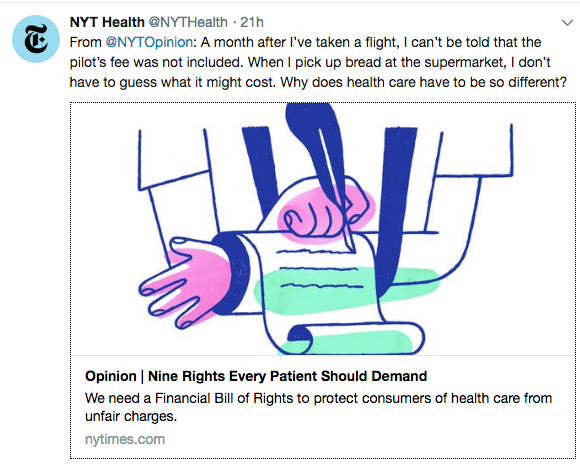
NY Times: Financial Bill of Rights for Patients

NY Times: Nine Rights Every Patient Should Demand

This article addresses a fundamental problem in medicine: lack of price transparency, and the complexity of understanding health care expenses..

The right to an itemized bill in plain English.

  • Patients can’t detect and dispute improper charges if their bills involve dozens of pages of medical abbreviations. Studies have found that 30 percent to over 50 percent of hospital bills contain errors…

The right to never receive a surprise out-of-network bill.

The right to accurate information about the provider network in my insurance plan.

  • Doctors … must be in-network for all the procedures they normally perform and on all days of the week they practice. If a provider is listed as in-network but is not, the insurer should take care of the charge.

The right to a stable network.

  • I buy my insurance policy for a year. If my doctor or insurer stops participating in my network within that year or in the midst of treating me for an acute disease, I should still be billed as an in-network patient.

The right to be informed of conflicts of interest.

  • Patients should know if their doctors own a financial stake in a testing or procedure facility before a test or procedure is ordered or scheduled…

The right to be informed in advance about any facility fees.

  • A procedure can come with different price tags depending on where it is performed…

The right to see a price list for elective procedures.

The right to be informed of cheaper options.

  • Many doctors recommend the most expensive course of care and don’t tell patients that there are other options…

The right to know that a disputed bill will not be sent to a collection agency.

  • The threat of dealing with bill collectors and a damaged credit rating is used to intimidate patients into paying up without asking questions…

I know these rights might seem like a fantasy in our current system, with its overwhelming complexity and cost. But they are actually quite similar to the rights we expect in any other sector of our economy. 

My take: The way we pay for health care does not make sense.  Understanding costs for medical care should be like reading the nutrition label boxes.  Currently, even an expert in health care has difficulty understanding what costs to expect.

What Happens with Cost Transparency in Medicine?

While it is true that some tests, like MRI and CT scans, may be performed better (better images, better contrast administration, etc) at some locations than others, many times the test is similar but the costs to the patient may be widely divergent.  Yet, for most patients the exact costs are not known until the bill arrives in the mail.  A recent study shows that many patients will consider the costs of these expensive tests if they are provided beforehand.  Here’s the NY Times link, MRI study,  and an excerpt:

study released Monday in the journal Health Affairs suggests we are smarter than that.

The insurer WellPoint provided members who had scheduled an appointment for an elective magnetic resonance imaging test with a list of other scanners in their area that could do the test at a lower price. The alternative providers had been vetted for quality, and patients were asked if they wanted help rescheduling the test somewhere that delivered “better value.”

Fifteen percent of patients agreed to change their test to a cheaper center. “We shined a light on costs,” said Dr. Sam Nussbaum, WellPoint’s chief medical officer. “We acted as a concierge and engaged consumers giving them information about cost and quality.”

The program resulted in a $220 cost reduction (18.7 percent) per test over the course of two years, said Andrea DeVries, the director of payer and provider research at HealthCore, a subsidiary of WellPoint, which conducted the study. It compared the costs of scanning people in the WellPoint program with those of people in plans that did not offer such services.

Related blog posts: