Colchicine and Leukopenia

A recent study (E Sag et al. J Pediatr 2020; 224: 166-70) provided some useful information about the development of leukopenia in children receiving colchicine.

This study included 213 patients receiving colchicine at doses between 0.5 mg adn 2 mg/day.  Routine labs were obtained 2 weeks after starting treatment, at 3 months, and then every 6 months.  If leukopenia was identified, f/u labs were obtained 1 week later. Colchicine doses were decreased in patients with persistent leukopenia.

Key findings:

  • 23 (10.8%) developed reversible leukopenia.  No cases of leukopenia were severe and there was not an increased rate of infections.

Related blog posts:

Canakinumab for Recurrent Fever Syndromes

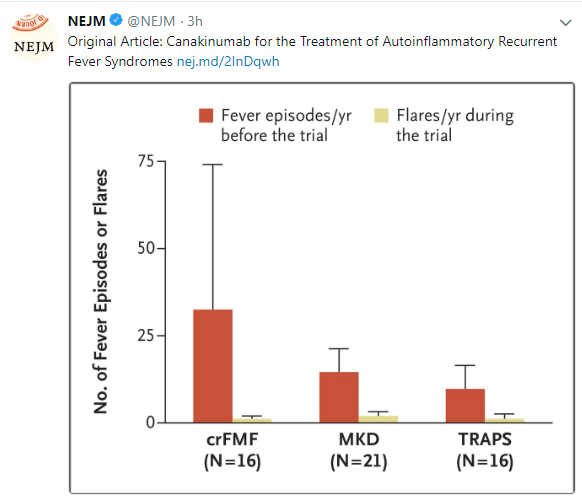
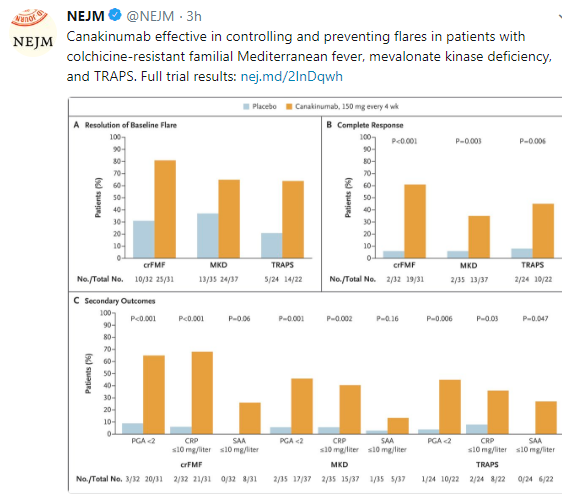
A recent study (F de Benedetti et al. NEJM 2018; 378: 1908-19) presents data on canakinumab, an anti-interleukin-1β monoclonal antibody, for three hereditary periodic fever syndromes in the so-called “CLUSTER” trial.  Canakimumab is administered as a subcutaneous injection. The three periodic fevers were the following:

  • Familial Mediterranean Fever (colchicine-resistant)
  • Mevalonate kinase
  • Tumor necrosis factor-receptor-associated periodic syndrome (TRAPS)

PFAPA Conference Report

A conference report on periodic fever, aphthous stomatitis, pharyngitis, adenitis syndrome (PFAPA): L Harel et al. J Pediatr 2018; 193: 265-74

This report reviews PFAPA along with other fever syndromes.

Table II reviews several published criteria.  Most of these include abrupt onset of fever, duration of symptoms <5 days, presence of constitutional symptoms, exclusion of cyclic neutropenia, presence of  aphthous stomatitis, pharyngitis, cervical adenitis, presence of asymptomatic intervals, normal growth.

  • The authors note that ~25% of patients are >5 years of age.
  • They note that it is important to exclude exudative tonsillitis.
  • They suggest NOT testing for familial Mediterranean fever (FMF) in the absence of clinical suspicion. The pain symptoms with FMF are much more intense and  consistent with a peritonitis.
  • They recommend checking acute phase reactants between attacks to assure normalization
  • Corticosteroids (single dose) have been shown to shorter course.  “The recommended full dose is 2 mg/kg prednisone or 0.3 mg/kg betamethasone.”
  • “It is our practice to conclude the following: 1. Fever recurring the next day [after steroids]–not a PFAPA episode, 2. fever recurring withing 2-4 days –the corticosteroid dose is too low, and 2. attack recurs >1 week –new episode.”
  • Any of the following should exclude PFAPA: “neutropenia, cough, coryza, severe abdominal pain, significant diarrhea, rash, arthritis, or neurologic abnormalities; elevated acute phase reactants between attacks”

Differential diagnosis and characteristics are reviewed in Figure 5, with emphasis on mevalonate kinase deficiency, FMF, cryopyrin-associated periodic syndromes (CAPS), and tumor necrosis factor receptor-associated periodic syndrome (TRAPS).

Related blog posts:

Disclaimer: These blog posts are for educational purposes only. Specific dosing of medications/diets (along with potential adverse effects) should be confirmed by prescribing physician/nutritionist.  This content is not a substitute for medical advice, diagnosis or treatment provided by a qualified healthcare provider. Always seek the advice of your physician or other qualified health provider with any questions you may have regarding a condition.

View from Bright Angel Trail

Colchicine treatment for an orphan disease

In Atlanta, patients with Familial Mediterranean Fever (FMF) do not have a specific specialist and may remain in the care of a pediatric gastroenterologist as a consequence.  Fortunately, when the diagnosis is established, an effective treatment, colchicine, is available (J Pediatr 2012; 161: 1142-6).

Specific pointers in this reference:

  • Often the diagnosis of FMF is a clinical one as 2 mutations (MEFV gene) are found in only 38-72% of patients.
  • Mean age of onset is 1.1 years, but due to diagnostic delays, mean age of treatment is 3.2 years. Early in life, fever attacks may be the only recognizable feature.  Several years later serositis typically develops.
  • Colchicine prophylaxis is recommended for all patients diagnosed with FMF
  • In this 4-year study of 153 patients (all younger than 17 years), 22 (14.4%) developed diarrhea with colcichine and required dose reduction.
  • 18 patients (11.8%) had transient mild increase in transaminases (max ALT 152 IU/L).   One mechanism of liver toxicity for colchicine may be to increase NAFLD.
  • Colcichine dosing in the study: 0.5 mg daily in 11 children (<4 years), 1 mg in 105 patients, 1.5 mg in 19 patients, and 2 mg in 18 patients.
  • Previous recommendations for colchicine dosing in literature were for 0.5 mg for <5 year olds, 1 mg for 5-10 year olds, 1.5 mg for >10 years of age. In this center, most patients receive 1 mg by 2 years of age.
  • In the discussion, the article reviewed the literature showing colchicine seemed to be safe during pregnancy and few adverse effects.

Additional References: