
HBV Vaccination Prevents Cancer

In a Gastroenterology study from Taiwan, HBV vaccination has been shown to reduce the risk of Hepatocellular Carcinoma.
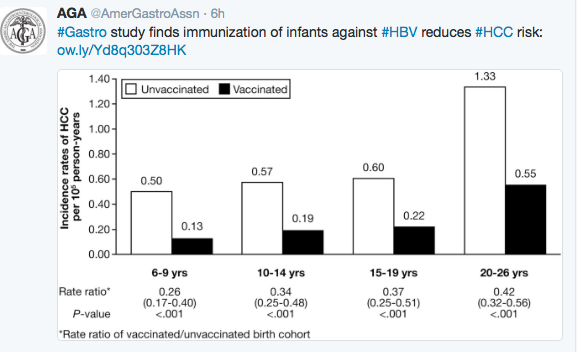

screen-shot-2016-09-07-at-5-54-23-pm


screen-shot-2016-09-07-at-5-54-00-pm

Results

Of the 1509 patients with HCC, 1343 were born before, and 166 were born after, the HBV vaccination program began. HCC incidence per 105 person-years was 0.92 in the unvaccinated cohort and 0.23 in the vaccinated birth cohorts. The RRs for HCC in patients 6–9 years old, 10–14 years old, 15–19 years old, and 20–26 years old who were vaccinated vs unvaccinated were 0.26 (95% confidence interval [CI], 0.17–0.40), 0.34 (95% CI, 0.25–0.48), 0.37 (95% CI, 0.25–0.51), and 0.42 (95% CI, 0.32–0.56), respectively. The RR for HCC in 6- to 26-year-olds was lower in the later vs the earlier cohorts (born in 1992–2005 vs 1986–1992; P < .001 and 1986–1992 vs 1984–1986; P < .002). Transmission of HBV from highly infectious mothers and incomplete immunization were associated with development of HCC.

Hepatitis B Vaccine Protects for Up to 30 Years

From summary at GI & Hepatology News: Hepatitis B vaccine protection lasts 30 years

An excerpt:

  • Ninety percent of patients in a 1981 hepatitis B vaccine trial still had evidence of immune protection 30 years later, according to a study in the Journal of Infectious Diseases…
  • 243 members of the original cohort who responded to the original primary vaccine series but received no subsequent doses during the 30-year period…
  • Of the patients tested, 125 (51%) had anti-HBs levels greater than or equal to 10 mIU/mL. Among participants with anti-HBs levels below 10 mIU/mL who were available for follow-up, 75 of 85 (88%) responded to a booster dose with an anti-HBs level greater than or equal to 10 mIU/mL at 30 days.
  • Read the full study in the Journal of Infectious Diseases (J Infect Dis. 2016 Jan 21. doi: 10.1093/infdis/jiv748).

Related blog posts:

Bell Tower, Univ Mich

Bell Tower, Univ Mich