
- GutsandGrowth Milestone: this is the 3000th blog post
- New COVID19/IBD worldwide registry (so far zero cases reported. Can report cases at the following: SECURE-IBD Registry
——
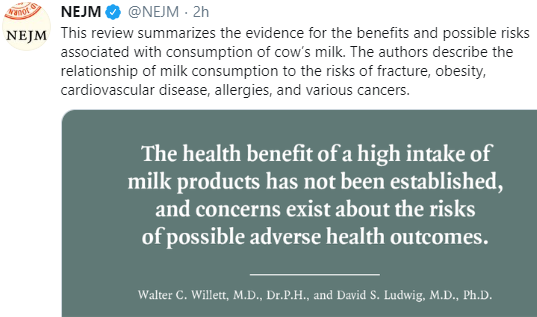
A provocative review (WC Willett, DS Ludwig. NEJM 2020; 182: 644-54) provides a rationale for why a healthy diet may not need milk.
Key points:
- “The current recommendation to greatly increase consumption of dairy foods to 3 or more servings per day does not appear to be justified.”
- All the nutrients in milk can be obtained from other sources (including calcium and vitamin D). If diet quality is low, especially for children, dairy foods can improve nutrition. “If diet quality is high, increased intake is unlikely to provide substantial benefits, and harms are possible.”
- Overall evidence does not support high dairy consumption will reduce fractures
- Total dairy consumption has not been clearly related to weight control or to risks of diabetes or cardiovascular disease
- The reported health benefits of milk depend strongly on what food it is being compared to; dairy intake is generally more favorable than processed red meat or sugar-sweetened beverages but less compared to plant-protein sources (eg. nuts)
- No clear benefit of consuming reduced-fat milk compared to whole milk
- Milk intake in childhood is associated with greater attained height which confers both risks and benefits
More details:
The authors review the composition of cow’s milk and compare it to human milk and cheddar cheese (Table 1). They note that cows have been bred to produce higher levels of insulin-like growth factor 1 (IGF-1) and that they are pregnant for most of the time they are milked; this greatly increases hormones like progestins and estrogens in milk.
The authors review how milk can promote growth and development in children. Tall stature, associated with milk intake, is associated with lower risks of cardiovascular disease but with higher risks of many cancers, hip fractures, and pulmonary emboli.
Bone health and fracture risk: “paradoxically, countries with the highest intakes of milk and calcium tend to have the highest rates of hip fractures;” this, however, may not be causal as their are a lot of confounding factors (eg. Vitamin D status, ethnicity). The authors also note that U.S. studies have shown calcium intake was unrelated to bone mineral density in the hip. Further, the authors point out the discrepancies between U.S. and U.K with regard to daily calcium requirements; at age 4-8 yrs, U.S RDA is 1000 mg per day compared to 450-550 mg in UK. Estimation of the calcium requirement is “problematic.”
Body weight and obesity. “Studies of milk consumption and body weight in children are few and are subject to confounding and reverse causation.” Available studies, however, have shown that whole milk and 2% milk are associated with lower risk of obesity than low-fat or skim milk.
Blood pressure, lipids, and cardiovascular disease in relation to milk consumption: Ultimately, whether milk is beneficial is mainly related to the comparison foods.
Milk and the development of diabetes: intake of dairy products has been associated with a modestly lower risk of type 2 diabetes. Despite some hypothetical risks for type 1 diabetes, children weaned to “hydrolyzed protein instead of cow’s milk did not have fewer autoantibodies to beta cells after 7 years than children who drank cow’s milk.”
Milk intake and cancer. Milk consumption is associated with a lower risk of colorectal cancer (likely due to its high calcium intake) and an increased risk of breast cancer, prostate cancer, and endometrial cancer; these effects may be mediated by the sex-hormones in milk.
Allergies to milk may affect up to 4% of infants. In addition, lactose intolerance “limits consumption of milk worldwide.”
Total mortality and its association with milk intake: “in a meta-analysis that included 29 cohort studies, intake of milk (total, high-fat, and low-fat) were not associated with overall mortality.” Again, the risk is related to what food is substituted for milk intake.
Organic/grass-fed production and potential detrimental environmental effects from milk production; the latter includes pollution, antibiotic resistance, and greenhouse gas production.
My take: These authors are not going to get any funding from the dairy industry. Dairy is typically an important nutrient source in children. Particularly in adults, lower intakes of dairy may be warranted.
Related blog posts:
- Is Drinking Milk Healthy?
- The Genius of Breastmilk | gutsandgrowth
- Overdiagnosis of Cow’s Milk Protein Allergy in Infants and Formula Industry Influence
- Pediatric Osteoporosis and Bone Health -Lecture Slides with commentary
- Feeling Guilty about Stopping Breastfeeding? | gutsandgrowth
- Long-chain polyunsaturated fatty acids, breastmilk, and infant cognitio
- More breastmilk, better development | gutsandgrowth
- More evidence that breastfeeding improves cognitive …

Island Ford, Sandy Springs
 gutsandgrowth