Since summer is around the corner, a recent article on Lyme disease may be of interest. This clinical practice article on Lyme disease opens w/ case, reviews tx strategies & guidelines, ends w/ recommendations. Here’s a link to the article:
Lyme disease is caused mainly by the spirochete Borrelia burgdorferi (and other related species outside of U.S.). Pediatric gastroenterologists sometimes are asked to evaluate children with persistent symptoms attributed to Lyme disease. This expert review makes a few key points:
- Erythema migrans lesions often do not have central clearing; the majority are uniformly erythematous or have enhanced central erythema (pictures noted in Figure 1). A useful differential diagnosis is noted in Table 2.
- Antibody testing is not indicated routinely in patients with erythema migraines due to poor sensitivity in early infections.
- Treatments are highly effective –mainly doxycycline, amoxicillin or cefuroxime
- Prophylactic treatment with doxycycline can reduce risk of infection after tick bite, but usually not given. “Even in areas where Lyme disease is highly endemic, the risk of disease transmission from a recognized bite is low (1 to 3%).”
- “There is no evidence that patients treated for Lyme disease who have persistent, nonspecific symptoms (eg. arthralgia and fatigue) have persistent infection; the risks of prolonged treatment with antimicrobial agents far outweigh the benefit, if any.”
- There is “extensive publicity as well as misinformation on the Internet about ‘chronic’ Lyme disease, a condition for which there is no clear definition or scientific evidence of its existence.”
My two cents: ‘an ounce of prevention is worth a pound of cure.’ If spending a lot of time outdoors, consider applying topical insecticides like DEET and/or wearing long sleeves/pants.
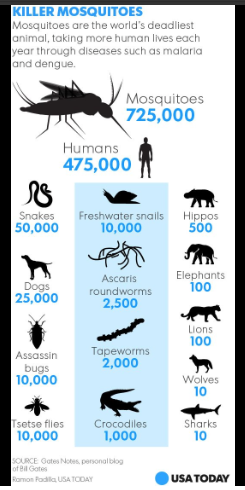
More important globally than Lyme disease is the deadliest animal in the world (from Bill Gates), http://b-gat.es/1kjGmpL :
Which animal kills the most people? Hint: It’s not sharks, lions, or even humans. Introducing Mosquito Week.


 gutsandgrowth