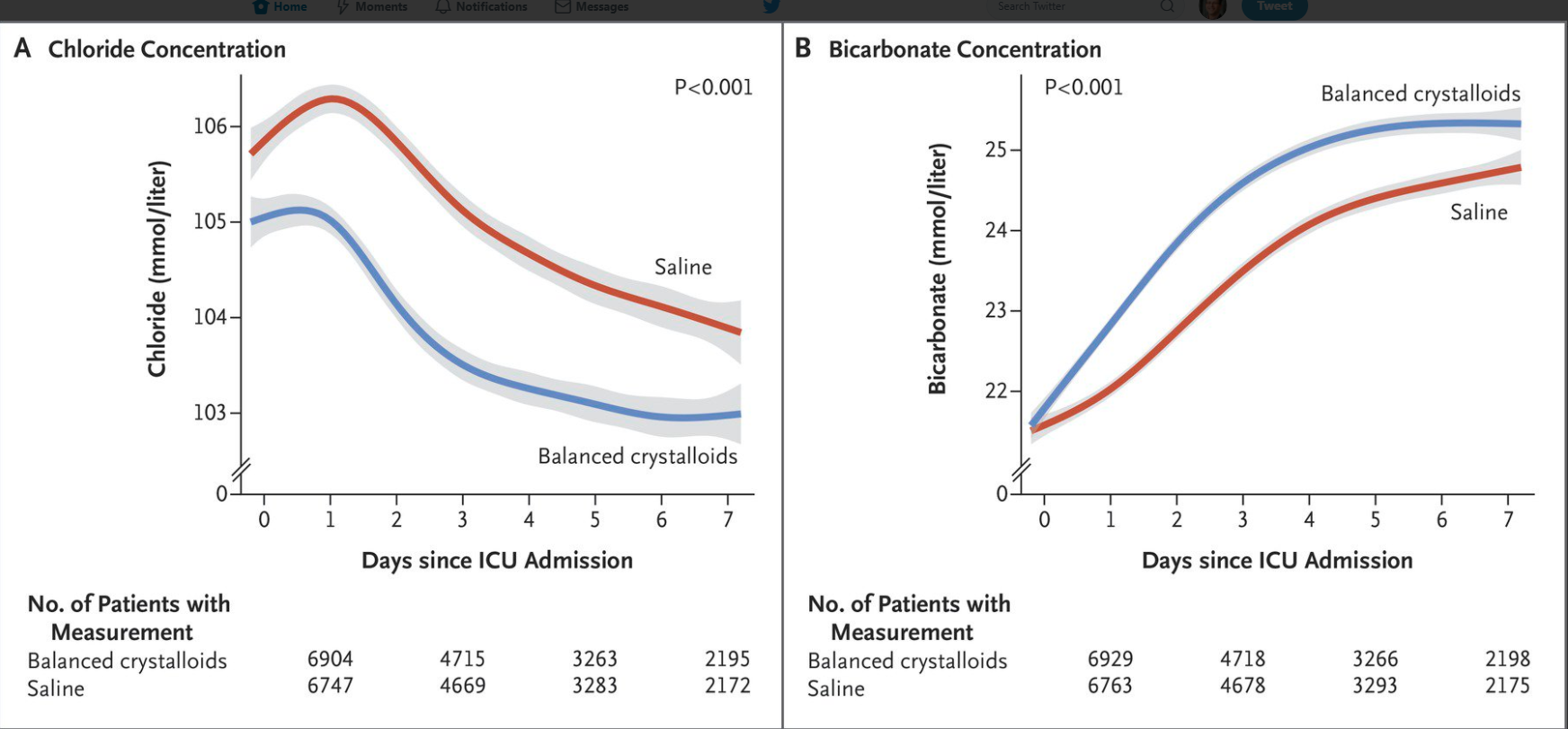
Is Lactated Ringer’s Better Than Normal Saline For Routine Use?

L McIntyre et al. NEJM 2025; 393: 660-670. A Crossover Trial of Hospital-Wide Lactated Ringer’s Solution versus Normal Saline

Background: “A single-center, multiple-crossover trial involving noncritically ill patients in the emergency department found that balanced crystalloid fluids were associated with a lower incidence of major adverse kidney events at 30 days than normal saline. A systematic review of 13 randomized, controlled trials comparing balanced crystalloids with normal saline in a total of 35,884 critically ill participants showed no significant difference in mortality (17.4% with balanced crystalloids and 18.2% with saline; relative risk, 0.96; 95% confidence interval [CI], 0.91 to 1.01) or in the incidence of the use of renal replacement therapy (5.6% and 6.0%, respectively; relative risk, 0.95; 95% CI, 0.81 to 1.11) in trials with a low risk of bias.4 However, the investigators in that analysis and those in another patient-level meta-analysis involving a Bayesian approach concluded that there is a high probability that balanced crystalloids are associated with lower in-hospital mortality and a lower incidence of the use of renal replacement therapy than normal saline.5

Methods of th “FLUID” trial: 3 hospitals used lactated ringer’s (LR) and 4 hospitals used normal saline throughout hospital setting for 12 weeks. Then after a 1-2 week washout period, the hospitals switched to the other fluid for 12 weeks.

Key finding:
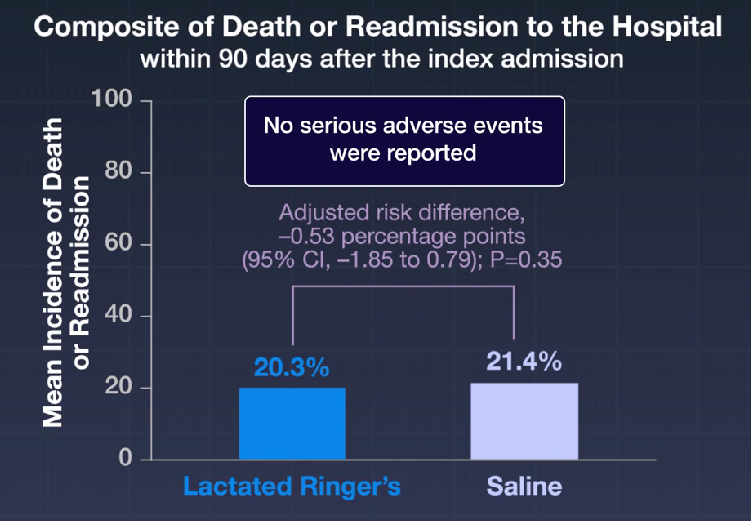
Discussion: “A limitation of this trial was the inability to recruit the total of 16 hospitals as originally planned owing to the Covid-19 pandemic. Hence, the trial had less power to detect differences that were small — but important to patients — at the level of the hospital or health care system…Our findings align with those of recent meta-analyses of randomized, controlled trials that suggest a small but clinically relevant reduction in mortality with balanced crystalloids as compared with normal saline.”

My take: This study did not show a significant difference in death or readmission at 90 days. Yet, lactated ringer’s is probably just a bit better fluid for most adult patients. In the pediatric population, more studies are needed.

Related blog posts:


Disclaimer
: This blog, gutsandgrowth, assumes no responsibility for any use or operation of any method, product, instruction, concept or idea contained in the material herein or for any injury or damage to persons or property (whether products liability, negligence or otherwise) resulting from such use or operation. These blog posts are for educational purposes only. Specific dosing of medications (along with potential adverse effects) should be confirmed by prescribing physician.  Because of rapid advances in the medical sciences, the gutsandgrowth blog cautions that independent verification should be made of diagnosis and drug dosages. The reader is solely responsible for the conduct of any suggested test or procedure.  This content is not a substitute for medical advice, diagnosis or treatment provided by a qualified healthcare provider. Always seek the advice of your physician or other qualified health provider with any questions you may have regarding a condition

Saline Shortages

Two interesting commentaries on the saline shortages:

  • M Mazer-Amirshahi, ER Fox. NEJM 2018; 378: 1472-4.
  • AM Patino et al.  NEJM 2018; 378: 1475-7.

The first explains that large quantities of saline bags are needed each month –more than 40 million bags per month!  While saline is inexpensive, the production requires meticulous care to avoid contamination and there have been supply issues since 2014, prior to Hurricane Maria.  However, the problem has been much worse since Hurricane Maria which damaged Puerto Rico.  Puerto Rico supplies 44% of the IV bags in the U.S.  These fluids are given to virtually all hospitalized patients, either for IV fluids or as a component with medications/flushes.

Other points:

  • “Drug manufacturers are not required to have redundancy in their facilities or even a business contingency plan in case of a disaster.”
  • The  FDA has “recently approved saline products from two additional manufacturers”
  • “To conserve large-volume saline bags, oral hydration is recommended.”

The article by Patino et al provides Brigham and Women’s Hospital Oral Rehydration protocol. Key points:

  • Using their protocol, the volume of IV fluid use decreased over 30% in the first week of implementation
  • The fraction of ED patients using IV fluids dropped by 15% in the first 3 weeks of implementation.
  • Oral hydration protocols are a “rational practice change…even after the current IV-fluid shortage crisis ends.”


Choosing the Right Intravenous Fluids

A recent “SALT-ED” study (WH Self et al. NEJM 2018; 378: 819-28) with more than 13,000 noncritically-ill adults indicated that patients who received normal saline had increased incidence of major adverse kidney events compared to those who received more balanced fluids like lactated Ringers’ or Plasma-Lyte A.

A 2 min quick take summary:Comparison of Crystalloids and Saline for Noncritically Ill

In a separate “SMART” study (MW Semler et al. NEJM 2018; 378: 829-39), investigators looked at balanced crystalloids versus saline in critically-ill adults (n=15,802).  The use of balanced crystalloids (compared to saline) resulted in a lower rate of mortality (10.3% vs 11.1%, P=.06) and fewer major adverse kidney events (14.3% vs. 15.4%, P=.04).


“We Still Have More to Learn”

“The most beautiful thing we can experience is the mysterious, it is the source of all true art and science. He to whom this emotion is a stranger, who can no longer pause to wonder and stand rapt in awe, is as good as dead: his eyes are closed.” –Albert Einstein.

I’m not sure the above quote has much direct relevance to today’s blog, but it came to mind after reading “we still have more to learn” in a recent editorial.  The editorial elaborated on another study showing that hypotonic fluids increase the risk of hyponatremia (J Pediatr 2014; 165: 163-9, editorial 14-15).  The editorial cautions that “intravenous fluid therapy is a prescription much like antibiotics or chemotherapy.  What we prescribe for intravenous fluids must fit the patient’s history and condition.”

The article was a systemic review of published studies.  Though 1634 citations were screened, only 10 studies (n=893) were included as independent randomized controlled trials.  Hypotonic fluids were defined as tonicity <250 mmol/L; isotonic fluids were defined as normal saline (0.9%), Ringer lactate, Hartmann solution, and any other fluid with tonicity approaching that of normal serum. The key findings:

  • Hypotonic fluids increase the relative risk (RR) of hyponatremia (Na <135) with RR of 2.37
  • Moderate hyponatremia (Na <130) risk was increased further with RR of 6.1.
  • Sub-group analysis of half-normal saline showed relative risk for hyponatremia was 2.42.

The editorialists comment that much has changed in the 55+ years since Holliday and Segar’s publication in 1957 describing maintenance fluid requirements.  These changes include sicker patients who are at increased risk for non-osmotic ADH release.  Thus, even patients receiving isotonic fluids are at some risk for hyponatremia.  However, the key point is that maintenance fluids are not appropriate for replacement of losses and in the perioperative setting.

Bottomline: Think twice before using a hypotonic fluid especially on admission or after surgery.  While there is no perfect intravenous fluid for all patients at all times, in many patients, isotonic fluids will be more favorable by reducing the risk of hyponatremia.

Related blog posts:


Unrelated link:

In Treating Crohn’s Disease, Earlier is Better | – AGA Journals Blog