
C-S Lee el al. JPGN 2023; 76: 418-423. A Pilot Study of Biliary Atresia Newborn Screening Using Dried Blood Spot Matrix Metalloproteinase-7
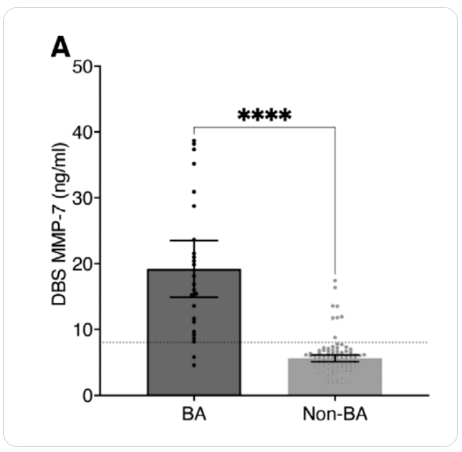
Methods: The study used stored DBS samples collected from 48 to 72 hours of life were retrieved from newborn screening centers in Taiwan (n=25 biliary atresia (BA), 107 non-BA)
Key findings:
- MMP-7 levels of BA patients on the DBS were significantly higher than those of non-BA patients (19.2 ± 10.4 vs 5.6 ± 2.7 ng/mL, P value < 0.0001).
- BA patients in this cohort underwent Kasai operation at a mean of 43 days. 32% (n=8) had surgery before 30 days of life, and 24% (n=6) had surgery after 60 days.
- In this cohort, at time of publication, 9 (36%) of BA patients had received a liver transplantation at a mean of 2.4 years. Patients with their native liver tended to have had an earlier Kasai (38 days vs 54 days, P=0.057).
In their discussion, the authors note that BA starts very early in life. Increase in MMP-7 within 3 days of birth, supports “speculation that most BA ” may start before birth (JPGN 2019; 69: 396-403, What Is The Evidence That Biliary Atresia Starts in Utero?).
My take: Incorporating MMP-7 testing with newborn screening needs to be looked at in a bigger study. Efforts to identify BA cases earlier have largely been unsuccessful over the past several decades despite the knowledge that delayed diagnosis leads to worse outcomes.
Related blog posts:
- MMP-7 Helps Sort Out Biliary Atresia from Parenteral Nutrition-Associated Liver Disease
- Landmark Study on Universal Screening for Biliary Atresia -It Works!
- More Data, More Nuance with MMP-7: Best Biliary Atresia Biomarker
- Online Aspen Webinar (Part 5) -Biliary Atresia Diagnosis and Screening (2020)
- How To Diagnose Biliary Atresia in 48 hrs

 gutsandgrowth