
B White, et al. Infammatory Bowel Diseases, 2024; XX, 1–13
https://doi.org/10.1093/ibd/izae107. Open Access! Inflammation-related Proteins Support Diagnosis of Inflammatory Bowel Disease and Are Modified by Exclusive Enteral Nutrition in Children With Crohn’s Disease, Especially of Ileal Phenotype
Background/Methods: The authors characterized the plasma levels of inflammation-related proteins (IRPs) in children with CD and ulcerative colitis (UC) compared with noninflammatory controls (non-IBD) and explored the effect of EEN in children with CD. Population included children with CD (n = 53), UC (n = 11), and non-IBD (n = 19). For 18 children with active CD, IRPs were measured before and after 8 weeks of EEN.
Key findings:
- Compared with non-IBD, patients with active UC and CD had different levels of 27 (24 raised, 3 decreased) and 29 (26 raised, 3 decreased) IRPs, respectively.
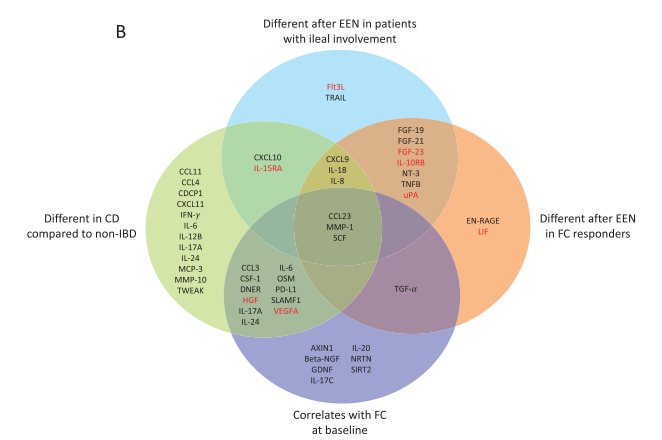
- Exclusive enteral nutrition modified the levels of 19 IRPs (13 increased, 6 decreased including CCL23, interleukin-24, interleukin-6, and MMP-1).
- More pronounced changes in IRP profile were observed in patients with ileal involvement and a ≥50% decrease in fecal calprotectin during EEN.
The discussion notes that “these profiles also helped to uncover some of the underlining pathological mechanisms, with CD demonstrating enhanced levels of IRPs related to IFN-γ and Th1-associated pathways, whereas in UC we observed an enrichment in IRPs related to Th17 pathways.”
My take (borrowed from authors): Inflammation-related protein profiles could help to stratify patients likely to respond to treatment with EEN.
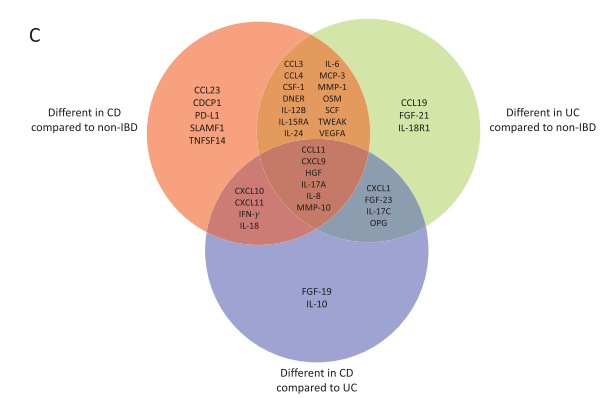
subtype compared to non-IBD controls and between each IBD subtype.
Related blog posts:
 gutsandgrowth
Pingback: Predicting Enteral Nutrition Therapy Response in Patients with IBD - reviewer4you.com