
Y Sunkoy, S Talathi. Am J Gastroenterol 2025; 2190-2193. Utility of the ESPGHAN Biopsy-Sparing Guidelines for Celiac Disease in Children
Thanks to Ben Gold for this reference.
Methods: Retrospective study of patients (n=2942 children) who had celiac serologies and duodenal biopsies
Key findings:
- Prevalence of CD in this cohort was 9% (226 of 2942 patients)
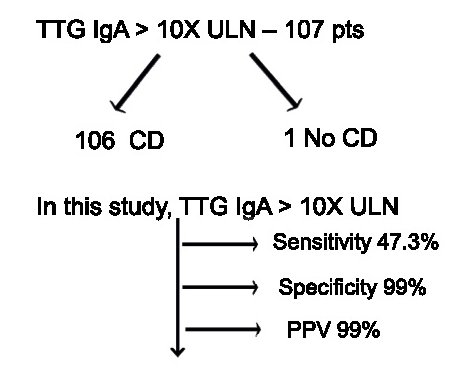
- In those with a high titer (>10xULN), 106 of 107 patients (99%) had celiac disease
- In this cohort, even in those with with >7XULN, had a Sensitivity of 55.3%, a specificity of 99% and a PPV of 97%
In their discussion, the authors note that “we did not obtain an EMA in a second sample, which is recommended in the ESPGHAN guidelines.”
Associated commentary: Erica Brenner, American Journal of Gastroenterology 120(9):p 1985-1986. The No-Biopsy Approach for Pediatric Celiac Disease: Ready for Prime Time in North America?
- “Shiha et al (8) found that the PPV ranged from 65% for a 1% CD prevalence to a 99% for a 40% prevalence. As the 9% CD prevalence in the study by Sunkoj et al (4) exceeds the 0.81$-1.4% prevalence in the United States (9), the reported PPV may overestimate reality.” (Related post: No-Biopsy Approach to Celiac Disease Diagnosis and Positive Predictive Value (Based on Population)
- “Children with type 1 diabetes and trisomy 21 have a higher risk of false-positive serology and therefor may not be appropriated candidates for a no-biopsy approach.”
My take: A larger recent study (Chang et al. Pediatrics. 2025;156(3):e2025070897) found that the no-biopsy approach had a significantly lower PPV in their cohort (94.9% overall, and 95.7% in those without T1DM). Thus, in cohorts with lower prevalence of CD, the no-biopsy approach could lead to 2-4% of children being placed unnecessarily on a gluten free diet. As such, it would be good practice to discuss making a diagnosis via endoscopy vs. the no-biopsy approach as part of shared decision-making.
Related blog posts:
- New Data on the Reliability of the No-Biopsy Diagnosis in Pediatric Celiac Disease
- Dr. Arun Singh: Tips and Tricks to Managing Celiac Disease
- Celiac Risk Among First-Degree Relatives of Index Case
- Celiac Studies: Lower Rates of Undiagnosed Celiac Disease in Norway, and Lower Rates of Celiac with Early Dietary Fiber
- Celiac Disease: Lower TTG-IgA Titers Associated with Isolated Duodenal Bulb Presentation
- 99% Accuracy in Non-Biopsy Diagnosis of Celiac Disease
- The Non-Biopsy Diagnosis of Pediatric Celiac Disease
- What To Do For Pediatric Patients with Non-Responsive Celiac Disease
- Celiac Disease: Pro Tips (Part 1)
- Celiac Disease: Pro Tips (Part 2)
- Celiac Disease: Pro Tips (Part 3)
- Celiac Disease: Pro Tips (Part 4)
- How Many Children with Type 1 Diabetes and High Celiac Titers Have Celiac Disease
- “When is Celiac Disease Celiac Disease?”
- 2023 ACG Celiac Guidelines for Adult and Children
- Taking One ‘Bite’ At A Time -For Celiac Diagnosis | gutsandgrowth
- Celiac Disease: “”80 percent of success is just showing up” | gutsandgrowth
- What To Do For Pediatric Patients with Non-Responsive Celiac Disease
- Treatment of Refractory Celiac Symptoms with a Low FODMAP Diet
- Predicting Risk of Celiac Disease in High-risk Families
- Celiac Advocacy: Food Labeling Modernization Act
- Persistent Villous Atrophy in Celiac Disease Despite a Gluten-Free Diet
- Real-World = Partially-Treated Celiac Disease
- Best Screening For Celiac At All Ages
- Does The Degree of Villous Atrophy Affect Long-Term Outcomes with Celiac Disease? Plus One
- Study May Indicate Biologic Basis for Brain Fog in Persons with Celiac Disease
- @AmyOxentenkoMD: Celiac Disease and Mimics
 gutsandgrowth