
Yesterday’s post (Incredible Video of Lung Cell Cilia) now has an important addendum: a reader’s comment notes that the winning entry is “being re-evaluated following criticism from other scientists that it was made with AI.” Here is an article from the BBC on this investigation: Tiny image sparks big backlash in Nikon photo contest (https://www.bbc.com/news/articles/ck4gjn1yzprno)
L Mathiesen et al. J Pediatr 2026;297:115201. Pediatric Neuroinflammatory and Neuropsychiatric Syndromes Associated with Dupilumab Treatment for Atopic Dermatitis
This case series of children between the ages of 6 and 16 describes the development of serious neurologic sequelae associated with the use of dupilumab for atopic dermatitis. 3 of 4 children had pre-existing genetic or neurodevelopmental conditions, including ADHD, autism spectrum disorder, an ABCD1 mutation, and homozygous FECH mutations.
Case 1: An 11 year old, with a history of ADHD, “developed poor attention, increased hyperactivity, worsening school performance, and aggression after two months of treatment. Over the subsequent 8 months, symptoms gradually worsened and evolved to include irritability, oppositional behavior, vocal and motor tics, language regression, and ultimately suicidal ideation.” After resolution of his atopic dermatitis, he had ~80% improvement off dupilumab. “However, in the setting of atopic dermatitis exacerbation, dupilumab was restarted and was associated with a rapid decline in mental state within 4 weeks leading to dupilumab discontinuation. He continued to decline, developing severe akathisia, tics, language regression, and transient episodes of confusion. Repeat brain MRI showed bilateral symmetric frontotemporal T2 hyperintensity with hyperperfusion without gadolinium enhancement.” Extensive neuropsychiatric evaluation (genetics, autoimmune, CSF analysis) was otherwise unremarkable.
Three of the patients received intravenous methylprednisolone which was associated with improvement. However, the patient in Case#1 has not returned to baseline.
Imaging from Case 4:
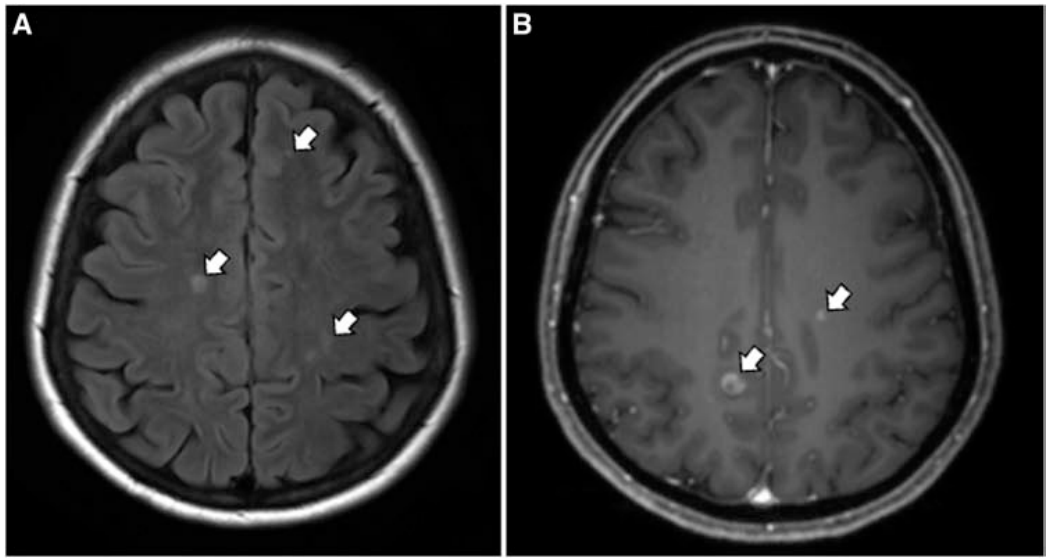
In their discussion, the authors discuss this “previously unreported association between dupilumab and neuroinflammatory syndromes in 4 pediatric patients with atopic dermatitis.” They discuss potential pathophysiology as well statig that dupilumab “may promote classical proinflammatory immune signaling…Although dupilumab is not expected to cross the intact blood-brain barrier, its potential neurological effects could be mediated through peripheral immune modulation. Systemic IL-4/IL-13 blockade could modulate immune cell trafficking to the central nervous system.”
My take: While neurologic adverse effects associated with dupilumab appear to be rare, there should be a low threshold for discontinuation when new neurological symptoms emerge. Only the first case had a rechallenge with dupilumab. This helped establish likely causality; however, this patient did not fully recover when dupilumab was stopped.
Related blog posts:
- How Does Prior Topical Steroids Affect Response to Dupilumab for Eosinophilic Esophagitis
- Dupilumab (Dupixent) for Young Children with Eosinophilic Esophagitis (Published Data)
- “Real-World” Dupilumab for Eosinophilic Esophagitis
- Dupilumab for Eosinophilic Gastritis: DEGAS study
- Normalizing Diet with Dupilumab Therapy
- When to Use Dupilumab for Eosinophilic Esophagitis: Multispecialty Guidelines (2023)
- Landmark Dupilumab Study for Eosinophilic Esophagitis
- Dupilumab for FPIES
- Dupixent Approved in Younger Children (15 kg+) Dosing of dupilumab reviewed on this blog post

