Background: Acuity circles are a geographic and medical prioritization model implemented on February 4, 2020, by the United Network for Organ Sharing (UNOS) to allocate deceased donor livers across the United States. Instead of relying strictly on fixed local Donation Service Areas (DSAs) and broader UNOS regions—which previously led to wide regional disparities in how sick a patient had to be to receive a transplant—the acuity circles system uses concentric distance-based radii measured in nautical miles (NM) from the donor hospital.
The policy was designed to level out the median MELD score at transplant (MMaT) across different parts of the country, ensuring that the sickest patients get priority regardless of arbitrary state or regional lines. Because organs travel farther on average, the system has led to increased median distances from donor to transplant centers, a higher frequency of charter flights (“fly-outs”), longer cold ischemia times, and rising liver acquisition and transportation costs for hospitals.
- KR Driscoll, LM McElroy. Liver Transplantation 2026; 32: 1461-1462. Open Access! Beyond allocation: What multi-listing reveals about equity in transplant access
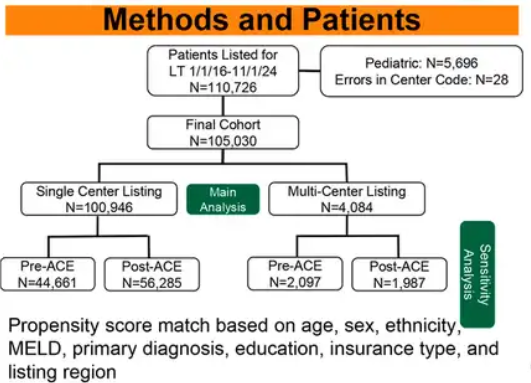
- C Cywes, et al. Liver Transplantation. 2026;32:1596–1603. Predictors and impact of multiple listing for liver transplantation in the United States across the acuity circles eras.
In the commentary by Driscoll and McElroy:
“Multi-listing is controversial, raising questions about the balance between patient autonomy and equity in access to scarce organs…
The central finding of this study is that patients listed at multiple centers were more likely to undergo transplantation than those listed at a single center, both before and after implementation of acuity circles. Multi-listed candidates were also disproportionately White, commercially insured, and more highly educated. These characteristics were also independently associated with transplantation, underscoring the persistent role of socioeconomic advantage in access to care…
Multi-listing remained uncommon, declining from 4.5% to 3.4% following the implementation of acuity circles. As a result, multi-listing itself is unlikely to be a major driver of inequities in transplant access…
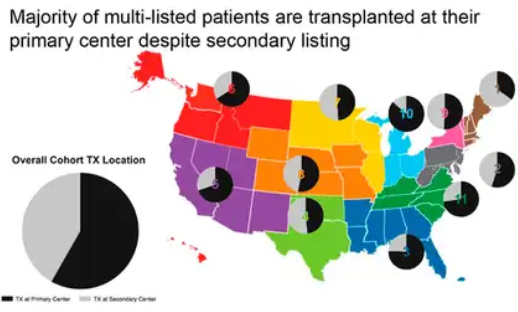
Most multi-listed patients ultimately underwent transplantation at their primary listing center...this observation challenges the conventional view that multi-listing primarily functions as a mechanism for obtaining organs elsewhere. Instead, multi-listing may represent an observable manifestation of broader disparities in patients’ ability to identify, pursue, and successfully navigate opportunities within the transplant system.
My take: Multi-listing has become less important with the current allocation system. Most patients continued to be transplanted at their primary center; however, multi-listing serves as a proxy for those with socioeconomic advantages which are associated with increased likelihood of transplantation.
Unrelated snarky satire from The Onion: Cancer Patient Charged Extra $2,000 To Ring Bell
Related blog posts:
- Liver Transplantation is Getting More Costly in U.S
- Fairness Lost: The Shift in Organ Transplant Practices
- How to Lower Pediatric Liver Transplantation Waitlist Mortality
- Unfortunate or Unfair Disparities in Liver Transplantation
- Liver Transplant Recipients Are Getting Older | gutsandgrowth
- Picking winners and losers with liver transplantation allocation
- Online Aspen Webinar (Part 7) -Liver Organ Allocation
- What Can Go Wrong with Living Liver Transplantation for the Donor
- Projected 20-Year and 30-Year Survival Rates for Pediatric Liver Transplant Recipients (U.S.)
- Costs and Opportunity Costs in Pediatric Liver Transplantation
- Liver Shorts: Relationship of Hepatic Steatosis to Cardiovascular Disease and the Cost of Liver Transplantation
- Financial Toxicity of Liver Transplantation and Cirrhosis