
AGA Practice Update: Acute Hepatic Porphyrias

B Wang et al. Gastroenterol 2023; 164: 484-491. Open Access! AGA Clinical Practice Update on Diagnosis and Management of Acute Hepatic Porphyrias: Expert Review
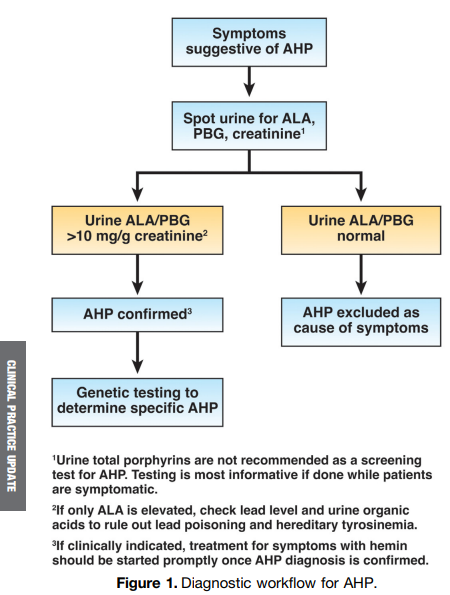
Overall, acute hepatic porphyrias (AHP) are rare disorders. “Acute intermittent porphyria is the most common type of AHP, with an estimated prevalence of patients with symptoms of
approximately 1 in 100,000. The major clinical presentation involves attacks of severe pain, usually abdominal and generalized, without peritoneal signs or abnormalities on cross-sectional imaging…The screening tests of choice include random urine porphobilinogen and d-aminolevulinic acid corrected to creatinine.”

“All patients with elevations in urinary porphobilinogen and/or d-aminolevulinic acid should initially be presumed to have AHP. The cornerstones of management include discontinuation of porphyrinogenic drugs and chemicals, administration of oral or intravenous dextrose and
intravenous hemin, and use of analgesics and antiemetics. Diagnosis of AHP type can be confirmed after initial treatment by genetic testing for pathogenic variants in HMBS, CPOX, PPOX, and ALAD genes.”

Some of the best practice advice:

  • Women aged 15–50 years with unexplained, recurrent severe abdominal pain without a clear etiology after an initial workup should be considered for screening for an AHP.
  • Initial diagnosis of AHP should be made by biochemical testing measuring d-aminolevulinic acid, porphobilinogen, and creatinine on a random urine sample.
  • Genetic testing should be used to confirm the diagnosis of AHP in patients with positive
    biochemical testing.
  • Acute attacks of AHP that are severe enough to require hospital admission should
    be treated with intravenous hemin, given daily, preferably into a high-flow central vein

Related blog posts:

“Turning Purple with Pain”

A recent clinical problem-solving case (TW Fredrick et al. NEJM 2021; 385; 549-554. Turning Purple with Pain) is a good review on episodic pain and acute intermittent porphyria (AIP).

The case presentation regarded a 32 yo with episodic severe pain for 10 years (associated with constipation) that required morphine. Episodes occurred every month or two and lasted for several days. Some clues in this case included the development of hyponatremia, purple urine, and an episode in which she was “out of it.” This episode was attributed to opioid use and providers were concerned about opioid-seeking behavior and a conversion disorder.

She had extensive evaluations including imaging, panendoscopy, and labs. Atypical labs included serum tryptase, cortisol, and C1 esterase inhibitor level. Ultimately, her constellation of findings led to a urine porphyrin levels which disclosed elevated porphobilinogen (PBG) and delta-aminolevulinic acid. The diagnosis of AIP was confirmed with genetic testing.

Key points:

  • AIP results from mutations in HMBS, the gene encoding hydroxymethylbilane synthase which plays an integral role in heme synthesis
  • AIP is rare, affecting about 5 people per million; age of onset is typically 18-45 years of age
  • In a case series, 18% of patients with AIP reported nearly constant abdominal pain symptoms, 73% had nausea/vomiting, 60% have constipation, and 55% had anxiety/depression.
  • Associated conditions included hypertension ((43%), peripheral neuropathy (43%), chronic kidney disease (29%), psychiatric disorders (22%), palpitations (19%), seizures (9%), cirrhosis (2%), and hepatocellular carcinoma (1%)
  • Flares of AIP may be triggered by alcohol, infections, low caloric intake, and medications (especially seizure medications and hormonal contraceptives)
  • The urine can appear red or brown and darkens on exposure to oxygen, light or heat. Purple urine reflects very high urinary PBG levels

My take: This article provides a useful overview. AIP needs to be considered in adolescents with severe abdominal pain that results in hospitalization (especially if episodic).

Related blog post: Liver Shorts -June 2020 (with AIP article)

Also, data supporting COVID-19 effectiveness in reducing the risk of hospitalization–CDC study shows unvaccinated people are 29 times more likely to be hospitalized with Covid (CNBC)

Sterling Pond. Jeffereson, VT