Fairness Lost: The Shift in Organ Transplant Practices

BM Rosenthal et al. NY Times 2/26/25: Organ Transplant System ‘in Chaos’ as Waiting Lists Are Ignored

An excerpt:

The sickest patients are supposed to get priority for lifesaving transplants. But more and more, they are being skipped over…For decades, fairness has been the guiding principle of the American organ transplant system…today, officials regularly ignore the rankings, leapfrogging over hundreds or even thousands of people when they give out kidneys, livers, lungs and hearts…

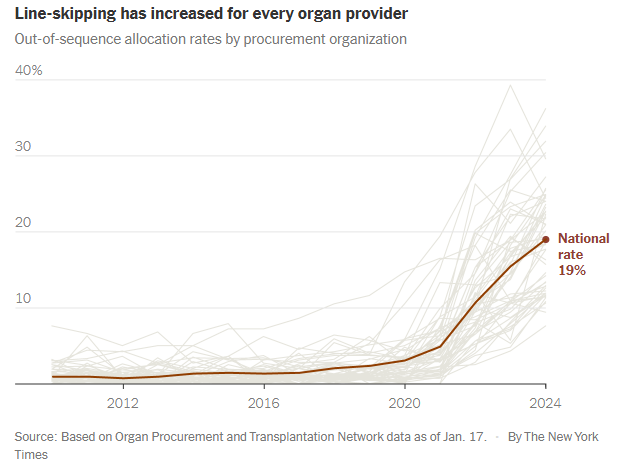
Last year, officials skipped patients on the waiting lists for nearly 20 percent of transplants from deceased donors, six times as often as a few years earlier. It is a profound shift in the transplant system, whose promise of equality has become increasingly warped by expediency and favoritism…

Under government pressure to place more organs, the nonprofit organizations that manage donations are routinely prioritizing ease over fairness. They use shortcuts to steer organs to selected hospitals, which jockey to get better access than their competitors.

These hospitals have extraordinary freedom to decide which of their patients receive transplants, regardless of where they rank on the waiting lists. Some have quietly created separate “hot lists” of preferred candidates...

More than 100,000 people are waiting for an organ in the United States, and their fates rest largely on nonprofits called organ procurement organizations…

The procurement organization is supposed to offer the organ to the doctor for the first patient on the list. But the algorithms can’t necessarily identify exact matches, only possible ones. So doctors often say no, citing reasons like the donor’s age or the size of the organ…

Until recently, organizations nearly always followed the list. On the rare occasion when they went out of order and gave the organ to someone else, the decision was examined by the United Network for Organ Sharing — the federal contractor that oversees the transplant system — and a peer review committee. Ignoring the list was allowed only as a last resort to avoid wasting an organ...

Procurement organizations regularly ignore waiting lists even when distributing higher-quality organs. Last year, 37 percent of the kidneys allocated outside the normal process were scored as above-average…

Skipping patients is exacerbating disparities in health care. When lists are ignored, transplants disproportionately go to white and Asian patients and college graduates

How a rare shortcut became routine

In 2020, procurement organizations felt under attack. Congress was criticizing them for letting too many organs go to waste. Regulators moved to give each organization a grade and, starting in 2026, fire the lowest performers... the organizations increasingly used a shortcut known as an open offer. Open offers are remarkably efficient — officials choose a hospital and allow it to put the organ into any patient...

Open offers are a boon for favored hospitals, increasing transplants and revenues and shortening waiting times. When hospitals get open offers, they often give organs to patients who are healthier than others needing transplants…Healthier patients are likelier to help transplant centers perform well on one of their most important benchmarks: the percentage of patients who survive a year after surgery...

It is impossible to gauge whether line-skipping prevents wasted organs. But data suggests it does not. As use of the practice has soared, the rate of organs being discarded is also increasing.
My take: This article was eye-opening for me as I am not actively involved in listing patients for transplantation. I was unaware of this increasing tendency of line-skipping and open source allocation. It is disturbing to see the distribution process undermined in this manner –better oversight is needed to assure fairness for those whose lives are at stake.

Related blog posts:

Need Liver, Will Travel (2019)

A recent study (AJ Kwong et al Clin Gastroenterol Hepatol 2019; 17: 2347-55) quantifies the potential advantage of moving to receive a liver transplant. This had been discussed in 2016 blog post as well (Need Liver, Will Travel)

During the study period (2004-2016), there were 104,914 waitlist registrations.

Key findings:

  • 60.985 patients received a liver transplant during the study period
  • 2930  (2.8%) pursued listing at a distant center
  • Distant listing was associated with a 22% reductinon in the risk of death within 1 year

My take: this study highlights socioeconomic disparity in acquiring a liver transplant along with potential geographic disparities.

Related article:

“Transplantation Traffic –Geography as Destiny for Transplant Candidates” NEJM 2014; 271: 2450-52.  Describes ongoing geographic inequality in organ distribution and obstacles to improving allocation.

Related blog posts:

Botanical Garden,, Chicago

How Does USA Compare to Other Countries in Pediatric Liver Transplantation

A recent study (B Fischler et al. JPGN 2019; 68: 700-05) compared the similarities and differences in allocation experience among 15 countries based on a survey completed by a representative hepatologist in each country.

Key findings:

  • The number of liver transplants was 4 to 9 million inhabitants younger than 18 years for 13 of the 15 respondents. USA had the 5th highest rate at ~7 per million inhabitants (Figure 2)
  • USA had the 3rd highest donation rate per million inhabitants, ~26 per million.  Spain had highest rate at 35 per million.  This is partly related to Spain allocating all nonugent pediatric cadaveric donors to pediatric candidates.
  • USA had the 3rd lowest rate of living-related liver transplantation percentage in children < 2 yrs, approximately 10%.  Both Turkey and Poland had rates near 90%.
  • USA had one of the lowest rates of %split liver transplantations for children <2 yrs, less than 10%. Italy, Netherlands, and New Zealand had rates near 90%.
  • USA had the 4th highest waitlist mortality for children <2 yrs, approximately 11%

My take: This study indicates that the rate of split liver transplants and living related liver transplants are much lower in USA than in other countries.  This is likely to reduce donor pool and contribute to increased waiting list mortality.

Related blog posts:

EXCEPTIONal Outcomes and Liver Allocation

A recent study (Hepatology 2015; 61: 285 & editorial 28-31) takes a closer look at US liver organ allocation and outcomes.

The editorial notes that our allocation in the US is targeted towards “need.” Since February 2001, the MELD score was adopted with “the stated aim of reducing deaths on the waiting list.”  Other potential aims:

  • Equity –so any one who might benefit from a graft has an equal chance and a first-come, first-served approach is adopted
  • Utility –organs are allocated to the recipient who is likely to have the best outcomes
  • Benefit –organs are allocated to the patient who has the greatest benefit, so taking into account the risks of dying with and without a transplant
  • Fairness — ‘an ill-defined combination of all the approaches’

The editorial notes that “despite the concerns the approach has been highly effective in achieving its goal in reducing waiting list mortality.”

“Like any system, it can be manipulated and, given the life-saving nature of transplantation, it is scarcely surprising that both legal and illegal methods have been adopted to artificially raise the MELD score and distort allocation.”

The study reviewed 78,595 adult liver transplant candidates (2005-2012).  27.3% of the waiting list was occupied by candidates with exceptions.

Candidates with exceptions fared much better on the waiting list compared to those without exceptions in mean days waiting (HCC 237 versus non-HCC 426), transplantation rates (HCC 79.1% versus non-HCC 40.6%), and waiting list death rate (HCC 4.5% versus non-HCC 24.6%).

The editorialists recommend that “we should consider diverting some of the resources used to develop and implement a perfect allocation scheme into increasing the number of donors and livers used for transplant and, in the longer term, finding treatments and interventions that will render liver transplantation a treatment of historic interest.”  Now that’s a lofty goal.

Related blog posts:


Geographic Inequity for Liver Transplantation

Organ scarcity remains a big problem for liver transplantation.  Use of the Model for End-Stage Liver Disease (MELD) score was intended to address inequity in liver transplantation allocation.  However, it has not been successful.  One recent study which examines donation after cardiac death versus brain death (Liver Transpl 2012; 18: 630-40) also yields some insight into liver transplantation allocation across the U.S.

In Figure 3, the thirty-day probability of receiving a liver transplantation (brain death donation) for patients with MELD score >20 was compared across UNOS regions.  In regions 3 and 11 (Southeastern U.S. extending to Kentucky and Virginia), the rate was ≥40%.  In region 1 (Northeastern U.S) and region 5 (Southewestern U.S.) , the rates were 9.6% and 11.8% respectively.  Thus, some patients with the exact same MELD score have a 4-fold higher probability of receiving a liver transplant.

Related blogs:

Alive and well? 10 years after liver transplantation

Picking winners and losers with liver transplantation allocation

Big gift, how much risk

Sarcopenia, fatigue, and nutrition in chronic liver disease

Picking winners and losers with liver transplantation allocation

From a pediatric hepatology viewpoint, I’ve always been concerned that scoring systems  do not favor children.  More data is now available relevant to this topic:

  • Goldberg et al. Liver Transplantation 2012; 18: 434-43, editorial: 381-83 
  • Sepulveda et al. Liver Transplantation 2012; 18: 413-422, editorial: 389-90

These articles and the editorials look at the model for end-stage liver disease (MELD) and exceptions for hepatocellular carcinoma (HCC) as well as the issue of split livers to expand the donor pool.

The goals of liver transplantation allocation is to distribute livers to  minimize waiting list mortality, to distribute this valuable resource fairly, and to improve long-term outcomes.  How are we doing?

With regard to HCC, the authors indicate that the current policy is increasing the number of individuals transplanted with this indication.  Before MELD, 4.6% of all transplants were for candidates with HCC.  Between 2002-2007, the number increased to 26%.  This has dramatically improved the outcomes in this previously almost universally fatal disease.

But is the priority afforded by MELD priority unfair?  From 2005-2009, Goldberg et al show that the rate of individuals with HCC removed from the waiting list because of death or disease progression was much lower than non-HCC patients: 4.2% vs. 11% (90-day waitlist outcome).  Patients with HCC with exception points were 2.62 times less likely to die by waiting.  Thus, the authors conclude that allocating 22 MELD points to HCC patients greatly overestimates 90-day mortality.  Other conditions that receive 22 MELD points include candidates with hepatopulmonary syndrome, cholangiocarcinoma, cystic fibrosis, familial amyloidotic polyneuropathy, and portopulmonary syndrome.

Sepulveda et al performed a retrospective review of the experience from split liver transplantation in French adults.  In their cohort of 36 patients who received extended right grafts from split livers, there were increased complications.  Only 21 patients had a relatively easy postoperative course.  Six patients required retransplantation.  Overall survival rate was 84.2% and 77.7% at 1 and 5 years.  Complications were related to ischemia of hepatic segment 4.

In the editorial, Riccardo Superina makes several important points:

  • Many centers have equivalent outcomes for whole and split livers; there is likely a learning curve to improve technique.
  • In the U.S., between 2002-2009, only 288 split livers grafts were performed in adults whereas there were >29,000 whole liver transplants performed.
  • In the U.S. children have the highest mortality rates on the waiting list.  In 2008, 18% of children died without a chance for liver transplantation.
  • In France, allocation policy dictates that livers from all donors less than 30 years old should be directed to children first with the stipulation of liver splitting.  If this policy were adopted in US, it could alleviate the organ shortage for children who are currently most disadvantaged by UNOS (United Network for Organ Sharing) allocation policy.

Related blog posts:

Big gift, how much risk

Sarcopenia, fatigue, and nutrition in chronic liver disease

A liver disease tsunami

Additional references:

  • -Am J Transplant 2010; 10: 1643-48.  HCC patients advantaged with current allocation
  • -Clin Gastro & Hep 2008; 6: 1255. solutble TNF receptor 75 better at predicting mortality risk than MELD>
  • -Gastroenterology 2008; 135: 1568. MELD has changed allocation -less-ill patients now getting higher risk organs.
  • -Liver Transplantation 2006; 12: S128-S136. Guidelines for exceptions (increased status)
  • -Liver Transplantation 2006; 12: 12-15, 40-45. 53% of pediatric livers allocated based on other factors (eg. exception, status 1) than PELD score
  • -Gastroenterology 2003;124: 91-96, 251. MELD scores works fairly well in adults; factors in bilirubin, INR, creatinine.