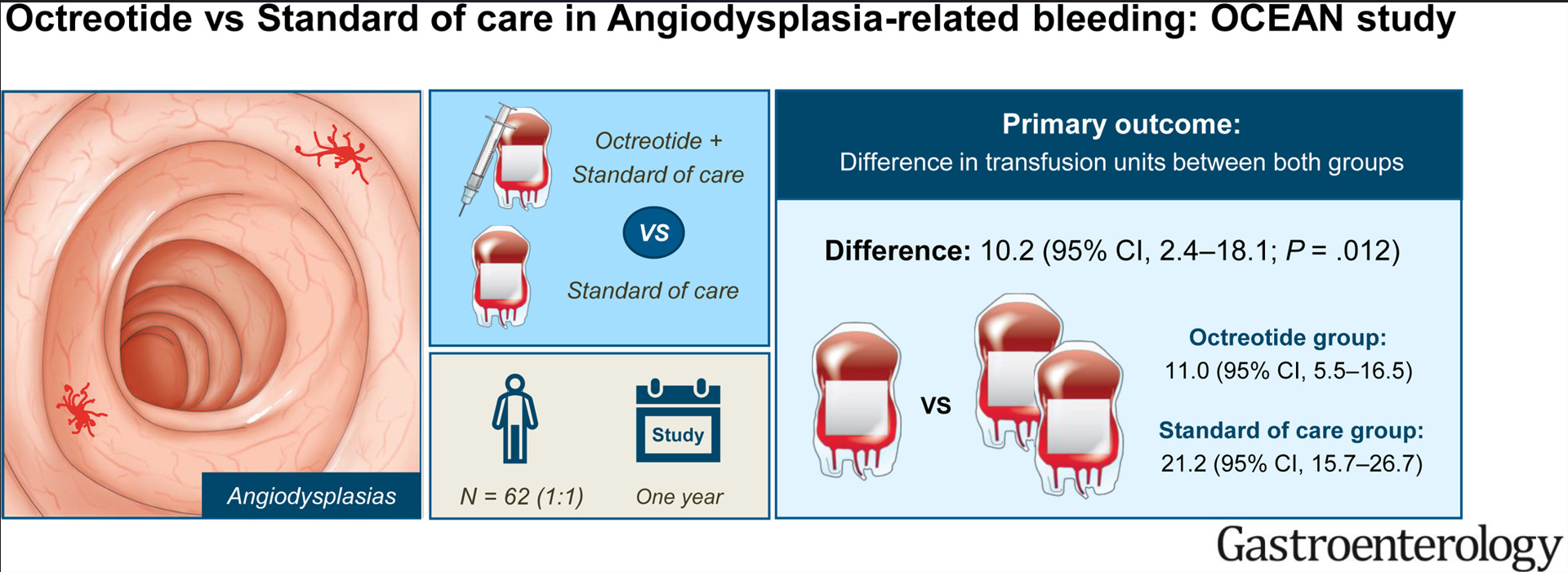
Octreotide in Angiodysplasia-Related Bleeding (the OCEAN Study)

LCMJ Goltstein et al. Gastroenterolog 2024; 166: 690-703. Open Access! Standard of Care Versus Octreotide in Angiodysplasia-Related Bleeding (the OCEAN Study): A Multicenter Randomized Controlled Trial

Methods: The study was designed as a multicenter, open-label, randomized controlled trial. Patients with angiodysplasia bleeding were required to have had at least 4 red blood cell (RBC) units or parental iron infusions, or both, in the year preceding randomization. Patients were allocated (1:1) to 40-mg octreotide long-acting release intramuscular every 28 days or standard of care, including endoscopic therapy.

Key findings:

  • Baseline: Patients (n=62, with mean age 72 years) required a mean number of 20.3 transfusion units and 2.4 endoscopic procedures in the year before enrollment.
  • During Study: The total number of transfusions was lower with octreotide (11.0) compared with standard of care (21.2). Octreotide reduced the annual volume of endoscopic procedures by 0.9.
  • Adverse events: Octreotide-related AEs were common (65%);however, these AEs were mild and self-limiting nature. They “rarely elicit treatment discontinuation.”
mean number of transfusion units patients in the octreotide
group and standard of care group

My take: Fortunately (for me), angiodysplasia is quite rare in the pediatric age group. In adults, octreotide helps reduce transfusions and need for endoscopy.

Related blog posts:

Is Thalidomide the Best Therapy for Angiodysplasia?

Chen H, et al. NEJM 2023; 389: 1649-1659. Thalidomide for Recurrent Bleeding Due to Small-Intestinal Angiodysplasia

In this multicenter, double-blind, randomized, placebo-controlled trial, 150 adult patients underwent randomization: 51 to the 100-mg thalidomide group, 49 to the 50-mg thalidomide group, and 50 to the placebo group. Thalidomide has antiangiogenic activity, with inhibition of VEGF.  It also has many adverse effects of thalidomide including peripheral neuropathy, fatigue, and teratogenic effects.

Key finding:

  • The percentages of patients with an effective response in the 100-mg thalidomide group, 50-mg thalidomide group, and placebo group were 68.6%, 51.0%, and 16.0%, respectively

Discussion points -(from the associated editorial by Loren Laine): The data for thalidomide for small-intestinal angiodysplasia is “of higher quality than evidence for any other therapy for this indication. In addition,….thalidomide may be disease-modifying, with efficacy persisting after discontinuation. However, many clinicians will still use somatostatin analogues first” due to convenience and safety.

My take: I am glad this is a rare problem in pediatrics. I am not at all excited about using thalidomide.

Related blog posts:

GI bleeding in Heyde’s syndrome

This eponym is derived from E.C. Heyde, a general practitioner from Vancouver, Washington who observed in 1958 that patients with calcific aortic stenosis were prone to massive gastrointestinal bleeding.  This clinical observation now has a molecular insight (NEJM 2012; 367: 1954-56).

Submucosal angiodysplasia was identified as the source of GI bleeding.  This in turn was discovered to be related to an acquired von Willebrand’s syndrome.  What’s happening is that elevated shear stress coverts the globular von Willebrand polymer into an elongated asymmetric protein.  This conformational change exposes a site to the protease ADAMTS13 which binds  and cleaves the protein, leaving a less competent smaller von Willebrand factor.

Another observation is that the von Willebrand factor is essential for the role that platelets have in maintaining vascular integrity.  Degradation of von Willebrand factor as in Heyde’s syndrome allows for the development of the angiodysplasia in these patients and it leads to an intrinsic vascular diathesis in young patients with hereditary von Willebrand’s disease.

It is pretty cool to see how the science explains the clinical picture.