INNOCENT Study: Psychological Impact for Gastroenterologist Associated with Procedural Complications

Holzwanger, Erik A. et al. Gastroenterology 2025. Psychosocial Impact of Endoscopic Procedural Complications on Gastroenterologists: The Second Victims

Background: “Serious adverse events (SAEs) are unavoidable occurrences for those performing complex endoscopic interventions. These affect not only the patient (the first victim), but also possibly the proceduralist (the second victim). Second victim syndrome (SVS) was first described by Dr. Wu detailing the negative psychological effects of adverse patient events on physicians (Ref: Wu AW. Medical error: the second victim. BMJ. 2000;320(7237):726-727).”

Methods: Survey responses form “X” platform (n=195) were collected in 2023. Only
responses from advanced endoscopists (defined as those who perform either endoscopic
ultrasound or endoscopic retrograde cholangiopancreatography annually) and advanced
endoscopy fellows were included.

Key findings:

  • Higher procedural volume (>1000/year) was associated with feelings of greater emotional preparedness for SAEs
  • Speaking with colleagues (53%), exercise (33%), discussions at conferences (17%) and meditation (8%) were rated as used and very or extremely helpful
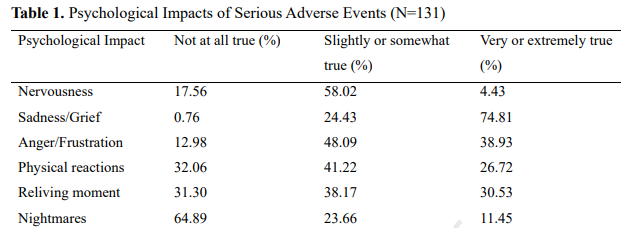
Discussion Points: “Peer support programs have proven to be well received and highly utilized. Additionally, surgeons criticize the often-punitive handling of SAEs, and note that the tone and culture in the review process following an SAE dictates reduction or exacerbation of SVS.”

My take: When I have had a complication in a patient, speaking with colleagues has provided a lot of support. One book I have recommended to others is the following: Complications: A Surgeon’s Notes on an Imperfect Science by Atul Gawande.

Related article (2022): “We Suffer in Silence” The Challenge of Surgeons as Second Victims

Related blog posts:

Improved Understanding 18 Years Later

A deeply painful experience for me occurred 18 years ago when a child that I cared for had a complication following an endoscopy.  Now, a recent publication (A Sierra et al. JPGN 2016; 63: 627-32) provides relevant information.  To be clear, this article would not have averted the complication but may help explain why it happened.

This retrospective study from 2010-2014 identified 7 cases of biopsy-induced intraduodenal hematoma (IDH) from a total of 2705 nontherapeutic upper endoscopies and 1163 duodenal biopsies.

Key findings:

  • 6 of 7 children had undergone a bone marrow transplantation and were at risk for graft-versus-host disease (GVHD)
  • 1 had Noonan syndrome
  • Thrombocytopenia was NOT correlated with IDH
  • No early perforations were associated with IDH

As part of this study, the authors reviewed the entirety of published IDH in children, 47 cases.  One prior author, Sahn et al (JPGN 2015; 60: 69-74) suggested that any organ transplant could increase the risk of IDH.  In this series, 29% of their patients had undergone transplantation (2 liver, 1 heart, 1 BMT).  Interestingly, among the entire 47 cases, there had been another report of a child with Noonan syndrome, suggesting some underlying susceptibility in the coagulation or platelet function pathways.

Clinical features of IDH:

  • Following endoscopy, particularly the first 3 days, signs/symptoms included epigastric pain, abdominal tenderness, and vomiting
  • Imaging including U/S, CT and MRI can confirm diagnosis
  • Resolution can take 2-3 weeks, during which parenteral nutrition is needed
  • IDH can cause acute pancreatitis or obstructive cholestasis
  • In trauma-induced IDH, surgery is much more likely than with endoscopic/biopsy-induced IDH

My take: BMT (and other types of transplantation) markedly increase the risk of biospy-induced duodenal hematoma. In this series, 7% of BMT patients had IDH compared with 0.1% of all others.

Related blog posts:

Jones Bridge & Chattahoochee River

Jones Bridge & Chattahoochee River

Adverse Events Following Pediatric Endoscopy –Underestimated Previously

A recent study (RE Kramer, MR Narkewicz. JPGN 2016; 62: 828-33) report the frequency of adverse events that occurred within 72 hours in a prospective observational cohort of 9577 patients from a single center.

The authors characterized complications more precisely and identified a much higher rate of complications than what has previously been reported.  Key findings:

  • The overall adverse event rate was 2.6% with 1.7% of all cases requiring unanticipated medical care.
  • Absolute risk of bleeding was 0.11%, infection 0.07%, and perforation 0.1% (n=12).  In total, these standard measures of complications were 0.28%.
  • Advanced and therapeutic cases had much higher rates of adverse events. Perforations occurred after esophageal dilatation (5), esophageal food impaction (1), polypectomy (4), and primary GJ placement (2).
  • Adverse rate with ERCP was 11.54%
  • Adverse rate with PEG was 10.71%
  • Adverse rate with dilatation was 10.94%.  It is noted that a total of 319 dilatations were reviewed.  5 had perforations.
  • Adverse rate with polypectomy was 6.27%.  It is noted that a total of 128 polypectomies were reviewed.  4 had perforations.
  • The authors did not identify a significantly higher complication rate with trainee physicians.

As noted in a previous entry (see below), studies in adults have an estimated a perforation rate of 0.09% and serious complication rates (GI and non-GI complications) of 0.15% for upper endoscopy and of 0.2% for colonoscopy. In addition, a large pediatric study of endoscopies, found a perforation rate of 0.014% for EGDs and 0.028% for colonoscopies. Thus, this report identifies a higher rate (10-fold) of perforation (driven by therapeutic endoscopy) and a much higher rate of adverse events, including 2.08% in diagnostic EGD and 3.9% for diagnostic colonoscopy.  Furthermore, for diagnostic EGD and for diagnostic colonoscopy, grade 2 (needing ER or unanticipated physician evaluation) or higher adverse events occurred in 1.21% and 2.31% respectively.

My take: Using a broader (and more accurate) definition of complications after endoscopy, the authors have demonstrated a much higher rate of adverse events, particularly following dilatation, PEG, polypectomy, and ERCP.  This report indicates that our preop counseling needs to be modified to inform families that complications are not quite so rare.

Related blog post:  High Endoscopy Complication Rate After Intestinal …

Complication -Unrelated to endoscopy:

pontine myelinosis

High Endoscopy Complication Rate After Intestinal Transplantation

A recent study (J Yeh et al. JPGN 2015; 61: 636-40) indicated a high rate of endoscopy complications in pediatric patients who have undergone intestinal transplantation.

Key points:

  • Complications: In this single-center study with 1770 endoscopies (1014 sessions), the serious GI complication rate was 1.8% (32/1770).  The complications included 11 GI perforations, 13 GI bleeds, 6 GI hematomas, 1 gastric mucosa avulsion, and 1 distention from retained air. The authors’ database was not designed to capture cardiopulmonary complications.
  • In comparison, the authors note that adults without intestinal transplantation have an estimated a perforation rate of 0.09% and serious complication rates (GI and non-GI complications) of 0.15% for upper endoscopy and of 0.2% for colonoscopy. In addition, a large pediatric study of non-transplant patient endoscopies, found a perforation rate of 0.014% for EGDs and 0.028% for colonoscopies. Thus, the authors are reporting a perforation rate (11 of 1770) that is more than 20-fold higher than this pediatric study’s colonoscopy perforation rate.
  • Their techniques are well-described. For example, “for ileoscopies, 2 to 3 sites each consisting of 2 to 3 biopsies were also taken every 5 to 10 cm from the distal graft…typically surveyed up to 50 to 60 cm from the ostomy or ileocolonic anastomosis.”
  • The reasons for endoscopy were most frequently related to diarrhea/stool output in 35% and for surveillance in 32%.
  • The other interesting finding was that “of histology-proven rejections, 45% had normal-appearing endoscopies.”

The authors recommend that patients with intestinal transplantation should have endoscopy at a specialized center with teams who are intimately familiar with these children.

My take: I worry that the high complication rates reported at this center may indicate that individuals (perhaps in training) who are less familiar with the patient’s anatomy are performing many of these endoscopies.  I think individuals very familiar with the patient’s anatomy are best-suited to perform these endoscopies; this may limit some individuals at these specialized centers and may include some skilled endoscopists outside of intestinal transplant centers.

Related blog postSomething Bad is Going to Happen | gutsandgrowth

Galapagos

Galapagos