
Universal Cholesterol Screening: The LEAD Initiative

JN Flyer et al. The Journal of Pediatrics, Volume 288, 114804. Accelerating Guideline-Recommended Universal Pediatric Lipid Screening: Launch of the LEAD Pediatric Initiative

Background: “Recent studies demonstrate only 11% of youth between 9 and 21 years of
age in the United States (US) had documented lipid screening, and 30%-60% of youth with dyslipidemia may be missed by targeted screening alone (ie, risk factors) compared with ULS [universal lipid screening]. Identification of youth living with familial hypercholesterolemia (FH) has the added benefit of triggering reverse cascade screening of family members, which can further identify at risk youth and adults.”

“In 2024, the Family Heart Foundation (FHF) established the Leveraging Evidence and Data (LEAD) for Pediatric Cholesterol Screening Initiative…The focus was not on creating new screening guidelines, but on developing strategies that will lead to better implementation of the current NHLBI/AAP screening recommendations, and with the overall goal of reducing global ASCVD [atherosclerotic cardiovascular disease] burden.”

In FH, untreated elevated levels of LDL-C in childhood significantly increase the risk for premature atherosclerotic cardiovascular disease (ASCVD), which is the leading cause of death both in the US and worldwide. However, early initiation of statin therapy for children living with FH reduces the ASCVD risk in adulthood.”

Key points:

Three common barriers to pediatric ULS were identified.

  • First, many parents and caregivers are not aware of the current pediatric lipid screening guidelines.
  • Second, the major rationale for ULS in young children and adolescents—early identification of a treatable genetic condition—may not be clear to patients, families, and/or clinicians.
  • Third, the values and concerns of families may be dismissed by clinicians if there is a misunderstanding of the rationale for ULS

Practical ways to improve ULS:

  • Improve education of parents and clinicians that ULS can reduce the risk of premature death from the leading cause
  • Point-of-care testing
  • EHR prompts
  • Develop physician “FH champions”

The article notes that a survey in 2017 showed that many PCPs were unaware of the national guidelines. In addition, “few were comfortable prescribing a lipid-lowering therapy.”

Recommended PCP Screening Algorithm:
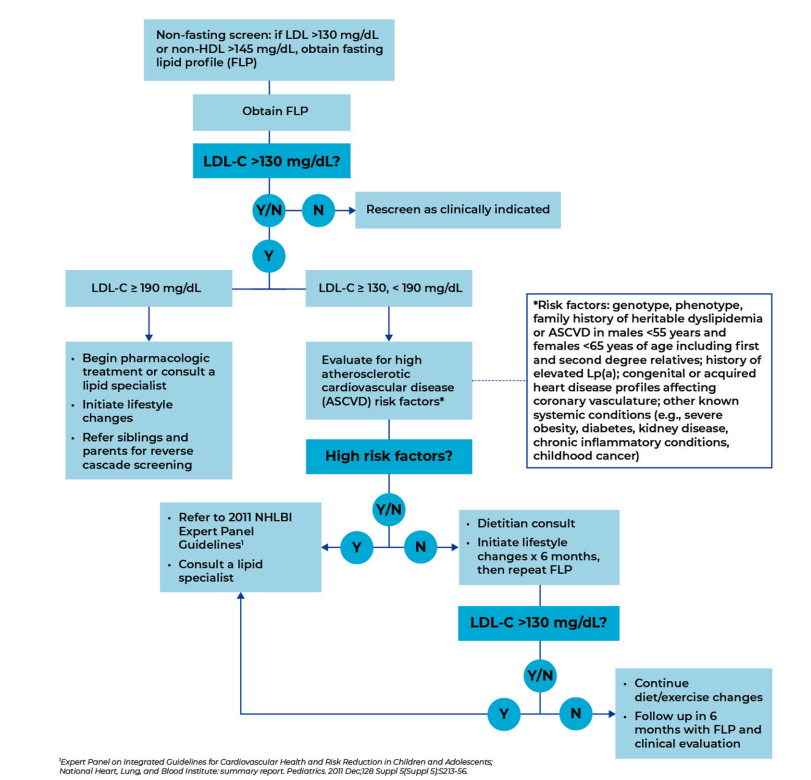
My take: It is unfortunate that this article, which has an aim to improve awareness for universal pediatric lipid screening (ULS), is not an open access article. Incentives to implement lipid screening could help — screening rates are quite low despite guidelines that were published 14 yrs ago.

Related blog posts:

  • The Case for Universal Cholesterol Screening During Childhood (2024) — An excellent summary of the need/rationale for ULS. Heterozygous FH (HeFH) is the second most common potentially fatal genetic disorder in humans, affecting 1 in 250-300 people.8…Homozygous FH (HoFH) [is] much rarer, occurring in 1:250 000-1:360 000 people.. Proof that screening can make a difference:
  • Treatment Outcomes in Children and Adolescents with Hypercholesterolemia In a 20-year follow-up study, Luirink et al studied a cohort of individuals with genetically confirmed HeFH who had initiated statin therapy in childhood. When compared with their HeFH parents who had not had the benefit of childhood therapy, statins virtually eliminated excess ASCVD risk in adulthood. At age 40, 26% of parents had experienced a cardiac event and 7% had died of ASCVD, whereas only 1% of the those treated as children had needed a vascular procedure (coronary artery stenting) and none had died.

With regard to incentives, a recent commentary (DM Cutler, RS Huckman. NEJM 2025;  2025;393:2177-2180. Has Corporatization Met Its Match? The Challenge of Making Money by Keeping People Healthy) notes that the U.S. health system has financial incentives that rewards care for individuals who are sick rather than keeping patients healthy. “The system focuses its resources primarily on treatment rather than prevention…The dearth of successful business models aimed at keeping people healthy highlights one of the central challenges of the growing corporatization of health care: how to make money producing health, not just health care. The path to doing so will require fundamental changes in the incentives for individuals and institutions and, potentially, broader structural change by policymakers to increase access to or financial support for basic preventive care.”

Disclaimer: This blog, gutsandgrowth, assumes no responsibility for any use or operation of any method, product, instruction, concept or idea contained in the material herein or for any injury or damage to persons or property (whether products liability, negligence or otherwise) resulting from such use or operation. These blog posts are for educational purposes only. Specific dosing of medications (along with potential adverse effects) should be confirmed by prescribing physician.  Because of rapid advances in the medical sciences, the gutsandgrowth blog cautions that independent verification should be made of diagnosis and drug dosages. The reader is solely responsible for the conduct of any suggested test or procedure.  This content is not a substitute for medical advice, diagnosis or treatment provided by a qualified healthcare provider. Always seek the advice of your physician or other qualified health provider with any questions you may have regarding a condition.

Possible Quality Metric for Fatty Liver Disease: Dyslipidemia

With nonalcoholic fatty liver disease (NAFLD), it is well-documented that adverse cardiovascular events influence mortality more than any other factor.  Dyslipidemia plays an important role in these outcomes.

A recent study (KE Harlow et al. J Pediatr 2018; article in press. DOI: https://doi.org/10.1016/j.jpeds.2018.02.038) indicates that “clinically actionable dyslipidemia” is present in more than half of pediatric patients with NAFLD.

This multicenter, longitudinal cohort study included children (n=585) with NAFLD enrolled in the National Institute of Diabetes and Digestive and Kidney Diseases Nonalcoholic Steatohepatitis Clinical Research Network.

Key findings:

  • The prevalence of children warranting intervention for low-density lipoprotein cholesterol at baseline was 14%. After 1 year of recommended dietary changes, 51% achieved goal low-density lipoprotein cholesterol, 27% qualified for enhanced dietary and lifestyle modifications, and 22% met criteria for pharmacologic intervention
  • Elevated triglycerides were more prevalent, with 51% meeting criteria for intervention at baseline. At 1 year, 25% achieved goal triglycerides with diet and lifestyle changes, 38% met criteria for advanced dietary modifications, and 37% qualified for antihyperlipidemic medications.

My take: Assessing/managing dyslipidemia is an important component of NAFLD care.

Link to abstract: Clinically Actionable Hypercholesterolemia and Hypertriglyceridemia in Children with Nonalcoholic Fatty Liver Disease

Related blog posts:


Treatment Outcomes in Children and Adolescents with Hypercholesterolemia

A recent study (MM Mendelson et al. J Pediatr 2016; 178: 149-55) provides some useful data indicating that statin therapy for children and adolescents is typically effective based on cholesterol reduction levels.

This observational study prospectively collected data from 2010-2014 among 1521 pediatric patients seen for a lipid disorder.  In this cohort, 1260 patients (83%) did not receive statin therapy during the study period.  Ultimately, 97 patients (6% of clinic cohort) had received statin therapy and had adequate data for evaluation.

  • 70 patients received simvastatin: 1 at 5 mg/day, 26 at 10 mg/day, and 43 for 20 mg/day.
  • 24 patients received atorvastatin: 22 at 10 mg/day and 2 at 20 mg/day
  • 3 patients received pravastatin: 2 at 10 mg/day and 1 at 20 mg/day

Primary outcome for therapy: LDL-C <130 for patients without high risk factors and <110 for patients with high risk condition(s) (eg. diabetes mellitus, end-stage renal disease, heart transplant, Kawasaki disease with aneurysms)

Key findings:

  • Median baseline LDL-C was 215.
  • LDL-C decreased by 37% on average (83 mg/dL) within the first 60 days of therapy
  • Achieved primary outcome: 60% at 1 year,  73% at 2 years, and 87% at 3 years
  • No patients presented with relevant hepatic or myopathic side effects. 2 of 97 had transient epiosde of ALT > 3 x ULN.

Discussion:

  • Overall, the reported outcomes in this select cohort were at least as good as outcomes reported in studies of adults in the general population.  This may be due to parental supervision or perhaps due to a better physiologic response. In addition, as this was an observational study, poorly adherent patients may be lost to follow-up and would not be accounted for.
  • Currently statin therapy is recommended if lifestyle modifications are not sufficient to lower LDL-C.  Thus, “it is estimated that more than 700,000 US children and adolescents may be eligible for statin therapy according to the 2011 NHLBI guidelines.”

My take: Since cholesterol and LDL-C are biomarkers of treatment, the long-term benefit (& possible risks) of statin therapy remains unclear .  However, more data on meaningful endpoints like heart attacks and strokes could take decades.  Until then, the best evidence available suggests that the potential benefit of statin therapy could be quite substantial.

Related posts:

waterwarriors

Omega-3 Fatty Acids and Nonalcoholic Fatty Liver Disease

A recent study (Janczyk W. J Pediatr 2015; 166: 1358-63; editorial 1335-6) examines whether omega-3 fatty acid supplement would be helpful for overweight/obese children with nonalcoholic fatty liver disease (NAFLD).  This randomized controlled trial had 64 patients complete the study; the median age of enrolled patients was 13 years.

Free Full Text Article: Omega-3 Fatty Acids Therapy in Children with Nonalcoholic Fatty Liver Disease: A Randomized Controlled Trial

The treatment cohort received doscosahexaenoic acid (DHA) and eicosapenatenoic acid (EPA) at a dose of 450-1300 mg/day.

Key finding:

  • After 6 months, omega-3 fatty acid supplementation did not increase the number of patients with decreased ALT levels and it did not affect liver steatosis on ultrasound.

The editorial reviews a previous positive study for DHA supplementation from Italy (n=60) but notes that other larger trials in adults have not shown efficacy of omega-3 fatty acids (Gastroenterol 2014; 147: 377-84.e1, Hepatology 2014; 60: 1211-21). It could be that much longer studies will be needed to determine whether omega-3 fatty acids will be helpful.

Take-home message: Overall, the sum of these studies indicates that supplementation with omega-3 fatty acids has not been shown to be effective for NAFLD and it is not likely to be a significant breakthrough.  Even if it were shown to help modestly, would pediatric patients be placed on therapy indefinitely?

Briefly noted:

Kusters DM et al. “Efficacy and Safety of Ezetimibe Monotherapy in Children with Heterozygous Familial and Nonfamilial Hypercholesterolemia” J Pediatr 2015; 166: 1377-84.  Ezetimbe (10 mg), a cholesterol absorption inhibitor, lowered LDL by 27% after 12 weeks from baseline. It was well-tolerated

Conflicting Cholesterol Guidelines –Massive Undertreatment or Massive Overtreatment?

A fascinating article (Gooding HC et al. JAMA Pediatr doi:10.1001/jamapediatrics.2015.0168) studies a cross-sectional analysis of the National Health and Nutrition Examination Survery (NHANES) population and determines the frequency of the need for statin therapy for hyperlipidemia based on two separate guidelines.

  • 2011 Integrated Guidelines for Cardiovascular Health and Risk Reduction in Children and Adolescents of the National Heart, Lung, and Blood Institute (Pediatrics 2011; 128 (sup 5): S213-S256) PEDS RECS
  • 2013 Guidelines on the Treatment of Blood Cholesterol to Reduce Atherosclerotic Cardiovascular Risk in Adults from the American College of Cardiology and American Heart Association (Circulation 2014: 129 (25) (supl 2) S1-S45) ADULT GUIDELINES

Specifically, the design of the study focused on 17-21 year olds in which the guidelines had overlapping recommendations. While the NHANES population involved only 6338 patients, this representative sample was used to calculate the likelihood of statin therapy more broadly among the US population of 20.4 million in this age group.

Key Findings:

  • Among the cohort of 6338, 2.5% would qualify for statin treatment using PEDS RECS compared with 0.4% under ADULT GUIDELINES.
  • This finding extrapolates to 483,500 patients nationwide compared with 78,200, respectively.  This is a difference of more than 400,000 and reflects a 6-fold difference.

Why the discrepancy?

  • ADULT GUIDELINES recommend use of statins only if LDL-C is >190. PEDS RECS extend to as low as 130 or 160 if additional risk factors (highly prevalent) are present, including hypertension, obesity, and smoking.
  • ADULT GUIDELINES are based on randomized clinical trials, though “they advocate for physician’s judgement in areas where the evidence base is insufficient.” PEDS RECS use extrapolated evidence for lifetime risk of coronary vascular disease.

Bottomline: While these guidelines highlight differences among 17-21 year olds, the decision regarding statin therapy extends across the age spectrum in terms of whether a low or high threshold should be in place.  Also, it is unfortunate that the additional modifiable risk factors (smoking, hypertension, and obesity) are so prevalent as to create this divergence in approach.

Related references:

  • NEJM 2015; 372: 1489-99. Alirocumab, a monoclonal antibody that inhibits PCSK9, lowered LDL 62% in patients receiving maximal statin therapy. Randomized, placebo-controlled study with 2341 patients.
  • NEJM 205; 372: 1500-09. Evolocumab, a monoclonal antibody that inhibits PCSK9, lowered LDL 61% in two open-label randomized trials (n=4465).

Related blog posts:

Sandy Springs

Sandy Springs

Is fasting needed before checking lipids?

Not really.  According to a recent study involving 209,180 individuals, fasting times showed little association with lipid levels in a community-based population (Arch Intern Med 2012; 172: 1707-10).

Although current guidelines suggest obtaining lipid levels after fasting, lipid levels do not vary much between fasting and nonfasting states.  Furthermore, fasting may not be reflective of the patient’s typical metabolic state.

Design: cross-sectional study over a 6-month period in 2011 (Calgary) using a large community-based cohort.  The average age of the participants was 52.8 years.

Results: In tables 1 and 2, the authors provide the cholesterol values for fasting times that varied from 1 hour to 16 hour.  The vast majority fasted for 10 hours or more.  For example, less than 1% of the cohort fasted for only 1 hour.  However, fasting time showed little association with lipid subclass levels, suggesting that fasting for routine levels is not necessary.

There were several limitations of the study.  The meal choices in the nonfasting groups were not known and the study was not randomized.  In addition, LDL values were not calculated when triglycerides were >400 mg/dL; this represented 1.5% of the study population.  The authors recommend that in individuals with triglycerides >400 mg/dL that fasting lipid levels could be considered.

Related blog entries:

Cholesterol controversy

Recent guidelines (Pediatrics 2012; 130: 353-56) have recommended universal screening for hypercholesterolemia between ages 9-11 along with additional targeted screening.  These recommendations have been met with a number of criticisms (Pediatrics 2012; 130: 349-52).

In the first referenced commentary, the experts who issued the guidelines commissioned by the National Heart Lung and Blood Institute (NHBLI) claim that the criticism “misrepresent the evidence regarding screening and the specificity and rigor of the guideline development.”  In the second commentary, the guidelines are considered overly aggressive and not adequately founded on evidence-based medicine.  In addition, they cite two JAMA commentaries that also question the wisdom of the guidelines (JAMA 2012; 307: 257-58, & 259-60).

NHBLI recommendations:

▪  Universal screening of all 9-11 year-olds with a nonfasting lipid panel.

▪  Targeted screening of 2-8 year-olds and 12-16 year-olds with 2 fasting lipid profiles.  The targeted group are for those with diabetes, hypertension, BMI >95%, smoke cigarettes, have a parent with cholesterol >240 (or known dyslipidemia), 1st or 2nd degree relative (includes parents, aunts, uncles, and grandparents) with stroke or coronary artery disease <55 years for men or <65 for women.  According to the critical commentary, 30-40% of children will meet family history criteria and many more will meet other criteria.

▪  If LDL ≥130 mg/dL, then a “CHILD-1” diet is recommended.

▪  Individuals with abnormal screening are to have fasting lipid panels every 6-12 months indefinitely even if their values become acceptable.

Criticisms and responses by guideline authors in italics

▪  While the critics concede that cumulative exposure to high LDL and hypertension increase the risk of cardiovascular disease (CVD), they indicate that with the exception of a small number of individuals (rare homozygous familial hypercholesterolemia) that there is not proof that intervention in childhood is necessary.  The chain of evidence cited by the panel has “notably the absence of even observational evidence or modeling to estimate the clinical event benefits of screening for and intervening on these risk factors in children.”  Atherosclerosis is a lifelong process…Heterozygous familial hypercholesterolemia affects 1:500 and 51% of untreated men develop CV disease events by age 50 years… Accidental death studies (ages 15-30 years) have shown that a 30 mg/dL increase in non-HDL was equivalent to 2 years of vascular aging.  Bogalusa Heart Study showed that number of risk factors correlated with increased atherosclerosis at autopsy after accidental death.  Carotid intima media thickness in adulthood correlates with LDL levels obtained between 12-18 years of age.

▪  No quantification of potential harms such as neuroses, family conflict, CVD anxiety or from medication.  Among children with familial cardiovascular disease, interview studies have shown positive future health perceptions and effective coping.  ‘A study of universal CV risk screening in schools, accompanied by environmental change, showed improvements in healthy lifestyle behaviors and CV risk profiles.’  Risk of statin therapy, (only 0.8% of adolescents would be eligible per authors) has shown no adverse effects in children and adolescents.

The majority of the panel members…disclosed an extensive assortment of financial relationships with companies making lipid-lowering drugs and lipid-testing instruments.  Evidence regarding the efficacy and safety of these medications would not be available without academic partnership with industry.  Potential conflicts of interest were declared and vetted.

▪  Cost/cost-effectiveness. The present policy proposes an intervention applied to a healthy and asymptomatic population, with an enormous impact on costs and the potential to transform well children into patients with a chronic disease label. “Any intervention with nonzero benefit may be recommended, regardless of how much it costs and how much better health might be achieved by investing those resources elsewhere.”  There have been several studies exploring the cost-effectiveness of screening and management strategies for familial hypercholesterolemia (FH). In the Netherlands, a genetic screening program showed that new cases of FH gained 3.3 years of life at an average lifetime cost of US$8700 per year gained.  More complex cost-effectiveness modeling of treatment of children and adolescents has not yet been performed.

So who is right in this debate?

Previous related blog entry:

Cardiovascular disease for the entire family