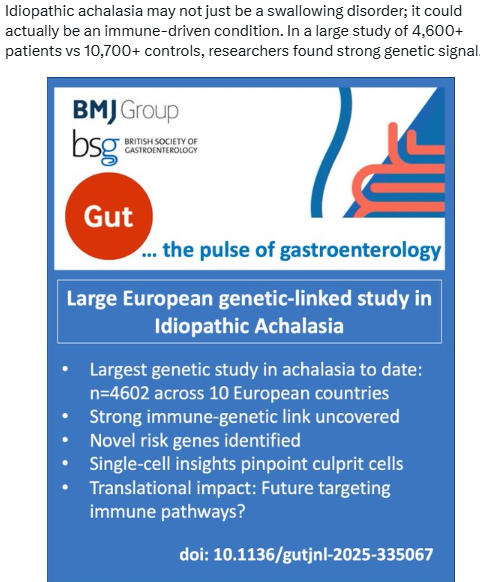
S Grover et al. Gut 2026;75:476–485. doi:10.1136/gutjnl-2024-334498. Open Access! First genome-wide association study reveals immune mediated aetiopathology in idiopathic achalasia
Key findings:
- This genome-wide association study (GWAS) confirms the idiopathic achalasia (IA) “association of variants in HLA-DQB1 and HLA-DQA1, but also points to a more complex genetic risk architecture at this locus that involves an IA risk variant in HLA-DRB1. Moreover, the GWAS resulted in the identification of three novel disease variants outside HLA. One leads to an amino acid substitution with functional effect in PTPN22. One further novel IA risk variant leads to a downregulated expression of TNFSF8, TNFSF15 and TNC in immune-relevant cells. The remaining disease variant is located near ZNF365, but the cellular pathogenic mechanism remains unknown.”
- “On the polygenic level, this study provides the first IA heritability estimate and shows that immune-mediated mechanisms that are shared with Crohn’s disease (CD) contribute to IA aetiopathology.”
My take: This study “highlights that immune-mediated mechanisms influenced by genetic risk are of major relevance for disease development.”
Related blog posts:
- Achalasia -More Complexity to Pathophysiology?
- Increased Mortality with Achalasia
- Briefly Noted: Pediatric Achalasia
- Achalasia Frequent in Patients with Eosinophilic Esophagitis
- POEM vs Surgical Myotomy for Achalasia -Randomized Trial
- Achalasia -Updated Epidemiology (2017)
- New Mutations: Achalasia, Pseudoobstruction, & IBD