CFTR Modulators for Cystic Fibrosis

Two more studies have shown the effectiveness of CFTR modulators for subsets of patients with cystic fibrosis.

  • JL Taylor-Cousar et al. NEJM 2017; 377: 2013-23
  • SM Rowe et al. NEJM 2017; 377: 2024-35.

In the Taylor-Cousar study, the authors treated patients with homozygous Phe508del cystic fibrosis with either combination tezacaftor-ivacaftor or placebo for 24 weeks. Combination therapy resulted in FEV1 that was 4% higher along with a 35% lower rate of pulmonary exacerbations than placebo.

In the Rowe study which examined patients some retained CFTR function (which occurs ~5% of CF patients), a prospective trial of tezacaftor-ivacaftor had a greater effect on increasing FEV1 than ivacaftor alone.  Ivacaftor monotherapy and tezacaftor-ivacaftor combination therapy were both more effective than placebo.

A related editorial (H Grasemann. pgs: 2085-8) helps provide context to help understand the importance of these studies.  His key point:

“Although CFTR modulator therapies have measurable beneficial effects on some aspects of the disease, there is still an unmet need for truly effective new therapies to be developed for all persons with cystic fibrosis.  The clinical efficacy of the current combination therapies for patients with cystic fibrosis who have the most common CFTR genotype (Phe508del/Phe508del) is suboptimal and falls within the range of established symptomatic therapies, such as nebulized inhaled hypertonic saline or recombinant human DNAse.”

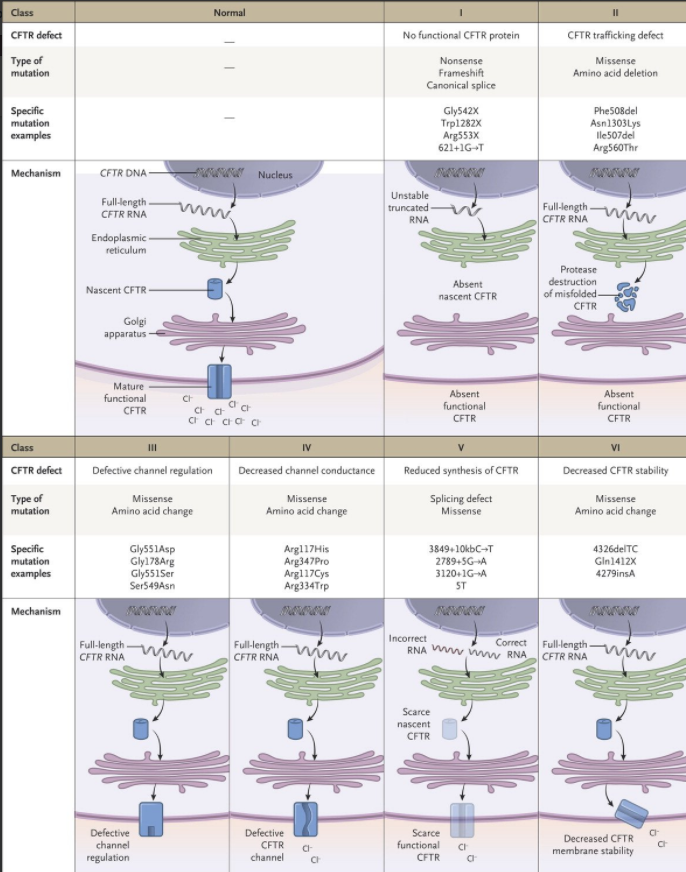
This figure depicts the types of molecular defects: No functional CFTR with framshifts for deletions or insertions (class 1), CFTR trafficking defect due to misfolded protein (class II), defective channel regulation (class III), reduced cholirde conductance (class IV) , reduced synthessis (class V) or decreased CFTR stability (class VI)
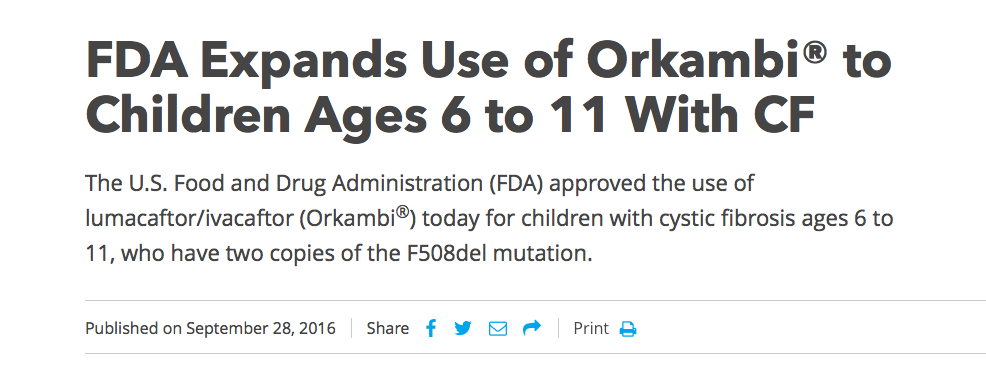
Lumacaftor-Ivacaftor for Cystic Fibrosis

“Lumacaftor–Ivacaftor in Patients with Cystic Fibrosis Homozygous for Phe508del CFTR”  DOI: 10.1056/NEJMoa1409547

Abstract (from NEJM twitter feed):

BACKGROUND

Cystic fibrosis is a life-limiting disease that is caused by defective or deficient cystic fibrosis transmembrane conductance regulator (CFTR) protein activity. Phe508del is the most common CFTRmutation.

METHODS

We conducted two phase 3, randomized, double-blind, placebo-controlled studies that were designed to assess the effects of lumacaftor (VX-809), a CFTR corrector, in combination with ivacaftor (VX-770), a CFTR potentiator, in patients 12 years of age or older who had cystic fibrosis and were homozygous for the Phe508delCFTR mutation. In both studies, patients were randomly assigned to receive either lumacaftor (600 mg once daily or 400 mg every 12 hours) in combination with ivacaftor (250 mg every 12 hours) or matched placebo for 24 weeks. The primary end point was the absolute change from baseline in the percentage of predicted forced expiratory volume in 1 second (FEV1) at week 24.

RESULTS

A total of 1108 patients underwent randomization and received study drug. The mean baseline FEV1 was 61% of the predicted value. In both studies, there were significant improvements in the primary end point in both lumacaftor–ivacaftor dose groups; the difference between active treatment and placebo with respect to the mean absolute improvement in the percentage of predicted FEV1 ranged from 2.6 to 4.0 percentage points (P<0.001), which corresponded to a mean relative treatment difference of 4.3 to 6.7% (P<0.001). Pooled analyses showed that the rate of pulmonary exacerbations was 30 to 39% lower in the lumacaftor–ivacaftor groups than in the placebo group; the rate of events leading to hospitalization or the use of intravenous antibiotics was lower in the lumacaftor–ivacaftor groups as well. The incidence of adverse events was generally similar in the lumacaftor–ivacaftor and placebo groups. The rate of discontinuation due to an adverse event was 4.2% among patients who received lumacaftor–ivacaftor versus 1.6% among those who received placebo.

CONCLUSIONS

These data show that lumacaftor in combination with ivacaftor provided a benefit for patients with cystic fibrosis homozygous for the Phe508del CFTR mutation. (Funded by Vertex Pharmaceuticals and others; TRAFFIC and TRANSPORT ClinicalTrials.gov numbers,NCT01807923 and NCT01807949.)

Take-home point: The combination of a CFTR corrector and potentiator may “benefit patients who are homozygous for the Phe508del CFTR mutation and represents a treatment milestone for the 45% of patients with cystic fibrosis who are homozygous for this mutation.”

Related blog postIvacaftor for Cystic Fibrosis | gutsandgrowth

Ivacaftor for Cystic Fibrosis

Recent FDA approval of Ivacaftor (Kalydeco) is a promising step for a subset of patients with cystic fibrosis who have the G551D mutation.  This drug enhances the cystic fibrosis transmembrane regulator (CFTR) gene in these patients; only ~4% of CF patients or about 1200 patients in the US have this genetic defect.

http://www.fda.gov/NewsEvents/Newsroom/PressAnnouncements/ucm289633.htm

Additional references:

-NEJM 2011; 365: 1663. Effect of VX-770 -a CFTR potentiator -mild improvement in study of 167 pts. (Ivacaftor).
-NEJM 2010; 363: 1991. Effect of VX-770 -a CFTR potentiator -mild improvement in study of 39 adults.