
Case Study: Elevated Liver Enzymes in Diabetic Ketoacidosis

Å Sjöholm et al. N Engl J Med 2024;391:1528. Glycogenic Hepatopathy

Case report: “An 18-year-old man with type 1 diabetes mellitus who had been admitted to the hospital with diabetic ketoacidosis had unexpected elevations in aminotransferase levels. Laboratory studies showed a peak alanine aminotransferase level of 972 U per liter.”

“Computed tomography of the abdomen showed hepatomegaly without parenchymal changes (Panel A). A liver biopsy showed swollen hepatocytes with abundant deposition of glycogen in the cytoplasm, as evidenced by positive staining with periodic acid–Schiff (Panel B) and digestion of the deposits after treatment with diastase (Panel C).”
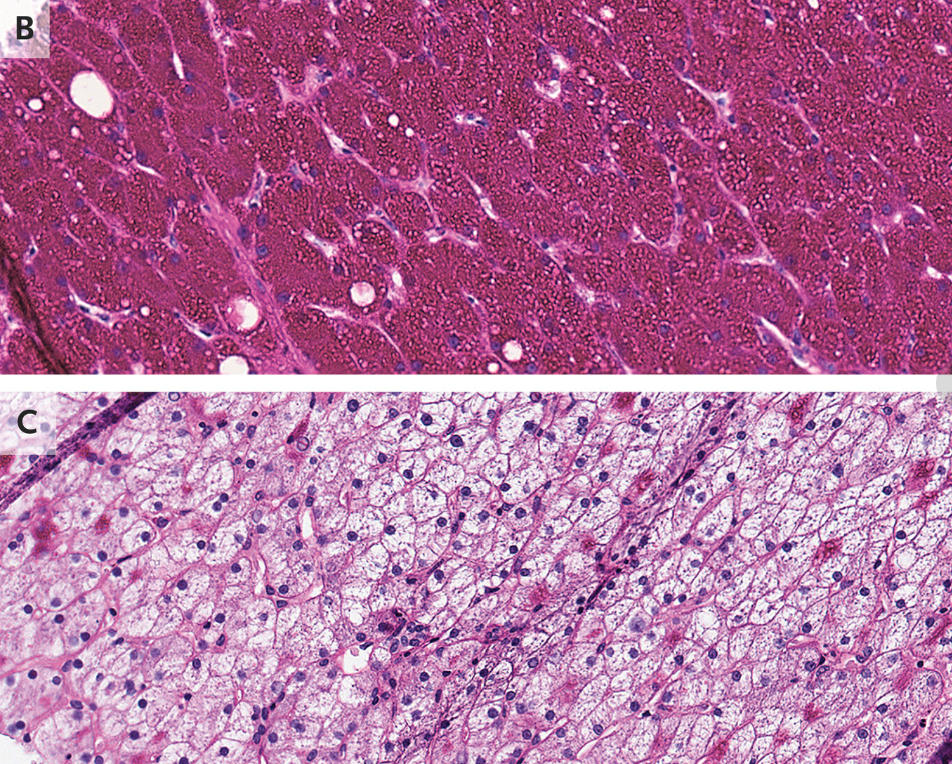
“At follow-up 3 weeks after discharge from the hospital, the patient had been adherent to insulin therapy, and his aminotransferase levels had normalized.”

My take: The potential etiologies for elevated liver enzymes in the setting of diabetic ketoacidosis include glycogenic hepatopathy, ischemic hepatitis, infectious etiologies, autoimmune hepatitis, celiac disease, and steatotic liver disease. This recent case report describes glycogenic hepatopathy. There was not a discussion as to why a CT scan and a liver biopsy were deemed necessary.

Related blog post: Mauriac Syndrome (Glycogenic Hepatopathy)

Mauriac Syndrome (Glycogenic Hepatopathy)

A case report (T Malikowski et al. Gastroenterol 2017; 152: 947-49) provides some insight into a fairly common problem –elevated liver tests in the setting of poorly controlled type 1 diabetes mellitus.  This 18-year-old had presented with a glucose of 497 mg/dL, elevated lactate, aspartate aminotransferase 257 U/L, and alanine aminotransferase 178 U/L.

The authors note that Mauriac syndrome “occurs in young patients as a result of poorly controlled type 1 diabetes mellitus.”  It may result in growth retardation, pubertal delay, and cushingoid features.

“Glycogenic hepatopathy is a underrecognized complication of Mauriac syndrome that presents with abdominal pain, nausea, vomiting, elevated serum transaminases, elevated plasma lactate levels, and hepatomegaly  The pathogenesis stems from an accumulation of glycogen in the liver…The diagnosis…is made …when all other causes of liver disease have been excluded…When glucose control is achieved, prognosis is excellent.”

My take: There are many potential reasons for elevated liver enzymes associated with type 1 diabetes mellitus, including celiac disease, and autoimmune hepatitis.  However, familiarity with glycogenic hepatopathy helps with pattern recognition and helps explain the frequent concurrence of liver disease with poorly controlled type 1 diabetes mellitus.