
An excellent editorial provides insight into the complex interaction between social problems and health issues. In this age of widespread information availability, the biggest problems are not solved by knowing everything and memorizing facts. Solving problems with teamwork and identifying resources are increasingly important.
Here’s the link: NY Times: Giving New Doctors the Tolls They Need
Here’s an excerpt:
But consider the skills I would need to be more effective in just this one clinic session: understanding social issues that contribute to health; marshaling support resources like case management, social work and rehabilitation centers; exploring my patients’ values and goals and encouraging behavior change; leading interdisciplinary care teams; employing new technologies and methods of patient engagement like telemedicine; and appreciating how health systems fit together to influence an individual patient’s care — from home care and community centers to clinics and hospitals. None have traditionally been emphasized in medical education — and, unsurprisingly, doctors in training like myself are often ill-equipped to practice in today’s health care environment…
The new Dell Medical School at the University of Texas, Austin, which enrolls its first class in June, is hoping to revolutionize medical education. The school plans to focus on helping students understand how health systems, communities and social issues contribute to individual health through a variety of innovative methods.
Instead of traditional lecture halls, Dell’s students will learn in collaborative workspaces with a curriculum that emphasizes team-based management of patients. They’ll take weekly classes with pharmacy, nursing, social work and engineering students. Dell’s “Innovation, Leadership and Discovery” program affords students an entire year to pursue projects related to population health and delivery system redesign.
Dell also features a unique collaboration with the university’s College of Fine Arts — known as the Design Institute for Health — to bring design thinking to health care. Here students will learn to think about everything from better hospital gowns and more hospitable hospital rooms to how patients access services online and how to make waiting rooms obsolete.
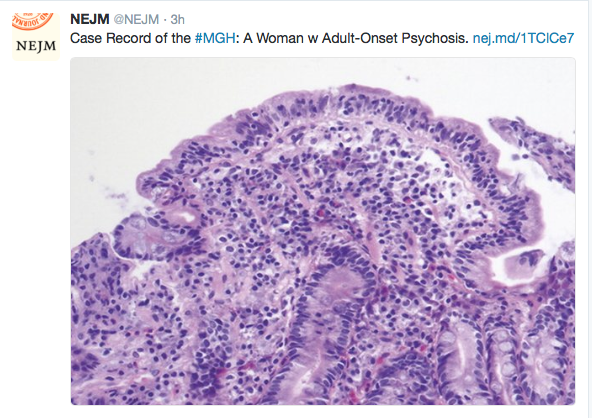
A representative case of the complexity referred to in this blog post: NEJM 2016; 374: 1875-83. This figure of intestinal histology shows damaged surface epithelium. This is from a lady with new-onset psychosis associated with celiac disease who is not adherent with her gluten free diet
 gutsandgrowth